

Ann Arbor superintendent's proposed budget cuts include 50 teaching positions, pay-to-play
Ann Arbor Superintendent Todd Roberts’ proposed budget for the 2010-11 school year would eliminate 50 teaching positions, 22 support positions and nine administrative positions to shed nearly $16 million from the budget.
But unless the district is able to get another $4.5 million in savings from wages and benefits concessions from its unions - including the teachers union - it will likely need to eliminate another 36 teaching positions, three middle school counselor positions, one central administration clerical position and two custodial administration positions.Â
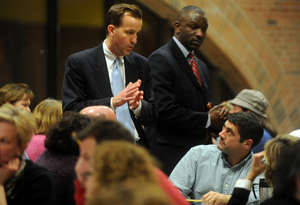
Todd Roberts is shown at an earlier meeting, where he outlined possible budget reductions.
Other measures, including deeper cuts to supplemental pay used for extra-curricular positions, would also be implemented. The proposed plan does not close any schools.
Roberts presented his plan to the school board Wednesday night, but the proposal still needs to be approved by the board. The district is struggling to cut $20 million from its more than $180 million budget.
It’s not yet known how many of the cut positions would result in layoffs and how many would be through attrition and retirements.
For example, the district has about 65 tentative indications of pending teacher retirements, but that number changes regularly.
Roberts will return to the school board on April 14 to update board members on negotiations. If the additional $4.5 million in cuts hasn't been settled in negotiations, the board may be asked to approve layoff notices. By law, the district has to send layoff notices by the end of April.
Roberts and his cabinet-level administrators spent nearly two-and-a-half hours Wednesday night walking the school board through the first $16 million in proposed cuts and some ways the district could increase revenue.
The board likely won’t formally vote until June. By state law, it has until July 1 to approve the budget.
On Wednesday, board members asked questions about several items and expressed concerns about some proposed cuts.
Administrators created a series of scenarios as they constructed the budget - all based on differing projections of what the state will do with the district's per-pupil funding. Like all districts in the state, Ann Arbor gets the bulk of its revenue from the state’s per-pupil foundation grant, which varies by district. In Ann Arbor’s case, it's more than $9,000 per student.
In the first budget scenario, the district projected a $15.43 million deficit if the state makes no additional cuts to per-pupil funding.
In the second scenario, the district projected an $18.72 million deficit if the state issues a $200 per-pupil cut.
In the third scenario, the district projected a $20.36 million deficit if the state issues a $300 per-pupil cut.
Earlier Wednesday, the state Senate passed a budget plan that would enact a $118 per-pupil cut. That still has to be approved by the House and then signed by Gov. Jennifer Granholm.
Roberts said the district prepared a budget for the worst-case scenario.
Roberts didn't recommend the district privatize the transportation system or its custodial services Wednesday - but he didn't say it was off the table. The district has received bids for doing both.Â
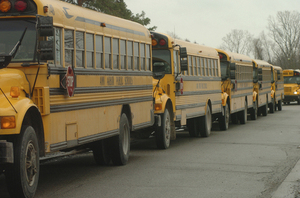
The Ann Arbor school district wants to see savings in transportation.
However, administrators did say they would prefer to join a countywide transportation system that's being discussed to get savings.
During the public comment period before the budget proposal was unveiled, several parents, custodians and bus drivers urged the board not to privatize.
“I would like to not give up the choice (of selecting) who comes into contact with my daughters,” said parent William Mayhew, noting he feels safe knowing the custodians and bus drivers who work in the district.
Bus driver Richard Miller expressed concern a private company wouldn't have students' best interests in mind.
"The bottom line reigns,” he said.
Teachers union President Brit Satchwell also weighed in on the possible privatization and the impact bringing in a private company would have on wages for workers.
“When you cut wages, you impoverish people and you impoverish our community because they are our neighbors," he said. “(Bus drivers) are teaching a classroom.”
He urged the board to dig deeper into its fund balance to help save jobs.
The district expects to end this school year with about $22 million in the fund balance. The district has said its needs about $16 million in that fund to help with cash flow and covering payroll during the eight weeks each year when the state doesn’t send foundation grant checks.
Robert Allen, the district’s chief financial officer, said under the worst-case scenario, if the district just covered the shortfall with its fund balance, it would have about $1.68 million left at the end of the 2010-11 school year.
In non-instructional support services, the district is looking to trim $4.4 million. Included in those cuts: using the middle school pools for only nine weeks per year, reducing contracted services by $100,000 and reducing administrative positions in the district’s bond office.
That area also includes the possible privatization of transportation and custodians. The district is looking for $1.5 million in savings from transportation and $2 million in savings in the custodial area.
In the district’s instruction support area, the proposed budget calls for $3.5 million in reductions. Among them are cutting eight special education teachers and reorganizing the district’s instructional administration to reduce several administrative positions.
However, it would add an administrator for curriculum and instruction at a salary of about $117,000. That position would be in charge of the district’s total instruction.
The position has been vacant for at least two years, since Gerry Middleton left the district shortly after Roberts arrived as superintendent.
“It’s important that we have a person whose focus is on this area,” Roberts said. “This is a reduction we made two years ago, and while it was the right decision at the time, it’s something I would not do again.”
Also included was cutting 3.5 positions in the district’s English as a Second Language Program and reorganizing that department. Administrators said the district has lost about 157 ESL students in the last couple years, but hasn’t reduced staff.
Administrators are also proposing a charge of $200 for the district’s four-week elementary summer school program, with scholarships available for students with financial need.
That drew criticism from multiple board members, including Trustee Susan Baskett. She said she thinks families could see the charge and decide not to send kids who need help to the program.
School board Trustee Glenn Nelson agreed and said all the cuts were painful to make.
“This process, even done carefully, is hurting the education of our students. They are going into a world where they need a really top-notch education," he said. "This, in my mind, is a bad thing for the children of our community and what it does for their future.”
The district also plans to reduce the general fund contribution to high school and middle school athletics and extracurricular activities.
In its place, administrators propose instituting a pay-to-play program that would cost a high school student $150 for the first sport and $50 for the second sport. A middle school student would pay $50 per year.
Also, the district would begin to charge a $50 fee to all students who use a district musical instrument.
The plan also calls for $1.2 million in wage and benefit costs savings in already existing union contracts; a 50 percent reduction of overtime in various departments; the move to November school board elections (which was already approved by the school board) and reduced printing and mailing costs to save $140,000.
At the elementary level, the district will restructure elementary specials - such as art, music, and physical education - and add a new humanities strand that will more closely integrate those areas into regular classroom hours, elementary administrator LeeAnn Dickinson-Kelley told the board.
For example, when students in first grade are studying the forces of motion, the physical education teacher will be involved in that lesson. When a second-grader is studying sound, the music teacher will be involved. The district has been running a pilot program of the concept at Mitchell Elementary School.
Elementary students will still have the same amount of those core special areas, administrators said.
In addition, the district will be reorganizing the media specialist role to focus more on technology. However, students will still be able to check out books from the library.
Nine teaching positions are expected to be eliminated at the elementary level, most in the area of media specialists.
At the middle school level, the plan would eliminate 8.2 FTE teaching positions - which would lead to increased class sizes, especially in elective classes.
The plan also calls for eliminating 3.4 teaching positions currently tasked to the Student Planning Center. Each middle school has a planning center, which is used for disciplining students, along with conflict resolution and other ways of helping students.
That proposed cut drew sharp criticism from several board members, including board President Deb Mexicotte. She said she served on a middle school restructuring committee about a decade ago that worked to beef up the centers to make sure they fit with the district’s curriculum goals.
“We are now moving back to a model that was seen as less good,” she said.
She and Baskett said it might be the time to get rid of the planning center.
At the high school level, the plan calls for axing two assistant principal positions, one each at Pioneer and Huron high schools. It also calls for cutting five staff members at the district’s alternative high schools, leading to increased class sizes and fewer sections of elective classes.
The plan also proposes cutting 11 teaching positions at the comprehensive high schools, which would raise class sizes and reduce the number of sections for some elective classes.
Counselor positions, clerical positions, lunchroom supervisor positions and community assistant positions would also be reduced at the high school level.
In addition, the budget presentation touched on ways to generate more revenue.
The proposal includes increasing fees for University of Michigan home football parking, adding cell tower revenue (projects were approved by the board on Wednesday) and providing human resource and maintenance management service for other local school districts for a fee.
The bulk of the revenue increases would come from opening 170 schools-of-choice seats to students outside the district; 60 seats will be open in kindergarten, 60 seats in first grade and 50 in the middle school.
The school board unanimously approved making Ann Arbor a limited schools of choice district without comment Wednesday. The application period will begin April 1.
Roberts said the reductions total 17 percent of the district’s administration and support budget and a 5.5 percent in the instruction and support budget.
Staff members were briefed on the proposal earlier Wednesday.
Joan Fitzgibbon, the principal at Allen Elementary School and the head of the principals union, said Roberts “engaged a wide and diverse group” of community members, parents and staff members in making the plan.
Negotiations with the district's teachers union are under way. Roberts and Satchwell said the talks as going well, and both sides are working together to come up with savings.
"I'm positive with the progress that's being made,” Satchwell said. “Hopefully it will enable the staff and the community not to be stressed. We will see a naturally constricting district as the state constricts. We have to shrink smoothly while maintaining standards."
David Jesse covers K-12 education for AnnArbor.com. He can be reached at davidjesse@annarbor.com or at 734-623-2534.
Comments
A Voice of Reason
Tue, Apr 6, 2010 : 11:28 p.m.
AAPS Teacher Pay is $1000 more per pupil than Plymouth Canton (who work 20 minutes more and have to run a club or activity) and East Lansing and we have the same outcomes as these districts. School district has $4Million in accumulated sick time that goes to the teachers when they retire. I do not see AAPS on the list of top US NEWS Best Schools and Michigan did not make the list for RACE TO THE TOP because we refuse to evaluate teachers, pay good ones more and remove the bad ones. Not sure why we allow for a World Class University and a average school district -we are not leading the way other than in Grammy awards that 25% of our children cannot even read the certificate--sorry! Michigan is #4 highest in teacher pay and #49th lowest in ACT scores (Free Press). Until teachers are willing to have benchmarking done to see how are kids are really doing, then we are refusing to pay you any more $. I do not mean have the kindergarteners rating their teachers on pizza day. Great school districts have parents input into teacher evaluation. If you are doing your job, than you should not worry about being bench-marked. Look at the 5th Grade SRI scores this year--PARENTS ASK FOR YOUR CHILD'S SCORE! We are learning that 5th graders need help in reading and this is why we are offering summer school. Seven Washtenaw School districts are doing this already doing benchmarking-why is AAPS a follower and not a leader (other than in pay, benefits and minimal teaching time). AAPS is afraid of know how effective teachers and well children are really learning--and I do not mean the MEAP (which is always easier during elections). Also, why are the tax payers paying the salary for the AAEA Union President, VP and Sec? Plus giving 54 hours per month for union business by teachers at various schools. This rich union who is spending millions on advertising and has a office and staff of 6 in Ann Arbor should pick up the tab for their own president and activities. This is probably about $400,000 worth of money we are paying to have someone lobby against us and has only their own interest in mind. "When children start paying Dues, then we will represent them" MEA President
AlphaAlpha
Fri, Apr 2, 2010 : 4:27 p.m.
Hi Joe - Interesting insights; it's nice to hear from a school user. With respect to a perceived lack of support for schools via higher taxes, what you may not understand yet (and likely are not taught at school) is that our teachers are actually very well paid - they earn approximately twice the compensation that the average private worker earns. This is per BLS and AAPS figures. That's a remarkable disparity, and it's one which voters are increasingly recognizing as unjustified. There is growing support (nationally, in fact) for public employee wages to move closer to average instead of further from it. Good luck.
joe
Wed, Mar 31, 2010 : 8:31 a.m.
To the Editor Regarding the story Ann Arbor superintendents proposed budget cuts include 50 teaching positions, pay-to-play. I must say that as a student, I am disappointed by the communitys lack of support for public schools through increased taxes. I believe that if we had increased property taxes, we would not have to worry about all the cuts the district has to make. Now we have to start the pay-to-play rule at our school so that we can have sports teams, causing the prices to go up students and their families and, most likely, causing the number of players on the team will decrease. Scholarships will be offered, but no one wants to be put in the situation to ask for help. I think another thing that could help would be having fewer than 10 separate school districts in one county. Do we really need ten superintendants, ten human resources administrators, or ten bus systems? How hard is it to combine and just work together to help each other out? Combining schools systems might cut of a couple administrative positions but it would keep us from cutting great teachers from our schools I believe there are many unnecessary positions, like hall and cafeteria monitors, that should be considered for eliminations before teaching positions and pay-to-play rules are implemented. When I walk through the halls at my school, the hall monitors we have dont do anything, even when there are fights going on - they just stand there watching it. Im sure there is something else we can spend our money. In conclusion, I wish that the board would be more open with finances so that tax payers would be more supportive of needed taxes. I also hope other alternatives are considered before teaching positions are cut and pay-to-play rules are implemented. If pay-to-play rules are put in place, the money must be distributed more equally between teams than it currently is now Sincerely, Joseph Thomas Deakin
say it plain
Mon, Mar 29, 2010 : 1:17 p.m.
@AARES I have some ties to AA Open, and as I understand it, believe me, the 'extra classrooms' would not be desirable ones, shows how desperate the district would be to expand the program for the revenue (and maybe also, wouldn't that be nice, out of a realization that there is real demand for more open school venues?!). There are currently basement-level rooms that are not used during the school day, I believe, and those might be used in one scenario. I would imagine that everyone involved would very much prefer creating another open program venue to meet all the waiting-list demand, because there is no way that the current program is sitting in roomy digs storing books in spare rooms;-) and there isn't a square foot to spare in many of the classrooms frankly (they don't do traditional 'desks', and even so, the spaces are snug). As Alan indicates, the letter merely demonstrates what the district is playing with in order to simultaneously be as attractive as possible to the folks whom the system is not capturing with its other offerings, and to balance their books. The message was one about how this particular building might be affected by the general budgetary goings-on, and in this case, because this alternative program is so appealing that it has a waiting-list and many of those folks are currently not at other schools in the AAPS, instead of building-*closure* they are working out how to stuff the rafters more fully. I agree, I would also very much rather see budget balancing that does not increase class size, and does not fill individual schools to the rafters (and this would be, truly, I believe).
AARES
Mon, Mar 29, 2010 : 12:55 a.m.
Alan: I understand that her letter says Open has the physical capacity to add 60 kids in the next 3 years. But if they add those 60 students and 40% are not currently in the AAPS, then that is only 24 new kids worth of revenue for the school system (or about $228,000). If those new kids come at the cost of 3 more teachers (as in her scenario A when she suggests the adding of 3 new classes over that time), then it is a net cost to the school system since I am sure 3 teachers will cost more than $228,000 a year. I did carefully read the part of the letter you posted. It really did not make sense as far as the numbers. To add new classes they need actual classrooms. Thus, in scenario A they need to currently have 3 classrooms that are not used to fulfill the physical needs. Then they will need to add 3 teachers as well. To add more students via scenario B they just need physical room for desks in classrooms that are already in use and staffed by a teacher. If they currently have three empty class rooms plus space in current rooms, then the physical capactiy of the school should be greater than 60 extra kids. Put simply, it cannot be that you hit physcial capacity in 3 years under either scenario. Instead, they would have the option of adding three new classes and increasing all class sizes. I have seen this odd capactiy reasoning from the adminstration, not just at Open. It is what worries me. The administration has to think carefully about which resources are constraints. It is not empty class rooms that constrain us in most cases, it is the need to add teachers that will raise the costs. The school system needs something like an Activity Based Costing system (ABC) so they can understand what costs are driven by what actions. In this situation there are unit costs per students (books, cleaning etc), batch costs per class (main teachers, art teachers time etc.) and sustaining costs (principals, staff etc.). If we add students to existing classes, we only increase the unit costs, which are likely small in dollars (but perhaps large in learning). If we add classes, then we also increase batch costs. Under the current cost structure, that is likely to exceed revenue generated. To be clear, I think Open is a nice feature of the school system. It mattered to use when we moved here even though we decided not to apply after considering our children and their current needs. I think it may attract others to AA instead of other systems such as Dexter or Saline. But we can't use the math in her letter and view it as a positive revenue creator. Also, I voted for the milage. I agree that without the money things have to give and class size is one of the most likely. I would vote for another milage if it came up. I think a lot of the people who want to find revenue are missing the point: it is costly to educate children well. Alan, in the end we agree about Open and about the milage. But not about the potential to use Open to help fund revenue. If this manner of thinking were only in the Open letter I would not have commented. But I think it is important that we understand it district wide.
Alan Benard
Sun, Mar 28, 2010 : 11:32 p.m.
@AARES: A careful reading of the letter shows there is room to add 60 more children to Open before it reaches capacity, and this is planned at 20 per year over three years. Of course class sizes are going to increase. Many positions district-wide will be eliminated, and it may well be through attrition of retirees. Bringing this up as a drawback particular to these scenarios for open begs the question: If we are so worried about increased class sizes, why didn't we pass the millage? There isn't a damn thing we can do about it, now that we've voted against our best interests.I offered the information in the letter simply as a counter to calls to eliminate alternative in-district programs. A plan for a generate a small but respectable amount of additional revenue in a time when programs will be cut simply offers more proof of the program's value.
stunhsif
Sun, Mar 28, 2010 : 9:41 p.m.
@snapshot, could not have said it any better, you are laser focused, don't miss a thing and 100% right on. The post just below you may have read what you said but they didn't comprehend it. Too much of that going on the past several years!!
AARES
Sun, Mar 28, 2010 : 8:03 p.m.
We need to be careful about the focus on increased revenue via increased students. People seem to view it as coming with no cost. Alan Bernard above cites AA Open as potentially bringing students back into the district. But the message from the principal says 40% of the students are not currently in AAPS. That means a classroom of 20 will have 8 new to the district kids. At the current funding, that is about $76,000 and everyone seems to think funding will go down. The fully loaded cost of a teacher (salary and benefits) exceeds this based on any numbers we have seen (I know there is a dispute on the exact amount). So expanding Open on these terms will cost the district unless they can fill the 12 newly empty seats at the other schools with out of district students. Building entirely new open schools means not just hiring more teachers, but also more admin, bus drivers etc. An even less economic decision. Increased bodies are only useful if they can be put in places where the incremental cost is limited. That is, classrooms that are currently under filled. It appears AA Open is not one of those places. In fact, I would bet that most parents do not feel their kids class room needs more students regardless of the school. Focusing on revenue is nice because it makes us feel like we dont have to make do with less. But in the end it is just another way of saying we are going to increase class size. Which means it is another way to say quality will decrease. Related to this, I have been surprised that no one has focused on the open district decision. I am not sure where these kids are going to go. My kids school is on the list to take students. The current Kindergarten classes have 20, 21 and 25 (I may be off by one or two). Those class sizes are already bigger than what is threatened in the letter from the Open principal. I am told over sixty kids are already signed up for next years kindergarten. I think the first grade classes are around 22/23 each. The second grade classes are at 24, 26, 26. Again, above the numbers given for worse case at Open. I have nothing against Open and am glad it is there for the parents and kids who want it. I just don't think chasing revenue in this way is the answer to the budget issue. It may save laying off teachers (we can have more kids per class and in total, but the same number of classes vs. more kids per class, fewer kids total and fewer classes), but it won't fix our funding issues.
Lisa Starrfield
Sun, Mar 28, 2010 : 5:56 p.m.
Snapshot, You ask that unions live within their means. Funds to schools have been cut. To live within their means, the taxpayers either need to pay more or deal with services being cut (that means pay for play, closed schools, larger classrooms). How dare you expect that teachers pay this tax instead?
snapshot
Sun, Mar 28, 2010 : 4:16 p.m.
All this rhetoric and no money. Union leaders and members are arrogant enough to keep advocating that a non union member is less competant and untrustworthy and will put children at risk. Teachers complain of larger class sizes, parents contest school closings, supporters claim teachers are underpaid and can make more money elswhere, and everybody blames the state for the funding shortages. What is it about the issue of "there is not enough money" that all these folks don't understand? Where do you think the state gets its money from? Why would someone expect someone else to pay more money so they don't have to make less money? I don't get it? All you union folks, teachers, administrators, and government type folks need to suck it up and live within your means. Quit using the childrens best interest to try to extort more money from the taxpayers. Compensation reductions are not such a big sacrifice. You show your true colors when you resist modest reductions. Even a 10 percent reduction is modest in my opinion. Some folks have lost their life savings, their pensions, the ability to send their children to college, and the security they worked all their lives for. They didn't get buyouts, early retirements, and many never even had pensions. And you guys are crying about 4 or 5 percent reductions and a few more kids in a classroom. You should be ashamed.
Dan Rubenstein
Sun, Mar 28, 2010 : 11:12 a.m.
jns131 - "Most parents would prefer charters and privates..." Source? Many charters have many problems. Not to mention that as structured in Michigan they are union busters.
jns131
Sun, Mar 28, 2010 : 10:32 a.m.
Granholm signed something into law giving charters more chances to build into communities where there are none or few. This is going to give Ann Arbor a run for its money. Why? Because Ann Arbor is trying to lure students from other districts with its open school policy to their schools. Yes, it will work. But, most parents would prefer charters and privates and smaller classroom sizes. Ann Arbor the city will get schools like Ann Arbor Open once they start building or taking over schools that have closed permanently. So, again, AAPS is again going to have to get creative. Challenges are good for a school system. Going to be interesting once we see how the board votes on April 14. Per Chai's comment? I am not be disparaging, I am being honest.
Lisa Starrfield
Sun, Mar 28, 2010 : 9:55 a.m.
I would like to see more schools like Ann Arbor Open... especially for the elementary level. I think we could lure back some of the private/charter school kids.
Dan Rubenstein
Sun, Mar 28, 2010 : 9:23 a.m.
Great posts, sayitplain and Alan. Just a few comments. I'm not sure when CHS didn't have excess demand. How to ration access has been a question for as long as I can remember. I would support new ideas as I don't particularly like the lottery. I would like to see an admissions board, but that would not be without its own issues. I'm not sure how success (test scores, college admissions) can "backfire". It's still an alternative philosophy; the fact it is coupled with success is a good thing. The naysayers who prowl these comments sections hammer on cost and racial disparities. The cost issue is a red herring (sure, there might be some very minor savings, but no two schools cost exactly the same. CHS is in line with other schools, period.). The racial disparity question is legitimate and I would welcome the district looking into this (how spots are allocated is part of this question). One idea worth considering, besides an admissions board, is setting aside seats for each middle school -- a system of "mini-lotteries". But few of CHS's critics express interest in fiscal facts or addressing the access issue. They just resent the heck out of CHS, for reasons I can only guess. The idea of expanding smaller, more personalized programs is wonderful, and it can be done at reasonable cost. And, as Alan notes, it can even be key to increasing revenues. Very good ideas, both of you. Thanks.
Alan Benard
Sun, Mar 28, 2010 : 8:32 a.m.
@say it plain: Thank you very much for your informed, intelligent and thoughtful comments about Community High and Ann Arbor Open @ Mack. They are a much-needed counter to disinformation.Our nation needs public education in order to promote democracy and compete economically, but our people need alternatives, such as the open school programs. The unmet need is indeed great. The Open School's principal, Naomi Zikmund-Fisher, wrote in a recent -- and unreported by our education experts at annarbor.com -- letter to AAO parents the school's popularity makes it a key part of the strategy to bring families back to the Ann Arbor Public Schools:03/12/10...our waitlist is long and has about 40% students who live in Ann Arbor but are not enrolled in the public schools. The district can increase revenue by getting these students into the district.So, here is what the two plans look like for us:Plan A: Next year, we add an additional 1-2 class, admitting 20 additional students. The following year (2011-2012) we add an additional 3-4 class, and the year after that we add a 5-6 class. After three years, we cannot grow anymore because we run out of classroom space, so that issue must be resolved as part of the longer term planning process, which the district will begin in April. Possibilities include opening an entire new school or a school within a school elsewhere to serve more students over time, but nothing has been decided.Plan B: Class sizes throughout the district go up by quite a bit. In our building, we still admit an additional 20 students, but they are distributed throughout the grade levels. We do not add another teacher, as we would in plan A. Class sizes rise to an average of 20 for K, 24 for 1-2 and 27 for 3-8. We still add an additional section of 3-4 in 2011-2012 and 5-6 the year after that, and the size of our program still outgrows the building in the long term.Here we have best- and worst-case scenarios for the future of an open-school program. People wishing for these programs to end for reasons other than cost-savings can stop wishing, because they are rightly seen as popular revenue-generators.
Lisa Starrfield
Sun, Mar 28, 2010 : 7:13 a.m.
aataxpayer, I know you don't believe this but we've been taking cuts and additional responsibility for years. If 50 positions are cut (even through retirement) that will mean additional responsibility for the rest of us. Or are you simply demanding that in order for us to have 'credibility' we take a pay cut?
advocate
Sat, Mar 27, 2010 : 7:33 p.m.
To me it looks as though there will be layoffs and it will be the young teachers who pay the price. Things are bad now and I hate to think what will happen if the union and the school board fail to come to an agreement.
Lisa Starrfield
Sat, Mar 27, 2010 : 2:15 p.m.
Alphaalpha, In all the years of the unions existence,there have been threats of layoffs and even pink-slips but no one has ever not had a job when August came. Positions, not people, will be cut. We will likely have enough retirees to cover those 50 positions. People may get moved within the district against their wishes and that does suck but I don't think anyone will lose their job. For what it is worth, I think that Roberts has failed to make the tough cuts of closing schools which will be necessary as I do not think the state will maintain current funding levels for next year NOR do I think they will maintain next year's levels for 2012.
tmo
Sat, Mar 27, 2010 : 2:09 p.m.
A belief that closing Community wouldn't save money ranks right up there with a belief in perpetual motion machines and cold fusion. Are you saying Dan that if you eliminate the extra CHS administration, the building maintenance and utilities, and the bussing of students to and from other high schools, as well as sell the property - that this would be worth $0?
AlphaAlpha
Sat, Mar 27, 2010 : 1:15 p.m.
Hello Chai - Thank you for the link allowing us to read the various AAPS contracts. Very interesting reading; some surprises, all should read. All - It was disappointing to read sections 4.800 - 4.819, which describe details regarding how to effect layoffs; there is no mention whatsoever of sharing compensation cuts. Instead of sharing as a team, the defined option is to jettison as needed to protect the remainder. Fortunately, section 1.214 allows for contract amendments to be negotiated as needed. This renegotiation should commence immediately. We don't need 100-200 AAPS employees unemployed, and the remaining AAPS don't need the additional workload. A small pay cut now would allow avoiding all layoffs, while maintaining current educational quality and employee workload.
say it plain
Sat, Mar 27, 2010 : 10:27 a.m.
@Dan Rubenstein I think the negativity surrounding Community at least in part stems from admission being *only* by lottery, really. As an "open school" (this represents a pedagogical philosophy beyond just having an open campus, by the way, as probably some here realize, but some do not), it should, in my opinion, stand as part of a track of commitment to that style of education. There is a K-8 program in AAPS, Ann Arbor Open School, that is also currently popular with many parents and must therefore also use a lottery system for admission. I don't know for sure whether there is the level of unmet demand for the K-8 program that there is for Community High School, but ideally I believe AAPS should work (once all this unpleasant budget stuff is dealt with? Or maybe as part of a parallel plan to create very attractive school-system tracks for the AAPS to differentiate itself from surrounding districts in the competition for the almighty student-body dollar?) toward meeting the demand. If some of that demand isn't so much for 'open' education, but merely for smaller middle schools or for 'traditional' K-8 programs, then AAPS should gauge the nature of that demand and work toward creating programs accordingly as well. There are surely people who want to get in to Community because it is attractive as an option when held in contrast to the *big* high schools. But if that is the major attraction point, then that is a problem, in my opinion, and leads to this feeling among some that the "only" thing Community provides is a small-school privilege for the lucky few, essentially a 'private school' that we all pay for. Before the terrible overcrowding at the comprehensive high schools, when Community wasn't so popular as the only public alternative to *that* scene, there was no need for a lottery, because Community was attractive mostly to people who were interested in the 'open school' educational philosophy. Children already in that 'track' were automatically admitted, and the remaining enrollment spots were filled on a first-come first-served basis. This of course turned into wildly long lines outside the school in the cold, and a lottery replaced that. In some ways, I think, it was fairer to have those who wanted to be there so badly they'd be willing to wait for days in tents (of course, that wasn't *really* fair either), but by that point it was perhaps already a 'wait' for the chance to avoid overcrowded high schools. These days, we don't have that level of overcrowding, but we do have only other "big" schools, given the choice of the AAPS to build a new comprehensive school rather than create a couple of additional small-school alternatives. Now, Skyline seems to be truly trying to make for a 'small' school experience with their system of wings and magnets and "smaller learning communities", and that effort should be supported I think. There are other aspects of the CHS style that could benefit comprehensive high schools, and I hope that those are also incorporated. Community High is a wonderful resource for AAPS, but I think their 'marketing' emphasis (in part to counter the idea that it is some sort of 'slacker' school because the kids call their teachers by their first names and so on and otherwise don't stand by more traditional school-practices) on how wonderful the ACT scores are and how these kids get into all the best schools and so on has backfired in terms of overall public support and perhaps also in terms of what the school truly 'represents' these days. I honestly don't think relatively small differences in how much the school 'costs' would be so much the topic of conversation if it were continuing truly with its original mission--to provide an 'open education' alternative at the high school level. I think that what you refer to as 'whining' might stem from these issues.
Dan Rubenstein
Sat, Mar 27, 2010 : 8:16 a.m.
tmo and others spreading the same old lies about Community H.S. CHS is not expensive, it is at capacity, and closing it would save nothing. The district knows what it's doing. As for the lottery, propose a better system, stop whining.
L'chaim
Fri, Mar 26, 2010 : 10:41 p.m.
@Eyehearta2 you can find a copy of my and other contract here: http://www.mackinac.org/depts/epi/agreement.aspx I'm glad you like my blog. I stand by my statements. No concessions is a basic rule for workers rights.
Andrew Thomas
Fri, Mar 26, 2010 : 6:31 p.m.
KRC The excavation at Main and Stadium is for an underground storm water collection system, has nothing to do with parking or anything else like that.
krc
Fri, Mar 26, 2010 : 3:27 p.m.
I don't travel S.Main St very often so forgive me my ignorance...but what are they building there on the corner of PioHi property? Gas station? Fast food enterprise? Underground parking? Just in case it IS one of these, will the school get a cut? And where did the money come from?
owlnight
Fri, Mar 26, 2010 : 10:50 a.m.
@ jns131 Of the "4.5 million in saving from wages and benefits concessions from it's unions", 2 million of it the maintanence/custodions is told we must concession.
L'chaim
Fri, Mar 26, 2010 : 9:27 a.m.
@Will: you wrote "Is this the same Ann Arbor school community that boasts about how superior their schools are [...] which is now wanting all their teachers and their union "to take a hit?" Perhaps the custodians and bus drivers really are the ones responsible for such outstanding student achievement! I don't get it. Who are you trying to insult? The teachers? The administration? The bus drivers and custodians? The students? Or, just everybody in Ann Arbor?
stunhsif
Fri, Mar 26, 2010 : 7:57 a.m.
@Chai, The teamsters various pension funds are all an unfunded disaster. What are the teamsters going to do when YRCW goes belly up? At least the teamsters at YRCW have given up 15% of base pay and currently YRCW is not even funding the pension fund for 18 months. This will not save them, they are going belly up, stock price is 51 cents per share. That will be about 29,000 teamsters looking for work and not funding the teamsters pension funds anymore? Just like the teamsters in the transportation business, you teamsters in the education business need to give up some pay and benies or the school districts are going to privatize. There is nothing you can do outside of making yourselves "cost competitive" to stop this from happening.
belboz
Fri, Mar 26, 2010 : 7:43 a.m.
I'm sure more than 399 students participate in Special Ed, but not all the time. So, it ends up equating to 399 FTE units - full time equivalent. So, it could be 3999 use it, but only 10% of the time - turning into 399 fte's. I realize there are laws and guidelines. But, at 80k per FTE, I can't imagine there are not some efficiencies that can be implimented.
tmo
Fri, Mar 26, 2010 : 7:14 a.m.
@DonBee "Right now it feels like the classrooms are taking a larger cut than the building and central administration,....." I agree wholeheartedly. I'm concerned that the layoffs may affect the newest (less senior) teachers who often have more energy and enthusiasm. The link to building a viable economy is a sound educational system, which means cutting teachers should be the last resort not the first. Cutting out facilities and administration should come first. With surplus high school capacity now, closing Community for example, which represents nothing more than a privilege for a lucky lottery winners, would preserve teaching positions for everyone in the district. I want to know why this is off the table.
Steve Norton, MIPFS
Thu, Mar 25, 2010 : 10:58 p.m.
Just a note about special ed costs and enrollment: This isn't really my area, but I suspect we're talking about different student populations here. There are special ed classrooms, and some are even run by the WISD in AAPS classrooms. But spending on special ed includes, I believe, every child in the district who receives any special ed services, and that includes IEPs and similar plans. Out of 16,000-plus students, there is no way that only 400 have IEPs or draw on special ed services in any way. So I think there is a definitions problem. Also, with regard to special ed, it is also true that the district has significant legal obligations to provide these services to any child who is identified as needing them. The range of services can vary widely. Fortunately, much of the expense of these programs are covered by a combination of Federal (IDEA), State categorical and county-level millage funding. This funding can only be used for special ed services, however, and cannot be re-purposed for other activities. (As a matter of fact, nearly all the funding is distributed on a reimbursement basis, with the funds provided only after AAPS supplies proof that they delivered the services.) Moreover, it's not accurate to say (as some have in the past) that these funds should "count" as regular budget funds because the district would have to provide these services anyway. Much of the funding exists because it is designed to help pay for the programs required by the same legislation. That's true with the Federal funds, and also with the state funds (as a result of the Durant lawsuit against the state for unfunded mandates for special ed). My understanding is that AAPS has become the special ed provider of choice in the WISD area, and that a substantial portion of the increase in GF expenditures can be traced to a dramatic increase in the enrollments of students receiving special ed services and the consequent flow of money through the General Fund. But all of that is beside the point if you really want to look at what resources are available for general education.
belboz
Thu, Mar 25, 2010 : 10:37 p.m.
Andrew, your link shows the exact same number - 399. The first link. So, how can you say my numbers are way off? Especially when you don't even have the numbers? Here is the money side. $34.4 million. Page 48. http://www.aaps.k12.mi.us/budget/files/0910userfriendlybudget.pdf So, 80k per SE student it is. Should I take it by your initial dismay at the results of my calculation (I could hear you screaming I couldn't be right, that 80k per student was ridiculous...) that you are equally dismayed at the figures? Imagine the outrage if it were reversed.
AlphaAlpha
Thu, Mar 25, 2010 : 9:35 p.m.
Thank you for the link DonBee - another excellent contribution. Your investigative accounting efforts are appreciated by many.
belboz
Thu, Mar 25, 2010 : 9:23 p.m.
399 special Ed students per page 10 of 2009/10 budget. I even asked for clarification from finance manager. http://www.aaps.k12.mi.us/admin.bussvcs/files/0910approvedbudget.pdf anyhow, my initial comment that was one lined by Alan was in response to a poster who did not believe much cost savings could be found in special education. I absolutely disagree. Hence the word absolutely. I can only use the data aaps provides and verifies. I never said eliminate, just be a significant part of the cost cutting. I realize it is a value to many, but so are many other services being cut across America. It has nothing to do with what I use or anyone else. The philosophy that the money comes from the state or county is flawed since these sources are also cutting critical services. It all comes from the taxpayer anyways... As for that what Alan... People who run around pointing out who are ignorant - just because they don't agree with an opinion - come across as most ignorant. You seem to fancy the phrase Culture of Ignorance here and elsewhere. Perhaps you should use something a little less ignorant. Having been tossed into the group myself, I'll plead ignorance and ignore the rest of your response.
DonBee
Thu, Mar 25, 2010 : 8:25 p.m.
Here is the link to the actual cuts. I have not seen it posted elsewhere. http://news.a2schools.org/wp-content/uploads/2010/03/0325-ByTheNumbers.pdf When I look at this I am not surprised at where the cuts fell. I am surprised at the comment that the teaching staff is being reduced to match reductions in student counts (I am relying on comments and stories posted, I will not be able to watch the actual meeting until the weekend). At the current student/teacher ratio that would indicate a loss of about 800 students (e.g. roughly 16 students to the teacher). I do not recall that the population fell that much. Someone please correct me if I am wrong. Alan - I know you dislike the Amateur accountants, so I will forewarn you, I intend to do just that this weekend and try to figure out how deep the cuts are where. Right now it feels like the classrooms are taking a larger cut than the building and central administration, but I have not run any numbers yet.
AlphaAlpha
Thu, Mar 25, 2010 : 8:23 p.m.
Many words; few numbers. $16 million divided into 81 AAPS employees (50+22+9) = $197,530 per employee. That is significantly higher than compensation previously detailed onsite (which show AAPS teacher average compensation is about twice the average compensation of private workers), thus, there must be additional, unmentioned cuts being proposed. Approximately $8 million worth. Mr. Roberts? On the other hand, $4.5 million divided by 42 employees = $107,143 per year, a value quite close to figures previously shared onsite.
advocate
Thu, Mar 25, 2010 : 7:14 p.m.
I was looking over the recently posted budget plan and under Teaching Staff, Student Intervention and Support Services it list that eight teaching position are being eliminated at a savings of 160,000. What is the overall benefit of this? Lets not forget special education teachers work directly in the classroom and have a added benefit to all of the students in the classroom because they are trained and educated to see learning from all perspectives. Lets also not forget there are real people behind these numbers and odds are each number slated for elimination represents a young teachers, with young families with all of the other financial burdens that go along with starting out in life.
MaBear
Thu, Mar 25, 2010 : 6:44 p.m.
Which 6 postions will be gone from Specical Education?
Alan Benard
Thu, Mar 25, 2010 : 6:28 p.m.
@Alan... I attended the school meetings and listed exactly those same items with my attendance sheet. I was unaware that you were the cultural ignorance spokesperson that I needed to pass the approval of before my comments were deemed appropriate... What does this even mean? Are you offended? Your remarks offend me. I wouldn't call you ignorant per se, but I did collect a series of mean-spirited comments which I find to be ugly and which reflect poorly on their owners. Please, justify $80k per special ed student when other students receive $8k per pupil. It absolutely is a good place to look for cost savings. Like I said, everything should be under review.I have absolutely no idea that this assertion is correct, and in fact you have been corrected in an earlier comment. All of the amateur accountants engaging in junk bookkeeping who post comments here spread disinformation. I rely on the professional journalists on this site and others to provide me with financial facts, along with the district. Do we spend too much per pupil on special ed? I don't think that could be possible, since my personal experience is that the district pulls one's kid out of special ed as soon as it can legally justify doing so. But some families have children who -- through birth or accident -- are complete incapacitated, and they are not only compelled to send their children to school by law, but the law also compels the district to treat those disabled students the same as regular-ed students, no matter that it may cost hundreds of thousands of dollars a year to do so. In the continuum from the least able to those with manageable learning differences, some kids receive a lot of services and some hardly any. Is some complainer on a blog the right fella to make the call on how much is too much? Or should I trust the professionals and give them all the money they say they need to do it right? We used to just throw these kids away -- now, an increasing number of them graduate high school and enjoy the fruits of their state-sponsored education. That is the right direction to move in, and away from ignorance in the service of dumping the different. And, I assume by your statement that foreign language should have a higher priority than economics? That type of thinking is exactly why we are in the economic mess we are in. People certainly should have the option, but it cannot be of higher importance than understanding how our economy works.You are the one setting up the false dichotomy between the two disciplines. I think they hold equal value. But disparagement of foreign-language instruction speaks to something unsavory in American populism. I expect the schools at every level to teach kids that there are other people who speak different languages and have different cultures and to value those as much as we do our own. That has to be at least as important as economics. I believe to think otherwise is to encourage ignorance.Quit dramatizing with one liners. How about you post what you want and I'll post what I want? If I dismiss what you have to say with a simple, easy to remember slogan it is for a reason -- it is true, and people need to be reminded that dragging Michigan out of the grip of Ignorance is life-long process, and we cannot relent. I certainly am allowed to comment when crank after crank gets to post lies and poisonous ideas on this here blog over and over again. The culture of ignorance is led by those trying to identfy the ignorant. What?
proudtobeme
Thu, Mar 25, 2010 : 4:37 p.m.
belboz you obviously don't have a child who receives special ed services. I DO and I am offended by your comments. YES special ed children really are THAT special. My child receives speech services,occupational therapy (fine motor skills) Physical therapy for his gross motor,and is in a special ed classroom most of the day. He also has a slight hearing loss and is occasionally seen by the hearing impaired specialist. Without these services and resources he would not be where he is today. And because of these services and resources he will be a valuable contribution to society when he is an adult. Of course you probably won't think so because after all what's so special about special needs students.
say it plain
Thu, Mar 25, 2010 : 4:33 p.m.
d'oh! yes, Jack, that's what I meant, sorry for my confusion in naming the organization, and I wish I had waited just a couple minutes longer...it took me way too long to get that post organized lol!
Jack Panitch
Thu, Mar 25, 2010 : 4:22 p.m.
I wonder if "say it plain" might have meant the PTO Council when s/he referred to "PTSO efforts" with Lansing. Check this out: http://news.a2schools.org/?p=1432 Anybody who actually follows this link, pay no attention to Prince Clueless on the left side of the associated picture.
Will
Thu, Mar 25, 2010 : 4:22 p.m.
Wow! Is this the same Ann Arbor school community that boasts about how superior their schools are academically compared to all the other neighboring districts, which is now wanting all their teachers and their union "to take a hit?" Perhaps the custodians and bus drivers really are the ones responsible for such outstanding student achievement!
Andrew MacKie-Mason
Thu, Mar 25, 2010 : 2:43 p.m.
Belboz: "The district receives money in bulk, and it is up to the district to spend appropriately and "legally." The district has 399 Students classified as Special Ed. The district spends $34.4 million on special education. That is over $80k per special ed student. Are they really that special?" Your statistics are way off. I can't speak to the total amount of money the district spends on special education, because I don't have that information in front of me right now. However, the Ann Arbor Public Schools had 2,170 special education students as of the December 2009 headcount. That makes it only $1.5 thousand per student, per your totals. You can find the statistics on the WISD website here: http://www.wash.k12.mi.us/about/wisdsummaryp.cfm
alarictoo
Thu, Mar 25, 2010 : 2:35 p.m.
Has anyone else noticed that Brit Satchwell has been completely quiet on this blog thread? Normally he seems to like to insert commentary...
Jack Panitch
Thu, Mar 25, 2010 : 1:56 p.m.
Say it Plain -- In the commentary above, you referred to the "PTSO efforts" with Lansing. I'm not sure which organization you are referring to, and I just wondered if you could clarify. I think this is important, because folks who are so-inclined ought to know how they can get involved in advancing the ball on school funding issues.
say it plain
Thu, Mar 25, 2010 : 1:36 p.m.
@alarictoo I agree about those comments from the AAEA rep, and it really worries me. I find it troubling that lay-offs would be preferable to the teachers union, and in some ways equally troubling that the threat of letting massive lay-offs happen would be a 'negotiating technique', and the whole process is frustrating to concerned parents. That so much of the equation of how these budget problems will affect our kids and our schools lies in this darkness of negotiations among and within and between unions and management and so on....very disconcerting and unpleasant (no matter who is responsible for keeping them out of the light, sigh..)
alarictoo
Thu, Mar 25, 2010 : 1:14 p.m.
It also makes me wonder how serious the AAEA will be in making concessions during negotiations, if they are wanting AAPS to spend down those funds.
alarictoo
Thu, Mar 25, 2010 : 1:12 p.m.
I find it somewhat ominous the Brit Satchwell "urged the board to dig deeper into its fund balance to help save jobs." This, to me, illustrates a fundamental lack of understanding by the AAEA on the district's financial situation.
tracyann
Thu, Mar 25, 2010 : 12:11 p.m.
I can't say I'm surprised. There was a budget deficit in Washtenaw County so a millage went up for vote. Complaining about things didn't change the fact that there was still a deficit and public opinion was heard via the voting down of the millage. So why are the cuts such a surprise? They gotta do something. Maybe it is time for the teachers to step up and give a little more than they do, however, I'd like to know why the district feels justified in paying an administrative position $117,000/year. Really? How much do teachers make again? People complain about teachers getting the summer off. Do the administrators work year round?
owlnight
Thu, Mar 25, 2010 : 12:07 p.m.
I do not have a problem giving up some of my pay to help the AAPS, but if you look at the budget of last year,$1,802,619 maintanemce,$6,955,697 cuatodian=$8,758,316 for both. now Mr. Roberts said give up $2,000,000. That works out to be give back 23% he gave up 8%???????????
L'chaim
Thu, Mar 25, 2010 : 11:48 a.m.
@jns131: you wrote "If the classroom has 82% overhead, then yes, time to start slicing and dicing the teachers and their classrooms." Since when does the classroom have "overhead"? Where do you get this figure? are you talking about the Districts budget, which is (famously) "82% people" to quote Mr. Allen at the meeting? That's the cost of a labor intensive institution. It's not "overhead." You also wrote: "I am so happy to hear that finally the teachers are going to get the hit..." and that we (support service workers) "have been taking a hit every change the MEA can get." Well, I'm not happy that anyone has to "take a hit." Teachers are worth all the pennies they're paid. It is District Administrators who come to support workers demanding concessions when the Teachers stand up for themselves and protect their earnings and rights (and even when they don't). It is not the teachers who, "every chance" they get, hit us up for classroom funding. You've got things very confused and you're spinning things in a very negative light. I wish you'd think about your comments for a while longer before you spew them out.
say it plain
Thu, Mar 25, 2010 : 11:36 a.m.
@ToddAustin I voted for the millage, but I surely understood the position of those who felt overtaxed already given the current economy. I don't pretend to understand much right now about ways we could improve the state school-funding structure, but I think it behooves us all to get behind the PTSO efforts to make Lansing understand that this inconsistency and sudden changing in funding is incredibly distracting to the mission of educating MI children, to *everyone's* detriment. Mr. Satchwell also made comments to the effect that our state is not taxing where the money actually *is*, and that sort of argument relates I think to why the millage effort was not successful. Nobody likes to pay more taxes, but some folks are understandably feeling particularly empty-pocketed. I don't want to here argue the merits of making state income tax a progressive one, for instance, or taxing services not currently taxed, but as MI parents we can make our voices heard better than we do now. Lord knows the business interests and all-taxes-are-evil contingencies seem to get traction in Lansing, so those of us who'd like to support public education might want to get a little louder. @Nerak I like your suggestion that we strive to widen and deepen the CR program that is so popular at Community High. Encouraging students to reach out into the community for elective and advanced studies should be good for everyone, because schools *should* be felt to be part of communities fostering the growth and development of young people. Ann Arbor is a great town for that; we have great colleges and universities and lots of smart civic-minded people. AAPS staff involved in organizing such studies would necessarily get more engaged with their students' interests and educational needs and goals, and perspectives all around would be broadened. I mean no disrespect to the pro-millage people who created the "it takes a millage" to educate a child slogan, but I recall at the time thinking that this had to have been a huge turn-off of a twist on the "it takes a village" idea. Whatever you thought about the millage, I hope people don't lose sight of the village concept!
Jack Panitch
Thu, Mar 25, 2010 : 11:23 a.m.
aataxpayer: I can't hear you. Somebody must be pealing an onion. Patience. I don't see another millage proposal yet, and these things take time.
belboz
Thu, Mar 25, 2010 : 11:17 a.m.
@Alan... I attended the school meetings and listed exactly those same items with my attendance sheet. I was unaware that you were the cultural ignorance spokesperson that I needed to pass the approval of before my comments were deemed appropriate... Please, justify $80k per special ed student when other students receive $8k per pupil. It absolutely is a good place to look for cost savings. Like I said, everything should be under review. And, I assume by your statement that foreign language should have a higher priority than economics? That type of thinking is exactly why we are in the economic mess we are in. People certainly should have the option, but it cannot be of higher importance than understanding how our economy works. Quit dramatizing with one liners. Present reasons why you feel foreign language is more important than economics, or why it is crticial to spend 10 times the amount of education dollars per pupil on special ed students. The culture of ignorance is led by those trying to identfy the ignorant.
L'chaim
Thu, Mar 25, 2010 : 11:14 a.m.
@EyeheartA2: You wrote..."Regarding bus drivers and custodians - sorry, but they would get more support if they didn't hide behind the union and hold us all up in the process." I'm thankful for the support we got, which was abundant. We're not hiding behind a union. We are the union. And you wrote..."It is cheaper for a sports team to take a charter than a school bus, but the bus driver gets to "bid" on it before it goes out to the charter company. Why is this OK?" I haven't looked into it myself, but I hear from reputable sources that charter buses are more expensive than school buses at AAPS (at least one of our drivers moolight's at Getaway and knows the business). And, you're misinformed, AAPS drivers (I'm one of them) don't bid on runs that go to a charter company. We're not told about chartered runs. The District is free to arrange transportation as it sees fit, through the Dept. of Transportation or a charter company. And you wrote..."We are getting held up, bent over whatever you want to call it by the MEA - and I'm not talking about salaries, but garbage like this." Bus drivers and custodians aren't in the MEA. The MEA has had nothing to say about 'garbage like this.' This "garbage," is my job. You speak with a very pronounced anti-union accent. You're not talking "about garbage," you're talking garbage. You wrote more, but it was not worth respoonding to beyond what I've already said, and the ignorance your comments above reveal. If you're going to sing your song so loud, you ought to learn the words first. @aataxpayer: You wrote..."This is typical collective bargaining that leaves taxpayers poorly informed largely because the union prohibits management from talking freely about what being discussed...Shutting the public out..." I'm a union rep and a member of the bus drivers bargaining team. The rules governing bargaining say that contract negotiations may be open to the public, by mutual consent of both parties. As a union rep I support having public negotiations. However, neither my cohorts on the union bargaining team NOR THE DISTRICT supported my proposal for open negotiations when we began two years ago, nor raised it themselves. You're right that negotiations should be done openly, but you're dead wrong on why it doesn't happen. Unions can't "prohibit" management in this regard (nor nearly any other) and management isn't seeking public negotiations, which your comments could imply.
News Watcher
Thu, Mar 25, 2010 : 11:08 a.m.
Bravo to jns131 for stating it plainly: the teachers' union is overly strong and has guided cuts towards support staff: custodial, transportation, ITD, etc. for years. Too often are bad teachers protected -- the kind that just sit at the head of the classroom and play on their AAPS-provided laptops while the students read their textbooks, watch a PowerPoint presentation, or work on handouts prepared not by the teacher but by the head of that particular department. I can think of several teachers like this just off the top of my head... and the sad thing is, these teachers often have student teachers training with them. What a great way to train the next generation of bad teachers. While I agree that cutting administrators' salaries is a start, as is getting rid of excess administrators (does each high school grade truly need its own principal?) and closing down one of the high schools (merging Stone with Clemente is worth considering) or an underpopulated elementary (see Chelsea's example), cutting back on special education is as bad a suggestion as was cutting the gifted & talented program years ago. Why not hire an independent evaluation group to thoroughly review each teacher, speak to parents, review student performance for each teacher, and from this draw up a conclusive list of faculty -- whether tenured or not -- that should be terminated? Yes, it will cost something to hire an evaluation team like this, but the money it will ultimately save the district is worth it. We don't want our kids -- gifted, special needs, or not -- to fall behind and not meet the expectations of today's world, but in order for that to happen they'll need technology, they'll need a safe, clean place in which to learn, they'll need safe transportation to and from school, and they'll need teachers who actually know what they're doing. And there are just too many who skirt by, simply using notes, presentations, and exams they themselves did not prepare and referring kids to textbook web sites or tutoring for the information the teachers themselves can't provide. I'm not saying that all AAPS teachers are like this -- I can also think of several excellent, hard-working teachers on staff -- but we need more of these and less of the dead weight.
sh1
Thu, Mar 25, 2010 : 11:03 a.m.
Can we have a rule that every time someone accused the MEA of something, they have to back it up with evidence (and I don't mean quoting the right-wing radio host that espoused it). There are too many lies here to keep track of.
jondhall
Thu, Mar 25, 2010 : 10:55 a.m.
There was a time a long, long time ago, when a Doctor became a Doctor not for the money $$$$, but he/ she wanted to save lives and make a difference. The same is true for being a police officer, they wanted to serve and protect. A fireman wanted ot save lives. That was a long time ago... then we had Alice and if all else failed we had "wonderland". Today we have "unions" and the world is a much more dangerous place in which to live! Today we lock our doors to keep the thief's out or to keep the unions out? When a teachers teaches for Benefits or the complete summer off, well the unions have made a mess of it as some would say. "Many firmly believe that teachers are overpaid given the summers off. The teachers have the unions to protect them, they have not fear my Dear, they teach as they see fit. And they command wages far more than private enterprise would permit, so what do we do, we get rid of what " private enterprise". How about an "education Tax" the smarter you are the more you pay? As you move up to the next level you get more taxes, what a novel idea. Then we can have a "tax Czar", who would appoint that person ones asks? I say we let the President do that, he can appoint the "Czars" to serve his cause, not the cause or the will of "the people". Oh that will never happen said the founding fathers........... and then daylight came and it all started over again, was that a nightmare of what?
Anonymous Due to Bigotry
Thu, Mar 25, 2010 : 10:27 a.m.
"Many firmly believe that teachers are overpaid given the summers off. As a husband of a teacher, this could not be further from the truth." @Gene Rye: I agree completely. It would be nice if higher pay actually attracted more qualified teachers, but unfortunately that doesn't seem to work.
Alan Benard
Thu, Mar 25, 2010 : 10:02 a.m.
eliminate all administration in the actual schools, which in turn puts less pressure on the teachers - so they can do their job...Special Ed absolutely is a great location to look for cost saving measures.Oh. And how about dropping foreign language and making economics a part of elementary education.Kill two birds with one stone. Have the teachers drive the busses. More evidence of Michigan's Culture of Ignorance. Really, these are shameful statements. No one would say these standing on their hind legs in a public forum... or here if they were not anonymous.
say it plain
Thu, Mar 25, 2010 : 9:37 a.m.
@Nerak I agree about counselors especially being important. I'd like to see counselors providing the kind of support that apparently Mr. Satchwell claims is being provided to some kids by the custodial staff instead, yikes. I want the whole school community to support children, and it stinks to have to make such choices, but if it comes down to paying less for custodians to save caring counselors, I'd want to save the caring counselors! @EyeheartA2 Just for the record, I don't have strong feelings one way or another about whether AAPS should privatize transportation. I was merely pointing out that Mr. Satchwell's statements might be more profitably interpreted as support of these other people, or this other union, take your pick, probably some of both, right? I mean, we are a *community*, after all, and however one might feel about the employment situation of the teachers with all the contentious variables there (salaries, benefits, retirement packages etc), there is also the employment situation of the non-instructional unionized staff. Clearly members of our community have all these various strong feelings and attitudes about their neighbors' priorities regarding self and others...witness the commentary for instance about teachers driving foreign cars (some of which are made in the US, of course, but perhaps not by unionized workers, and so on and so forth on into forever, sigh...), which seems irrelevant to some but obviously not to all. I do agree that the nature of union negotiations, the secrecy and the posturing and the strategic manipulation of access to knowledge is particularly particularly destructive and unseemly in the context of a *community* organization, but I don't like to hold that against *teachers*...ironic awkward position to hold, perhaps, but there it is. I surely believe that for some people the appeal of charter and private schools is in no small part because the non-involvement of union-structure vibes makes for less 'us versus them' in so many things. I share your frustrations in that regard.
jns131
Thu, Mar 25, 2010 : 9:32 a.m.
I am so happy to hear that finally the teachers are going to get the hit instead of the custodians, the maintenance workers, the bus drivers and the monitors. These positions have been taking a hit every change the MEA can get. They have always seen these positions as ones to take something from and put into the classroom. If the classroom has 82% overhead, then yes, time to start slicing and dicing the teachers and their classrooms. Time for them to consolidate as well. Thank you parents for helping to end privatization among those with first contact with your children. You won't regret it. As for Skyline? If you remember long ago they would start with 9 and add to this as the first students enter the next level. This school will be full within 5 years. Lets see the teachers step to the plate with what they are willing to give up.
grye
Thu, Mar 25, 2010 : 9:28 a.m.
There has been some talk about cutting teacher salaries, both at the State level and at the school district level. Many firmly believe that teachers are overpaid given the summers off. As a husband of a teacher, this could not be further from the truth. Teachers require at least a 4 year degree but need to progress towards a Masters degree and even further to maintain certification. They work more hours than the most individuals arriving for work at least an hour prior to the start of classes, staying after the last bell to assist students and attend staff meetings, then spend most evenings at home reviewing homework, grading tests, and preparing for the next day's events. Summers off include additional training or education, as well as research into new material for the next teaching year. All this on a salary that is sometimes 1/2 of what could be earned in a non-teaching position. Overpaid? I think not. Regarding the administration staff levels, there have already been a number of cuts made at the district level and at the support level in the schools. Maybe there is room for more, but at some point the cuts become detrimental to the success of the school system. There needs to be a conscience decision in our society to ensure education is properly funded. Our future relies upon educating the children of today. Yes, there needs to be controls on spending, ensuring waste is minimized (like the new high school, but lets not short change the classroom teachers.
ToddAustin
Thu, Mar 25, 2010 : 9:25 a.m.
It's rather extraordinary to read this article and the long list of comments and see hardly a word about the school millage that was turned down by voters last fall. No one who voted against the millage should be upset or surprised to see that our schools are being strangled now. The self-interested greed that has come to characterize our society is dragging us all down. Taxes fund the services that provide us a civilized society. Michigan has become the poster child for the ultimate result of Reaganomics. When all you ever do is cut taxes, you end up with a decaying shell of a society, filled with angry, sick, badly-educated, un- and underemployed people armed to the teeth who don't trust one another any more. What has become of us?
Nerak
Thu, Mar 25, 2010 : 9:01 a.m.
Counselors and special ed teachers should be the last teachers to go. Both are absolutely essential to the students and provide services not provided by other teachers. I think it's time to reduce the number of electives and focus on basics, reducing the number of teachers in those areas correspondingly. Then more electives could be pursued through the CR model used by Community HS. And Yes to county-wide transportation and Yes to privatizing non-core functions such as custodial and maintenance. Finally, re: revenue, let's sell under- or unused land, such as the Pioneer prairie and woods; charge everyone substantially more for parking and building or room rental; and maybe even seek corporate sponsorship for buildings, wings and other facilities (with naming rights), or even sell buildings outright and lease them back.
lumberg48108
Thu, Mar 25, 2010 : 8:51 a.m.
they want to charge MORE to park at Pioneer? $30 is not enough?
say it plain
Thu, Mar 25, 2010 : 8:47 a.m.
Oh, c'mon folks...the comments made by Mr. Satchwell about bus drivers "having a classroom" behind them wasn't such a big deal. He was obviously expressing his support of the bus drivers and custodians, whose jobs are in danger because of the possibility of privatization. While his statement about busdrivers being "like teachers with their backs to the room" was perhaps a bit ill-considered given the circumstances lol, it was an attempt to highlight how bus-drivers really do have to 'manage' a group of children, and good ones can make the lives of the children better, while uncaring or incompetent transportation staff can surely be a problem. Frankly, what was 'scarier' to me was Mr. Satchwell's statement about the role sometimes assumed by custodial staff. He stated how for some children it is only their relationship with the school *custodian* that keeps them coming to school! That for some kids, he claimed, it is the custodian's "hello" or "hey, how did that soccer game go?" that allows him or her to feel connected enough to keep on keeping on. While I very much respect our school custodians, and can understand why someone *not* on the instructional staff may prove less intimidating and judgmental to a student in some cases, I found it a little disturbing to ponder what such a scenario implies about children feeling lost or uncared for by the rest of the school's community.
Awakened
Thu, Mar 25, 2010 : 8:43 a.m.
Kill two birds with one stone. Have the teachers drive the busses.
belboz
Thu, Mar 25, 2010 : 8:35 a.m.
Oh. And how about dropping foreign language and making economics a part of elementary education. It seems kids (and parents) would benefit more from understanding how an economy works and the interdependencies (schools relying on taxpayers who rely on jobs who rely on people buying produbcts made in the US etc etc...). I don't need my 11 year old son coming home telling me how to say happy birthday in Spanish. I'd rather have him ask me why so many teachers buy foreign cars instead of supporting the people they rely on for their jobs - the taxpayer.
KeepingItReal
Thu, Mar 25, 2010 : 7:52 a.m.
It saddens me to see our school districts struggling with their budgets while the penal system budget continues to outpace our investment in education, but yet no one is addressing this issue. Instead we have snide remarks about "Obamocare" when in reality we need to be addressing the fact that our penal system is locking up individuals who otherwise may benefit more from rehabilitating activities in the community. We as taxpayers are footing the bill at an enormous amount simply because we have politicians who want to appear "tough on crime." If we sought meaningful reforms in our penal system, then perhaps we would have sufficient funds to support our education system. This is one of the reason I support Jeff Irwin candidacy for the 54 District because one of his platform issues is to address reforms in our penal system that are costly to us as a community. These reforms could result in enormous savings that could be re-invested in our education system and perhaps we would not be having these heated discussions about whether to cut teachers or privatize our school's custodial services. If Irwin is sincere in his promise then we need to support other politicians who support his position.
belboz
Thu, Mar 25, 2010 : 7:48 a.m.
Special Ed absolutely is a great location to look for cost saving measures. The district receives money in bulk, and it is up to the district to spend appropriately and "legally." The district has 399 Students classified as Special Ed. The district spends $34.4 million on special education. That is over $80k per special ed student. Are they really that special? When we spend only $8k per student for everyone else, it seems completely unbalanced. I'm all for helping those who need a little extra help, but to what end? It should not be a limitless bucket of money spent. So, as opposed to less attention on special ed, I'd say more cost cutting / spending efficiencies are needed. It is that philosophy that has pushed spending levels into the stratosphere. Everything should be on the table.
SonnyDog09
Thu, Mar 25, 2010 : 7:43 a.m.
Teachers union President Brit Satchwell said... (Bus drivers) are teaching a classroom. I nearly snorted my coffee through my nose when I read this! Bus drivers drive a bus! They don't teach! With leadership that is as bright as this, I now understand why Ann Arbor Schools are so screwed up.
David Jesse
Thu, Mar 25, 2010 : 7:37 a.m.
@donBee: The district did not make an electronic version of all the cuts available last night. I ran out of energy to type it in after I got done writing around 2:30 this morning. I'll try to get it up by this afternoon if the district hasn't posted it.
Kerry
Thu, Mar 25, 2010 : 7:06 a.m.
Special education staff's salary is reimburse by the county by around 80%, so cutting one position only reduces cost for AAPS by 20% compared to if you cut an administration position for a 100% savings. Also, do not forget that special ed services is mandated by federal law and must be given. This area is not good for effective cost saving.
InsideTheHall
Thu, Mar 25, 2010 : 6:58 a.m.
Oh and just wait until Obamacare kicks in and crowds out educational funding. They will need to cut 100+ plus teachers to afford Obama's bankrupting scheme.
sh1
Thu, Mar 25, 2010 : 6:34 a.m.
@David Jesse--my understanding is that special education teacher salaries are subsidized by the state and federal govt., thereby confusing me as to why we would cut those positions. Am I wrong in my belief?
mittengirl
Thu, Mar 25, 2010 : 6:31 a.m.
Combine Stone and Clemente, sell Community to U of M and eventually Sell Pioneer to U of M as enrolled declines, leaving the 2 newest and most cost efficient schools.
Tex Treeder
Thu, Mar 25, 2010 : 6:30 a.m.
Newsweek had the answer to a lot of problems in our educational system a couple of weeks ago. I can think of a few teachers in Ann Arbor that this applies to. http://www.newsweek.com/id/234599
treetowncartel
Thu, Mar 25, 2010 : 6:26 a.m.
Hah, opening up negotitation session the entire district. Should we hold that session at U of M stadium and everyone can take their turn to talk. your school board meets in closed door to discuss negotiations for a reason. While it is a matter of law, it is also a matter of respect that the respective negotiators keep their silence while they are going through the bargaining session. Just as pesky citizens might like to get in and thwart the process on their own agenda, so might some pesky citizens. We live in a consensus society, there are not enough hours in the day or days in the week for every single person to be at the table for every issue faced by state and local governemnt. Plus, with the apathy of today's voters eligible to vote(notice how I did not say registered voter)would we really get the most out of something like that?
sh1
Thu, Mar 25, 2010 : 6:23 a.m.
"The district projected an $18.72 million deficit if the state issues a $200 per-pupil cut." So, if the state cut $183/pupil instead, this would be a $17.1 million deficit, just $1 million more that the original plan, so drastic additional cuts to staff should not be necessary.
sh1
Thu, Mar 25, 2010 : 6:17 a.m.
@aataxpayer: Could you tell me which of the committee members don't pay taxes? That might be a big story.
DonBee
Thu, Mar 25, 2010 : 5:19 a.m.
Does anyone know where the full list of cuts is posted? I checked the AAPS site this morning and could not find it. Thank you in advance.
tredd
Thu, Mar 25, 2010 : 5:12 a.m.
Now Bob, you're just trying to stir things up :-)
Basic Bob
Thu, Mar 25, 2010 : 5 a.m.
We still aren't talking about empty buildings. 6 high schools? How about a poll of which high school we should close first: A. Pioneer B. Huron C. Community D. Skyline
Snarf Oscar Boondoggle
Thu, Mar 25, 2010 : 12:12 a.m.
only 9 administrators? that's called a 'good start' iirc. and i do type with real-world teacher experience. the singularly best teaching experience was opening a brand new school which was minimally administrator populated. as the population of administrators ballooned and saddled onto us through the years, the educational experience of the students and the teaching-reward for us decreased almost exponentially. i left and taught elsewhere.
owlnight
Wed, Mar 24, 2010 : 11:48 p.m.
@David Jesse- did someone say the maintanence/custodians are asking to give up $2,000,000?????
David Jesse
Wed, Mar 24, 2010 : 10:39 p.m.
We're nearing the 2 1/2 hour mark in the discussion on the budget and still going strong. Superintendent Todd Roberts just said that if the district can't get $4.5 million in savings from salary and benefit cuts from its unions, including the teacher's union, the district will have to cut an additional 36 teaching positions, three middle school counselors; 1 central administration clerical worker and two custodial administrators. The deadlline for making decisions on sending layoff notices and having the $4.5 million in additional savings is the April 14 board meeting.
Alan Benard
Wed, Mar 24, 2010 : 10:35 p.m.
@aataxpayer: I guess he thinks things are "at their best" without those pesky taxpayers at the table. Did we not tell you about the school board elections? Do you vote? That's when you're at the table. Your characterizations of the normal collective bargaining process under the law -- you voted for those legislators, too, right? -- are inaccurate. Repeating them in every school story doesn't make them any more correct.
Terry Star21
Wed, Mar 24, 2010 : 10:34 p.m.
Eliminate 9 administrative positions, what took so long... the teachers are the real success story to this school system... eliminate all administration in the actual schools, which in turn puts less pressure on the teachers - so they can do their job... select a group of teachers to also handle administration purposes, similar to how they run the MEA Association in their appropriate school. Teachers 1580... Administration 0.
frozenhotchocolate
Wed, Mar 24, 2010 : 10:15 p.m.
Good thing they built that new highschool to meet the declining student body. Knuckleheads.
David Jesse
Wed, Mar 24, 2010 : 9:32 p.m.
District will restructure the elementary specials. Administrators said will still keep art, music, PE. However will add elementary humanities strand mixing specials areas with classroom content, mostly in areas of science and social studies. For example, p.e. teachers will work with the science section on forces of motion in first grade.
David Jesse
Wed, Mar 24, 2010 : 9:01 p.m.
The district will be restructuring their ESL program to reflect a loss of more than 150 ESL students over the last several years. 3.5 FTE teaching positions will be eliminated.
David Jesse
Wed, Mar 24, 2010 : 8:59 p.m.
This presentation is still going on. Here's additional details. Under the plan, the district will restructure its central instructional staff, including reducing 3 positions. However, they will also hire a new administrator for curriculum and instruction, a position that has been vacant for several years.