

Local leaders rally in Ann Arbor, call governor's budget an attack on Michigan families
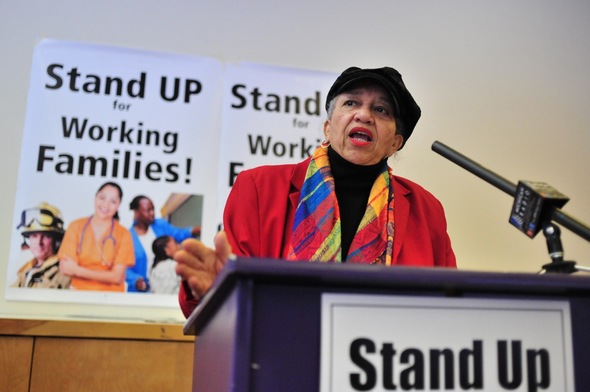
Ypsilanti Mayor Pro-Tem Lois Richardson said today during a rally at the Ann Arbor Community Center that local communities already have enough challenges without the added cuts proposed by Gov. Rick Snyder.
Ryan J. Stanton | AnnArbor.com
Calling Republican Gov. Rick Snyder's proposed budget an attack on Michigan's working class families, several citizens and community leaders spoke out today in Ann Arbor.
"If we don't stand together as one and work together against this budget that is being proposed, the whole state is going to be in a devastated state," Lois Richardson, Ypsilanti's mayor pro-tem, said during a press conference at the Ann Arbor Community Center.
"We've got to raise our voices," she said.
Today's event was one of several similar demonstrations organized by Progress Michigan in communities throughout the state, including some in Detroit, Lansing, Grand Rapids, Saginaw, Kalamazoo, Monroe, Mount Clemens, Marshall and Birmingham.
The coalition behind today's demonstration is calling on alternative reforms to fix what it agrees is a broken state government. Representing the interests of families, seniors, education, workers and other groups, the coalition plans to rally in Lansing on Wednesday.
"We are in a structural deficit, and until this state addresses revenue — as opposed to just expenditures — we will continue on our downward spiral," said Brit Satchwell, president of the 1,200-member Ann Arbor Education Association.
The state budget cuts Snyder has proposed — partly to close a $1.4 billion deficit and partly to finance $1.8 billion in tax breaks for businesses — would negatively impact schools, universities, cities, townships, counties, senior citizens and low-income wage earners, among other groups. It also promises deep cuts to the state's film incentives.

Brit Satchwell, president of the Ann Arbor Education Association, said today he doesn't believe Snyder's trickle-down economics approach will work.
Ryan J. Stanton | AnnArbor.com
Snyder explained the rationale behind his proposed cuts during a speech last week in Washtenaw County. He said there's no doubt going to be some short-term pain, but the result is a state budget that is fiscally sound, and that's going to be attractive to businesses.
"Personally, these calls are difficult calls because you are impacting people's lives, and you are causing issues with people," he said. "But one of the things I'm proud to say is we stopped thinking short-term and we stopped thinking just about today."
Satchwell spoke today about the impact of Snyder's proposed budget on K-12 schools.
"It proposes to cut K-12 education by at least $470 per student," he said. "In terms of what districts have faced in the last five or six years, that's like an asteroid. Here in Ann Arbor, we've cut $5 million or $6 million on average for the last six years straight."
Entering this school year, Satchwell said, Ann Arbor Public Schools had a projected deficit for next year of $7 million. As soon as Snyder released his budget, that projected deficit went up to $15 million. And if the district's special education millage renewal doesn't pass in May, the district's projected deficit climbs to $22 million, Satchwell said.
Satchwell said last year alone his union members gave up $3 million to avoid layoffs. Referencing other concessions, he said each teacher on average has given back more than $4,400 to help balance the district's budget in recent years.
When Snyder talks about "shared sacrifice," he's just blowing smoke, Satchwell said.
"We're erasing lines right now," he said. "It's not about public versus private. It's not about union and nonunion. It's about the middle class and democracy at this point."
Nancy Heine, a county employee at Washtenaw County Community Support and Treatment Services and president of AFSCME Local 3052, said unions have played a vital role in protecting workers' rights and improving quality of life.
They also have given back, she said, noting that in Washtenaw County alone, union employees have saved county government more than $5 million over the past two years.
"We have cut our own pay, we have cut our benefits, we have increased contributions to health care," she said. "And now because the legislators are feeling the heat, public employees are being used as scapegoats and blamed for the state's financial mess."
Heine shared concerns that the pending emergency manager legislation would allow emergency managers appointed by the state to void union contracts, make changes to pension plans and "hijack local municipal and county governments."
Bonnie Halloran, a professor at the University of Michigan-Dearborn and president of the Lecturers' Employee Organization, spoke out against Snyder's proposed 15 percent cut to higher education, saying it impacts families and children.
"This is going to impact families in this state, families who are no longer going to be able to afford to pay for their children's education at our public universities," she said. "This is appalling for the state of Michigan, this disinvestment in education."
Jaime Nelson, a U-M graduate who now works for U-M's Prison Creative Arts Project, also touched on the increasing cost of higher education.
"I know how hard I struggled to pay for college, and I'm still paying for college and probably will be the rest of my life," she said. "But I'm really concerned about the students that are going through now because I know how hard it was to pay, and still pay, for school five years ago."
Snyder's budget proposes a complete elimination of nearly $300 million in statutory revenue sharing payments for cities, villages and townships in the fiscal year that starts Oct. 1. Taking the place of those payments would be a lesser $200 million pot of money available to communities that consolidate and collaborate on services.
"To see all of our tax dollars go to the state, and the state do what they want to with them and not give them back to us, it really is not right and something must be done," Richardson said, adding Ypsilanti already has enough budget problems. "This year, our budget is $11 million and with $1.2 million of that is state shared revenue."
Richardson also spoke out against Snyder's call to eliminate tax credits that help finance redevelopment of old and blighted properties in urban areas.
Multiple speakers shared concerns about Snyder's approach to finance business tax breaks by increasing taxes for many individuals.
"Giving the businesses tax breaks, that's not necessarily what brings businesses to town. It's having a good strong educational system," Richardson said. "People look for good places where their children can get a good education."
For those who still believe in trickle-down economics, it's been two decades now and "it never did trickle down and it never will," added Satchwell, a sixth-grade math teacher.
"Every dollar that's put into early ed, K through 2, has a return on investment of $7 for every $1 invested," he said. "But no, they're going to take it from the poor, they're going to take it from the elderly, they're going to take it from public education, they're going to take it from your rights to bargain, they're going to take it from your rights to a democracy. It's happening right now."
Satchwell said another local rally will be held at 4:30 p.m. Tuesday at Forsythe Middle School, 1655 Newport Road. Calling it "a little bit of Madison right here at home," he said it will be attended by city officials, union representatives, parents, teachers and others.
Ryan J. Stanton covers government and politics for AnnArbor.com. Reach him at ryanstanton@annarbor.com or 734-623-2529. You also can follow him on Twitter or subscribe to AnnArbor.com's e-mail newsletters.
Comments
DonBee
Tue, Mar 15, 2011 : 7:04 p.m.
Riddle me this: According the US Census Bureau - if you add up all the units of local and state government we have today about 20,000 more government employees than we did in 1997. In 1997 the state had 9.7 million residents and 1.7 million children in K-12. Today we have 9.8 million and 1.5 million K-12 students. If we are in such a crisis, why with a very small increase in state population and a decrease in student population are the number of public employees up?
Caferacer
Tue, Mar 15, 2011 : 11:58 p.m.
Excellent research and a tremendously powerful example of unchecked government growth. Now we are feeding this bloated monster in the form of tax dollars and it is a hungry beast!
Roadman
Tue, Mar 15, 2011 : 5:45 p.m.
Arbor Update hs been resurrected s a blog for dispensing organizing information for protests against Snyder's proposed budget.
DaLast word
Tue, Mar 15, 2011 : 4:54 p.m.
There is NO answer to this problem that doesn't ultimately fall on the tax payers and all must share the pain. If you try to tax business more, then business will leave the state taking jobs with them. Just look at New York and California. For those business's that try to stay, they will have to either pass this cost on to the consummer (tax payers) or take the money out of the employee's pocket (tax payer) Many ignorant people blindly assume that all business's are making money hand over fist and just sticking it in their pockets. This notion is completly void of intelligent thought. Very few people are catagorized as rich in this country and yes they should help by paying more tax, problem is ...that won't solve the issues at hand.
cbta2
Tue, Mar 15, 2011 : 7:19 p.m.
Perhaps I made it overly complicated. Rick did fine. 20 years after coming to South Dakota and 15 years after leaving, he is fabulously wealthy from a crappy product and has been elected governor of a beautiful state far from South Dakota. Everybody else paid for it. South Dakota has an empty factory for all it's generosity, the city of North Sioux City is stuck with an infrastructure bond it can't payoff for things it doesn't need and can't use because the 5900 employees who were going to pay for had to move to the unaffordable, for most, Southern California, find another job elsewhere and move - again, or stay and accept unemployment. If the Governor can't solve the state's difficult and untenable financial circumstances through effective management, sound and fair principles, and asking corporate freeloaders to contribute their fair share to the mutually successful future of our wonderful state and people, perhaps the President should appoint an Emergency Manager.
cbta2
Tue, Mar 15, 2011 : 4:08 p.m.
I see a pattern here - cut taxes on corporate freeloaders, create a budget crisis, solve it with disastrous ideas on the backs of those least able to fix it and not responsible for creating it - tax grandma and fire my mayor. We should have seen it coming - it's GOP SOP. Gateway was the worst computer ever! It seems the founder and Chairman Rick had the brilliant idea to make computers in a cornfield in a state that boasts " The South Dakota business climate is rated Number One in the nation for entrepreneurs according to the Small Business Survival Index" - no corporate income, personal income , personal property, business inventory, or inheritance tax plus a 100% tax abatement for 5 years on new construction/additions. So Rick and his Gateway buddies move from Sioux City, Iowa a few miles and one state away to North Sioux City South Dakota. Chances are good North Sioux City sweetened the pot with infrastructure investments for the shiny new manufacturing facility employing 6,000. Fast forward 8 years, Gateway moves to California because they could not attract top talent to South Dakota to live, work, and play before being sold to Acer and offshored. Today the SD plant employees 100 people, the city is the same dump it was before, and the state gave the tax farm away. To the poor South Dakotans that subsidized Rick's business fiasco, instead of giving the money to out-of-state corporate freeloaders you should have hired public school teachers so the next generation of elected officials won't be so stupid and gullible. Flint, Highland Park, and Hamtramck opened their arms to businesses and wound up just like North Sioux City - empty factories and nothing to show for it but landfill -. Don't be fooled by encouraging corporate freeloaders that won't pay their fair share and contribute to our state to make it a better place like the rest of us who care about it - just tell them GO TO TEXAS -----------!
walker101
Tue, Mar 15, 2011 : 12:04 p.m.
Get over it, it's about time someone stopped the gravy train, why should I continue to have my tax dollars continue to be raised only to support those that have no desire to help themselves, the poor do not pay taxes only the working middle class. Enough is enough.
Hot Sam
Tue, Mar 15, 2011 : 12:03 p.m.
"""Wall Street running unchecked""" While that comment may be true, this governor has nothing to do with it. If we looked at controlling the completely out of control federal government, then perhaps states would not be in such a mess!
mac
Tue, Mar 15, 2011 : 11:13 a.m.
I agree with caferacer to a degree. we obviously need cuts no one disagrees with that. we also need businesses to see michigan as a viable place to do business. we can all agree on that one too. Our state, like so many other states is in trouble. why not convert our legislature to a part time status in Lansing and our Municipalities and require them to go back to private sector work sorta like the military reserves, and pay a stipends to them rather than a salary and have them contribute to their own benefit package. this could save the state a lot of money. Its not like we are making new laws 24/7 and I guess the Lobbyist and special interest group pacs can invest in other ways since congress will be busy representing their constituents the few days they are in session. Congressmen and women will be more in tune to their communities because they will actually be part of them.
Caferacer
Tue, Mar 15, 2011 : 11:54 p.m.
I like your thinking Mac. I suspect if we did this we would save a ton of cash and would be able to maintain a lot of the services that are currently on the chopping block.
leaguebus
Tue, Mar 15, 2011 : 1:46 a.m.
@TopCat you are right, it's time to take back the state, start paying teachers $10 an hour and putting them in jail when they can't pay their student loans. Treat all teachers like they are the dregs of society, slackers, and only work for 9 months a year. We too will then equal that right wing bastion of progressive education, Texas and graduate less than 65% of our high school seniors. Oh, by the way, in about ten years, see how many hi-tech businesses will want to move to this state and it's scads of educated workers. At the same time, keep cutting funds to the state universities, and watch the Michigan high school graduates start choosing out state schools in states that have continued to support their universities. Eventually as the cuts continue, we will become the northern Mississippi with really low taxes and all the poor students in the horrible public schools and all the rich kids going to Greenhills. The only way Michigan can maintain a chance of gaining jobs is to invest in our children's education and the states school districts. But in your weird way of thinking, we need to get rid of more teachers and give huge tax breaks to companies that will eventually leave the state because they can't hire any educated workers. By the way, I had three sons go through the AA Schools and by doing it the Britt Satchwell, Fred Klein, Dan Ezekial, and many other wonderful and dedicated teachers way, they thrived. other great teachers way, they thrived.
EyeHeartA2
Wed, Mar 16, 2011 : 3:18 a.m.
@ERM; Please read your quotation again. Neither my original post nor your quotation of that mentions teacher. Both, do mention Dems (sarcastically, I admit) - which would likely cover both the charter schools and the public schools in that area. Nice swing though. Kept trying, you'll hit something.
DonBee
Tue, Mar 15, 2011 : 2:17 p.m.
It is very very difficult to educate people who don't want to be educated. It is more difficult when they come from a culture that does not value education. Unfortunately Detroit has had the time to build such a culture. Auto assembly jobs did not require an education. They paid well. Add to that the welfare culture, where if there was a second parent in the house you got less money, and more babies meant a bigger check. While we have fixed this part of the equation, it had 40 years to settle in. In the welfare culture, that is almost 3 generations. It will take 40 years to change the culture in Detroit. 40 hard years.
Edward R Murrow's Ghost
Tue, Mar 15, 2011 : 12:45 p.m.
"Or we could be like that other great "right wing bastion", Detroit, and graduate 62% of our kids (nice to see it is on the upswing)" Test scores for students in Charter Schools in Detroit are no better, and often worse than those of the public schools (which is a national trend, as well--not just true of Detroit). Source: <a href="http://www.nytimes.com/2011/03/14/education/14winerip.html?src=recg" rel='nofollow'>http://www.nytimes.com/2011/03/14/education/14winerip.html?src=recg</a> So maybe the problems "in" Detroit's schools have little or nothing to do with the schools themselves? Perish the thought because, if that were true, we'd have to stop bashing the teachers in the district and come to grips with the much more difficult problem of the community's social disintegration. But that won't happen. Bashing teachers is more fun, it's cathartic, and it offers an overly simplistic solution to an incredibly complex problem. Good Night and Good Luck
mw
Tue, Mar 15, 2011 : 11:07 a.m.
"The only way Michigan can maintain a chance of gaining jobs is to invest in our children's education and the states school districts. " 'Invest more in education' -- that's been the plan for the last decade. How has it worked out? I'll tell you how it's worked out. Michigan spends more on education but does not improve its business environment and what happens? Our newly minted college graduates leave the state in large numbers because there are NO JOBS FOR THEM HERE. Not only is that a human tragedy, but the money that Michigan taxpayers have invested in that education goes to benefit other states where the business climate is better and the economy is growing. If you have a good business environment, you can benefit from *other state's* college graduates (by getting them to move to your state) -- but if you business environment sucks, you can't even benefit from you own graduates (because they're forced to leave for jobs). "We too will then equal that right wing bastion of progressive education, Texas and graduate less than 65% of our high school seniors. " Texas has a very high percentage of low-income Hispanic students for whom English is not their first language. When adjusting for race and ethnicity (comparing whites to whites, Hispanics to Hispanics, African Americans to African Americans), Texas does as well in education as Michigan does, and Texas -- unlike Michigan -- has been creating large numbers of new jobs in recent years. The Texas formula has been succeeding and growing (and retaining and attracting an educated workforce) -- the Michigan formula simply has not.
EyeHeartA2
Tue, Mar 15, 2011 : 1:51 a.m.
..or we could be like that other great "right wing bastion", Detroit, and graduate 62% of our kids (nice to see it is on the upswing) <a href="http://detroit.cbslocal.com/2011/02/22/detroit-high-school-graduation-rates-rise/" rel='nofollow'>http://detroit.cbslocal.com/2011/02/22/detroit-high-school-graduation-rates-rise/</a>
Caferacer
Tue, Mar 15, 2011 : 1:04 a.m.
There is no other practical way to manage out of this financial crisis other than cutting services. No revenue means you must lower costs. This is not a Democratic or Republican issue it is basic math. Let's stop debating and get to fixing our states problems.
james
Tue, Mar 15, 2011 : 2:06 a.m.
I'm not sure what the posters here want as an alternative. I suppose further raising the taxes even more on businesses is the answer. The problem is that even when we do this (IE: Granholm for the last 8 years), the supports either have a short-term memory or refuse to admit that this contributed to the destruction of the Michigan economy.
leaguebus
Tue, Mar 15, 2011 : 1:57 a.m.
All we have to do Is stop the tax cuts for the rich corporations and let them pay their share.
Caferacer
Tue, Mar 15, 2011 : 1:32 a.m.
I'm already hammered with taxes... Stop the insanity! We must face the music, we cannot support our costs. Let's swallow the medicine now so we are healthy in our future.
transmission
Tue, Mar 15, 2011 : 1:20 a.m.
The obvious alternative is to raise taxes.
ypsi
Tue, Mar 15, 2011 : 12:55 a.m.
Last one to leave Michigan turn out the lights!
mw
Tue, Mar 15, 2011 : 12:54 a.m.
"TopCat, what are you expecting the districts to do differently without any money that will improve our schools?" I'd suggest reducing administration and non-instructional staff bloat as well as re-negotiating union contracts while holding class sizes as they are now. But then I'm an impractical dreamer...
Hot Sam
Tue, Mar 15, 2011 : 12:05 p.m.
You could add to that eliminating or consolidating some of the almost 600 school districts in our state...
james
Tue, Mar 15, 2011 : 1:48 a.m.
So you know we need to spend less, but you aren't willing to cut spending? The level of entitlement in this thread is overwhelming.
Macabre Sunset
Tue, Mar 15, 2011 : 12:51 a.m.
The only division I see here is the royalty of those lucky enough to live off the taxpayers and the serfs who aren't. It's time compensation for the royalty is moved back in line with compensation for those in the private sector.
Dante Marcos
Mon, Mar 14, 2011 : 10:41 p.m.
Apropos of this discussion, helpful breakdown here of Snyder legislation. Especially helpful for Tea Party enthusiasts: <a href="http://www.dailykos.com/story/2011/03/14/956355/-Michigan-Gov-Snyder-set-to-auction-off-MI-towns-to-highest%C2%A0bidders" rel='nofollow'>http://www.dailykos.com/story/2011/03/14/956355/-Michigan-Gov-Snyder-set-to-auction-off-MI-towns-to-highest%C2%A0bidders</a>
Monica R-W
Mon, Mar 14, 2011 : 10:05 p.m.
Ann Arbor and Washtenaw County citizens against the proposed budget cuts and tax hikes of Nerd Gov. Snyder....just to let you know, there is a groundswell of a Recall Rick Snyder for Michigan Campaign that is GROWING LIKE WILDFIRES on Facebook. I have been tracking this group since 2/21 when it started out with just 569 fans. Three short weeks later, they have near to 12,500 fans and since yesterday....they grew by 2000 alone. I believe they are serious and groups around Facebook are pooling resources in order to assist. By Michigan election recall law, a petition can be started six months after the office of 'Governor' is filled, or July 1, 2011. A Minimum of 790,538 votes are needed (along with the language being approved for recall) within 90 days after the petition is certified. The group is looking to collect 900,000 signatures....which is a big task but, with Snyder's falling popularity...this might not be hard at all to get done. Hey, the Detroit Free Press noted his favorably rating LAST WEEK at 44 percent and the man has not been in office a good three months! Talk about falling out of love...it took Jennifer Granholm a second term to score that low. Anyway, here are the links and if you believe that Snyder is not right for Michigan...read up and join in... <a href="http://on.fb.me/eeEOUB" rel='nofollow'>http://on.fb.me/eeEOUB</a> - Recall Rick Snyder for Michigan FB Group <a href="http://bit.ly/dMyVa1" rel='nofollow'>http://bit.ly/dMyVa1</a> - A link to our initial blog post about this group formation on 2/21
DonBee
Tue, Mar 15, 2011 : 1:30 a.m.
Well you have roughly 500,000 signatures with government employees, so you are more than 1/2 way there. Get their significant others to sign and you will over the hump. Then with more public sector union dollars you can run an ad campaign to vote him out of office. Good hunting
C. S. Gass
Mon, Mar 14, 2011 : 9:42 p.m.
Good going Mr. Snyder. And you weren't even my first pick, I wanted Cox. Sure, cuts hurt, but the days of the government 'giving' everything to everyone who asks are long gone. There is simply no more money for it. If you look at education as a right, then this is going to be a problem for you. But it's not, it's a privilege. So many take it for granted, it's sickening. We cannot afford to keep funding things that do not work or that habitually fail and do nothing to change. Whether they are schools or government 'programs' (a euphamism for waste) makes no difference.
toolmaker2
Mon, Mar 14, 2011 : 9:33 p.m.
Why do Republicans hate teachers? Are the jealous of the pay? No I do not think so, teachers are not paid that well. Of course, there job is not important, is it? The teachers lower than average college graduate pay has allowed better than average benefits. It seems to balance. Why is this so hard to see? Toolmaker2
Moscow On The Huron
Tue, Mar 15, 2011 : 2:35 p.m.
This is known as the fallacy of the false premise.
Will
Mon, Mar 14, 2011 : 9:29 p.m.
Since the taxes we pay will now go towards making up the 1.8 billion in tax breaks to profit-making businesses, go research the demographics of who own most of the businesses and corporations doing business in Michigan. You should know where most of the tax breaks will be going. If you were angry at the wall street and corporate greed, get ready to be upset again.
DonBee
Tue, Mar 15, 2011 : 1:26 a.m.
Check your facts Will. Check your facts
GMC
Mon, Mar 14, 2011 : 9:24 p.m.
As a hardworking taxpayer (with children in public schools), thank you to Governor Snyder for finally representing the taxpayers of Michigan. You have certainly earned my vote.
David Cahill
Mon, Mar 14, 2011 : 8:54 p.m.
I hope those folks who are middle of the road and/or liberal, and who voted for Snyder, now realize that elections have consequences. If you vote for a Republican you'll get Republican policies every single time.
Moscow On The Huron
Tue, Mar 15, 2011 : 2:33 p.m.
Perfect point, EyeHeartA2.
EyeHeartA2
Mon, Mar 14, 2011 : 11:52 p.m.
"If you vote for a Republican you'll get Republican policies every single time." Shocking. Republicans keep their word.
Will
Mon, Mar 14, 2011 : 8:44 p.m.
1.8 billion in tax breaks for businesses...even for businesses that consistently turn large profits. The loss of 1.8 billion from businesses has to be replaced by taxes paid by Michigan residents. Buisnesses are able to turn profits. How many tax-paying residents can do the same? Doesn't seem fair to this tax-payer.
DonBee
Tue, Mar 15, 2011 : 1:25 a.m.
Not for the big companies, sorry Will, Ford, GM and others will not see a penny of this money. Most will go to Moe who runs the hardware store and Len who runs the feedmill, as well as Jenny the plumber and other small and independent business folks who now pay taxes based not on profits, but on gross reciepts. It breaks down to an average of about $3,000 for each of the small businesses in Michigan.
HaeJee
Mon, Mar 14, 2011 : 8:42 p.m.
Our newly elected Governor has hit HuffingtonPost and now is called worse than Walker (WI) or Scott (FL). Another embarrassing media day for Michigan. It is clear by these posts that he has many die-hard fans that buy into his justifications and believe Snyder's dreams. Call me a skeptic (thanks to Jenny), but I won't believe anything until I see it. Regardless if you are liberal or conservative, you have the same chance in getting a bad politician in office. I believe his proposals are too drastic and should been scaled over a course of time. Take away the tax breaks gradually over a 5 year course and then analysis the data to see if it works. I am just disappointed with the choices we have for politicians in Michigan and throughout the country.
DonBee
Tue, Mar 15, 2011 : 1:23 a.m.
On the Right Fox News and the Washington Post On the Left MSNBC and the Huffington Post To get to the middle - read both or watch both. Neither side tells more than 10 percent of the truth.
Monica R-W
Mon, Mar 14, 2011 : 10:26 p.m.
Quick correction to a slight typo HaeJee.....The recall signature gathering stage can began, with approval of the recall language, starting July 1, 2011....six months to the day Nerd Snyder took office. A minimum of 790,538 (25% of all voters that took part in the November 3, 2010 Governor election only) certified voters signatures are needed, within 90 days to place the petition on the ballot. Read more about it here.... <a href="http://on.fb.me/eeEOUB" rel='nofollow'>http://on.fb.me/eeEOUB</a> - Recall Rick Snyder for Michigan FB Group <a href="http://bit.ly/dMyVa1" rel='nofollow'>http://bit.ly/dMyVa1</a> - A link to our initial blog post about this group formation on 2/21
Monica R-W
Mon, Mar 14, 2011 : 10:14 p.m.
HaeJee, do not allow yourself to believe the hype. Trust me....half of these 'posters' do not stay in Michigan and the other half a Tea Party Extreme to the core. I am sure that this article was linked on Red State, Drudge Report or any other Conservative blog and 'they' came running to defend Nerd Gov. Rick. But there is a difference between Michigan and Wisconsin....we have until July 1, 201, NOT NEXT YEAR to Recall this mistake of an Governor and take our state back! And HaeJee....you want to know some more GOOD NEWS...we can recall members of the Super-Majorities state House and Senate too....starting the same exact date. Not a year, when people's memories will be less fresh but in the heat of summer with gas prices, increased food cost and knowing that if you are a taxpayer in the state of Michigan...you will receive less -with Snyder's TAX INCREASES for the Middle/Lower Classes...while paying more for everything else. Pass the word and join into Michigan's Revolution to send the Nerd to the back of the class....Recall Rick Snyder for Michigan.... <a href="http://on.fb.me/eeEOUB" rel='nofollow'>http://on.fb.me/eeEOUB</a> - Recall Rick Snyder for Michigan FB Group <a href="http://bit.ly/dMyVa1" rel='nofollow'>http://bit.ly/dMyVa1</a> - A link to our initial blog post about this group formation on 2/21
TripleVSix
Mon, Mar 14, 2011 : 8:54 p.m.
Actually, if the Huffington Compost doesn't like him, that's a sign that he's doing the right thing.
Stephen Landes
Mon, Mar 14, 2011 : 8:41 p.m.
Same warmed over Democrat tired line again and again. We are just beginning to face up to the mountain of debt that the old line politics of the past has given us. We need a new direction -- one that doesn't try to hide the real issues with smoke and mirrors. We need a reasonable business tax system to replace the disaster that is the MBT. We need to tax all retirement funds equally -- no special exclusions for defined benefit pension plans when the rest of us with IRA and 401K type plans are being taxed on the increased value of our plans. We need to get off the gravy train -- which is a figment of the imagination fueled by Federal funds (i.e.: borrowed form China) and one-time adjustments designed to hide the truth. To claim that what is happening in Lansing isn't "democracy" is true -- we don't have a pure democracy in this country: we have representative government. The people in Lansing were elected by us to represent us and we asked them to fix our budget and job problems. We asked Granholm and her friends to do that for eight years and all we got was Jennie telling us we would be "blown away". Well, many people in Michigan WERE blown away -- blown out of jobs, homes, and some right out of the state. Now we have a new team in Lansing and we are asking them to do the job that Jennie didn't do. Time to rethink everything about the way this state is organized and the way it works (or doesn't). If you depend for your job on hand outs and tax incentives (which the Left used to call corporate welfare) you had best find a new way of working because those days are, thankfully, behind us.
HaeJee
Mon, Mar 14, 2011 : 8:47 p.m.
Engler didn't do very much for the state of Michigan during his term either. Jobs started leaving during his watch and continued until we were in a full recession in our state. I am not going to blame all Republicans for it, just as liberals shouldn't be blamed for Graholm's neglect.
noreaster
Mon, Mar 14, 2011 : 8:08 p.m.
To quote Mr. Satchwell: "It proposes to cut K-12 education by at least $470 per student," he said. "In terms of what districts have faced in the last five or six years, that's like an asteroid. Here in Ann Arbor, we've cut $5 million or $6 million on average for the last six years straight." Thank you sir, for relating apples to asteroids. It is so helpful NOT, especially for those of us who do not memorize the number of students and perform division instantaneously, mentally. If you want to sway me, let me know how the present cuts compare to those in the previous years on a purely per-student basis. Instead of being swayed, I cringe for the president of the AAEA, and that saddens me.
DonBee
Tue, Mar 15, 2011 : 1:21 a.m.
If you look at the base funding from the state, which is all the Education Advocates want to look at, Mr. Satchwell is right. However, if you look at total funds from all sources available to AAPS, he is wrong. I expect that all the education advocates will take me on again on this topic. But it is true that when all the money is added together, the numbers are still trending up.
aataxpayer
Mon, Mar 14, 2011 : 8:08 p.m.
The public sector still has some catching up to do in terms of getting benefits, co-pays and deductibles much closer to the private sector. That said, public sector employment must remain reasonably attractive unless you want Barney Fife as your police officer and "D" students becoming teachers with much larger class sizes. I wish the AAEA would get out in front off this and accept another round of concessions so that the public could get behind an enhancement millage. I would also support allowing larger school districts (say over 4000 students) to ask voters directly for a limited enhancement millage rather than going through the ISD. This would encourage the consolidation Synder says he wants. Brit - any common ground here?
DonBee
Tue, Mar 15, 2011 : 1:18 a.m.
The local teachers unions are collecting funds to run ads and do mailings for the special education millage coming up. The fun part is they want to "guilt" you into either not voting "No" or voting "Yes". The way they plan to do this (in coordination with WISD and the local school administrations)? Two children, one special needs and one not. With the tag line: "Don't Make Teachers Choose Between Our Needs" They don't expect any opposition and expect it to pass with ease. I was ready to vote yes, until I heard about the mailing and ad campaign.
Basic Bob
Mon, Mar 14, 2011 : 8:47 p.m.
Don't pick on poor Mississippi. We have as many Barney Fifes as anywhere else. We have already won the race to the bottom and soon we will lap the competition with our blissful ignorance.
Edward R Murrow's Ghost
Mon, Mar 14, 2011 : 8:31 p.m.
Gee. Why is it that the public sector must have worse benefits? Why is it that the private sector doesn't have to catch up? Looks like a race to the bottom to me. Michississippi, here we come. Good Night and Good Luck
Dennis
Mon, Mar 14, 2011 : 6:54 p.m.
@ ickwbu try this site for information. Not all of them are local protests. <a href="http://uaw.org/page/state-battles-solidarity-action-calendar" rel='nofollow'>http://uaw.org/page/state-battles-solidarity-action-calendar</a>
hypsi
Mon, Mar 14, 2011 : 6:53 p.m.
Not a complete list but it's a start..if your looking for rallies: <a href="http://firericksnyder.org/rallies-dates-times-locations" rel='nofollow'>http://firericksnyder.org/rallies-dates-times-locations</a>
hypsi
Mon, Mar 14, 2011 : 8:11 p.m.
Hey don't shoot the meessenger...ickwbu had a question..just giving an answer.
InsideTheHall
Mon, Mar 14, 2011 : 7:59 p.m.
Elections have consequences. Try again in 2014.
Bogie
Mon, Mar 14, 2011 : 6:45 p.m.
Its not going to be easy, Rick. It has been 40 years of tax and spending crap. Hang in there.
EyeHeartA2
Mon, Mar 14, 2011 : 6:45 p.m.
No news here. Unions want handouts, democrats want higher taxes. This should be under the fold in section C, next to the Deja Vu ad.
DonBee
Tue, Mar 15, 2011 : 2:09 p.m.
HaeJee - Check the test scores in Tennessee and the economy in Tennessee and tell me the kids are illiterate anymore. In World War II, sure Oak Ridge was put in Tennessee and used illiterates to do much of the work. Today you would be better off in Detroit finding illiterates. And Michigan pays its teachers way better than Tennessee, but the fact that students in Tennessee are doing better overall than Michigan students does not suit your world view, so you can just ignore it.
EyeHeartA2
Tue, Mar 15, 2011 : 1:48 a.m.
@ Hajee: "illiterate like many other kids in states like TN, KY, etc" Wow, and you're calling ME biased. Well, you know how those "hill folk" are. Oh, by the way, according to US News and World Report, Kentucky's schools are better than ours, so what does that make our kids? <a href="http://education.usnews.rankingsandreviews.com/education/high-schools/articles/2009/12/09/americas-best-high-schools-state-by-state-statistics" rel='nofollow'>http://education.usnews.rankingsandreviews.com/education/high-schools/articles/2009/12/09/americas-best-high-schools-state-by-state-statistics</a> "Who would commit into going to college for 4-5 years and spend 100k for an education to get paid 20k-50k?" What guarantee does ANYONE have about how much money they would make? Furthermore, are you saying that anybody that goes to college should get paid "union wage"?
magnumpi
Mon, Mar 14, 2011 : 11:47 p.m.
Hae Jee, can you provide a link that shows teachers in KY & TN are only teaching because they failed to "get into any other profession", which in turn produces more illiterate kids than any other states? thanks.
magnumpi
Mon, Mar 14, 2011 : 10:46 p.m.
TN, KY? Stereotype much?
HaeJee
Mon, Mar 14, 2011 : 9 p.m.
Biased are you? Teachers are highly educated and commenter's like you just insult the profession. People will regret complaining about how much teachers get paid when our young become illiterate like many other kids in states like TN, KY, etc. Their kids can't read because they are stuck with teachers who failed to get into any other profession. Who would commit into going to college for 4-5 years and spend 100k for an education to get paid 20k-50k?
sh1
Mon, Mar 14, 2011 : 7:16 p.m.
Where in the article does it say unions want handouts? I believe the right to bargain in good faith is all they're asking for.
Nicholas
Mon, Mar 14, 2011 : 6:25 p.m.
'Snyder's plan constitutes an open and direct transfer of wealth from the working class to the wealthy. The claim by the governor that his budget represents a vision of "shared sacrifice" is absurd on its face. The rich and the corporate elite are not being asked to sacrifice a penny.' <a href="http://www.wsws.org/articles/2011/feb2011/mich-f22.shtml" rel='nofollow'>http://www.wsws.org/articles/2011/feb2011/mich-f22.shtml</a>
Mike
Tue, Mar 15, 2011 : 12:37 p.m.
He's taxing the incomes of retires and giving the money to those on welfare and medicaid; I don't follow your logic
Dennis
Mon, Mar 14, 2011 : 6:18 p.m.
You're correct Mr.Peter. All politicians do support corporations. However, Democrats also support the working class as well. Look up the dictionary defination of Conservative and Liberal and see the difference. My point is that we have already tried the Conservative Republican way many many times. During the depression and again under Ronald Regan, George Bush, and George W. Bush. It just doesn't work. Conservatives are locked into only one way of doing things. Give breaks to corpporations, unleash Wall Street, cut education, reduce "Entitlements". What Mr. Snyder is doing is just more of the same with the name re-invent Michigan attached. Don't take my word for it, go read up on how the great depression came about and why it lasted so long. Maybe then you will understand what I am trying to say.
DonBee
Tue, Mar 15, 2011 : 1:14 a.m.
Mr. Briegel - Where are you getting petitions signed at to change the state constitution?
David Briegel
Mon, Mar 14, 2011 : 9:07 p.m.
Stephen, actually we just wish to have a fair tax rate for those who inherited or stole the vast increase in the wealth of our nation over the last 30 years of the Reagan lie.
Stephen Landes
Mon, Mar 14, 2011 : 8:46 p.m.
It would be very easy to write the opposite point of view: Democrats are locked into one way of doing things: steal from those who earned it, give to those who didn't, make life as difficult as possible for those trying to create jobs, and complain that there isn't enough money being spent on what they want. See how easy that was? And it makes just as much sense as your comment.
Peter Jameson
Mon, Mar 14, 2011 : 6:13 p.m.
This was the first time in history that i voted for a politician and he did what i expected, unlike when I voted for Obama (terrible decision). i will continue to support non-career politicians. It's very problematic when the population votes for candidates who promise them more money.
Mike
Tue, Mar 15, 2011 : 12:36 p.m.
@sh1 - So the majority of people in the state of Michigan are rich according to your logic?
Gorc
Tue, Mar 15, 2011 : 12:22 a.m.
sh1 - is problematic for those citizens that mooch off the rest of society in the form of entitlements.
HaeJee
Mon, Mar 14, 2011 : 9:02 p.m.
It becomes hard to do your job as a Politian when you don't have connections with other politicians, i.e. Obama's current problem.
sh1
Mon, Mar 14, 2011 : 6:16 p.m.
It wasn't very problematic for the rich who voted for Snyder.
InsideTheHall
Mon, Mar 14, 2011 : 6:09 p.m.
Sound like union liberal moaning because the gravy train has ended. 40% of Americans are either unemployed, in foreclosure, two house payments behind, or under water on their mortgage. And WE the people are supposed to feel sorry for liberal unionists who have been feather bedding for the last 40 years?????????? This is mere grandstanding and more union shenanigans.
HaeJee
Mon, Mar 14, 2011 : 9:09 p.m.
I am not sure what your point is regards to your examples, but the 40% you refer to are people that took risks and now are paying for it. Instead of finding blame for the lack of jobs, you should be thinking about why these people are not re-educating themselves for a profession that they can get a job in. I don't sympathize for "unionist", but the employees. Why should people like you who are unhappy with their own current situation need make others miserable. They are paid a fair wage and many times lower in comparison to big business. Compare teachers and engineers. Engineers get paid more, yet they have the same amount of education.
Edward R Murrow's Ghost
Mon, Mar 14, 2011 : 8:17 p.m.
Teapartyist ill-logic tells us that unions harm the economy. Union membership is at its lowest as a percentage of the private work force than it has been since data started to be collected during the New Deal. Oooops. Facts get in the way of fairy tales. Good Night and Good Luck
sh1
Mon, Mar 14, 2011 : 6:16 p.m.
And again, your example of the gravy train over the last few years is....
sh1
Mon, Mar 14, 2011 : 6:02 p.m.
I'm curious where people get their ideas of "gravy trains" and coddled union employees. Engler stripped teachers of the right to strike years ago, which alters how they can bargain. Teachers have been paying more for their benefits and taking pay cuts in recent years. So why the public still thinks unions have the power of the "Jimmy Hoffa days" I don't understand. Too much AM radio, perhaps?
EyeHeartA2
Tue, Mar 15, 2011 : 1:32 a.m.
ERM; I suppose my definition of a gravy train would be one that is better than (and yes, I am guessing here) 90-95% of the private sector employees. Who, after all, pay the wages.
DonBee
Tue, Mar 15, 2011 : 1:12 a.m.
Right now in Michigan there is roughly 1 Government employee for every 7 people who are employed by someone other than the government. So lets just fix the problem. We will each invite 1 Government employee to spend 1 night with us each week. We feed and house them. Benefit and salary problems solved.
Edward R Murrow's Ghost
Mon, Mar 14, 2011 : 7:41 p.m.
Yup, I did. And the gravy train was . . . where? You mean that some bargaining units had better benefits than others? How is that a "gravy train"? What would be a concise definition of that term because, lacking that definition, it is simply a meaningless pejorative. Good Night and Good Luck
EyeHeartA2
Mon, Mar 14, 2011 : 6:47 p.m.
Did you read the "paper" yesterday?
transmission
Mon, Mar 14, 2011 : 6:01 p.m.
Tax cuts for Big Business, like Bush's and Obama's tax cuts for the wealthy, is just a re-redistribution of the wealth. Does anyone really believe Republicans care about workers? Name one Republican policy that ever showed support for normals who go to work for a living. Let's cut unemployment insurance. Let's cut health care. Lets make easy for business and government to walk away from pension obligations. Let's cut social security (relied on by people who spent their life working for a living). Let's fight minimum wage increases. Let's fight the ability for workers to organize. Let's enact laws that ties the unions' hands behind their backs. Let's say we're against illegal immigration but only punish poor illegal immigrants, while allowing the big business who hire them to get away scott free. Let's hire PR firms to demonize teachers and autoworkers with their "Cadillac" health care plans. Let's cut funding to neighborhood public schools Let's make a university education even more unaffordable to children of the working poor. Let's deregulate business and gut government watchdogs so that MegaDairies can pollute drinking water sources and do serious damage to homeowners' property values. Let's vote for every Free Trade deal, and expose our once middle-class workers to the vagaries of the open market. I understand it when the rich vote Republicans. It's in their interest. But I can not figure out why so many average Joes (and I am talking about white, working class males) continue to to grease the slide for people like Snyder. Then again, the Democrats have practically adopted all the Republican arguments and talking points as their own.
james
Tue, Mar 15, 2011 : 1:31 a.m.
"Tax cuts for Big Business, like Bush's and Obama's tax cuts for the wealthy, is just a re-redistribution of the wealth." It's so funny how the tables have turned. When the rich are being taxed, redistribution of wealth is A-OK. I wish all of our taxes were the same percentage. This way, people would understand how it feels to get money taken from the government and might not be so apt to gouge the people that actually bring jobs into the state. I don't even think you've read his actual proposals (like most people here). One of the changes being made is removing the small business tax on gross income. Yes, that's right, Michigan taxes you on the income you receive before profits (usually 5-15%). Most restaurants make 5-10% ROI. I will let you figure out why this doesn't work. Michigan is screwed..and you can thank Granholm for getting us to this point (OMG a Democrat). We need to bring more businesses into Michigan, because without more business interest, the state will be more bankrupt than it is now.
Ickwbu
Mon, Mar 14, 2011 : 5:54 p.m.
Exactly where is the information for these rallies? I've been following Wisconsin with a lot of interest but finding out where these rallies are in this state is nearly impossible. Can someone point me in the right direction? I'm sure a lot us in Washtenaw County would love to rally with our fellow pro-Union/Democratic people!
DonBee
Tue, Mar 15, 2011 : 1:10 a.m.
You could have taken the bus to the Wisconsin Rally on Friday. Our you could have been on the airplane full of State Employees from California headed to Wisconsin on Friday. Public sector unions from around the US are flooding Wisconsin.
2cats
Mon, Mar 14, 2011 : 10:41 p.m.
Up coming rallies in AA: Tuesday March 15, 4:30 Forsythe Middle School, Newport Rd Ann Arbor. and Tuesday March 15th 5:30 at Federal Plaza in Ann Arbor (5th and Liberty) is another rally to support collective bargaining and stand with Wisconsin.
sh1
Mon, Mar 14, 2011 : 5:58 p.m.
Sorry, I mean tomorrow at 5:30.
sh1
Mon, Mar 14, 2011 : 5:58 p.m.
Downtown library today at 5:30
Dante Marcos
Mon, Mar 14, 2011 : 5:47 p.m.
I can't stress enough that there is only one significant difference between Governor Scott Walker of WI and Governor Rick Snyder of MI: the way they've gone about what they've gone about. The former, as we're witnessing, is hanging himself. The latter, via cunning and camouflage, is succeeding. As for the rest of us: the citizens of WI are enraged, and have taken to the streets. Us here, on the other hand, are demonstrating how A2 is actually A3: Apathetic Ann Arbor.
Rusnak
Tue, Mar 15, 2011 : 3 p.m.
Walker told the public what he was going to do if he was elected. He did it. It wasn't a secret. And to the enraged that took to the streets? The union thugs bussed them in from out of state. Walker got rid of collective bargaining for state workers. When are people going to realize that an employer can't continue to pay benefits to you after you retire? My grandfather retired from Firestone years ago. He received benefits longer than the time he worked.
DonBee
Tue, Mar 15, 2011 : 1:08 a.m.
There are a lot more differences. The Govenor reached out and build an administration that includes both Democrates and Republicans, as well as independents. He raised taxes on many corporations by closing loopholes. He has set aside money for government units that consolidate and cooperate with each other. None of this is true in Wisconsin. He delivered his budget early and is pushing a 2 year budget cycle to reduce budget churn and allow planning. Is he cutting things? Yes he is, the Federal Handouts are gone and the Medicaid mandates in the Health Care Reform Act demand another $700 million from the state government.
sh1
Mon, Mar 14, 2011 : 5:45 p.m.
TopCat, what are you expecting the districts to do differently without any money that will improve our schools?
Dennis
Mon, Mar 14, 2011 : 5:45 p.m.
Back to the Future – They say the "History Repeats Itself". It does! One only need to look at the "Great Depression" of the 30's to see that Mr. Snyder's budget will not work. A Republican controlled government, Wall Street running unchecked, Banks Failing, Soup Kitchens, Home Foreclosures, Unemployment, and Homeless Families. Sound familiar? Again, after 12 years of Republican control(prior to President Obama), we are suffering what could be called the "Second Great Depression". Wall Street is again out of control, Banks have been in serious trouble, we have record Home Foreclosures, High Unemployment, Soup Kitchens, etc.. Just like the Getty's, J.P. Morgan, and the rest of the super-rich, the rich continue to get richer while the "average joe" continues to struggle to keep their homes, feed their families, and find work. "In 1936, main economic indicators (except unemployment) regained the levels of the late 1920s...but after the federal government cut spending with the expectation that the private sector would step in, the economy took another sharp downturn until WWII." Sound Familiar? Unions gained popularity and the working class started to make gains. "Causes of the Great Depression are widely debated but typically include a weak banking system, overproduction, bursting credit bubble, the fact that farmers and industrial workers had not shared in the prosperity of the 1920s, and a government-held laissez faire policy" The working class and unions are again under attack by an uncaring Republican Party. Michigan is just one example. You can see other examples where Republicans have gained control and are passing laws that limit the rights of all workers, not just union workers. Just look to New Jersey and Wisconsin. We would be better served by working together rather than letting ourselves be divided by a concerted effort of Republicans and Corporations.
McGiver
Tue, Mar 15, 2011 : 12:24 p.m.
What do you mean by working together? Sounds like democrat speak for do it our way. Elections matter. The republicans won now they get to do it their way.
Peter Jameson
Mon, Mar 14, 2011 : 6:05 p.m.
all politicians support corporations, not just republicans! They just support different ones. Look at corporate donations for the 2008 election.
KeepingItReal
Mon, Mar 14, 2011 : 5:43 p.m.
What a hypocrite! Lois Richarsdson. She has been on the Ypsilanti City Council for 10 year s and has done absolutely nothing to improve the conditions of the residents in her Ward. How can then advocate for the rest of the state. Her major initiative has been to have black kids locked because they are hanging out and there are no alternative programs to engage them in constructive activities in the community. How can she have the moxsy to even question the impact of the Govenor's budget on the state when she have not taken care of her own backyard. Do that first, then criticize the Govenor.
Marshall Applewhite
Mon, Mar 14, 2011 : 5:42 p.m.
Yawn. The gravy train is over, and I'm glad Gov. Snyder is finally willing to confront reality.
Dante Marcos
Mon, Mar 14, 2011 : 9:04 p.m.
But you support the multi-billion-dollar gravy train that Bank of Amerikkka got in American Taxpayer bailout money (though they don't pay a dime in taxes), I'm assuming? How's the weather in your Township?
zip the cat
Mon, Mar 14, 2011 : 5:36 p.m.
I for one wish I would have never voted for this anti blue collar/retired person. I am all for change,but not on the backs of the retired and middle class persons. I notice he gave all his cronies and friends who took his jobs HUGE wage increases. His budget wishes cost little or nothing extra for the well to do and his rich friends.. Sorry to say this Gov,but I made a mistake voteing for you. Never,ever,again will I vote for a richie/rich
Michael Christie
Mon, Mar 14, 2011 : 7:16 p.m.
Don't you use the same state services (roads, snow removal, etc...) as the rest of the tax payers? Why should the working class have to pay for the retired class in these areas? Additionally, this governor is saying what many before him didn't, that is the real reason we're "all blown away" by Granholm - a spending Dem BTW.
DFSmith
Mon, Mar 14, 2011 : 7:11 p.m.
Zip- would you please care to substantiate your claims? And where will you find a poor person to vote for?
Top Cat
Mon, Mar 14, 2011 : 5:35 p.m.
To Ms. Richardson, Mr. Satchwell, et al, we tried it your way for the last 8 years and it failed miserably. Doing the same thing over and over and expecting different results is a popular definition of insanity. Time for a fresh approach.
a2flow
Wed, Mar 16, 2011 : 3:17 a.m.
I guess I am bit confused...what did we try exactly? The state of Michigan has issues, but is Ann Arbor the root of the problem? AAPS has been cutting expenses for many years now. Here is a direct link to an Annarbor.com article, in which AAPS is praised by the conservative Mackinac Center for its fiscal responsibility. <a href="http://www.annarbor.com/news/mackinac-center-ann-arbor-public-schools-lead-in-lowering-health-costs/">http://www.annarbor.com/news/mackinac-center-ann-arbor-public-schools-lead-in-lowering-health-costs/</a> Beyond this, AAPS had three high schools in the top 12 in the state for academic achievement as measured by standardized assessment.