

EMU officials tweak Washtenaw-Oakwood construction plan, but some residents still unhappy
An Eastern Michigan University-developed project to alleviate traffic congestion at the intersection of Washtenaw Avenue and Oakwood Street will look slightly different than the plan approved by the Ypsilanti City Council in December.
EMU and Michigan Department of Transportation representatives updated the council and the public on those changes and the project’s new timeline at a work session Monday afternoon.
Still, some residents who live near the intersection continued to express their opposition to the plan. Joe Golder lives at the intersection’s northwest corner and has been particularly vocal in his opposition to the proposal because of the volume and the proximity of traffic. He vowed Monday to “walk away” from his home if the project is completed.
The council approved the original proposal at its Dec. 7 meeting. At that time, it was thought that plans had to be submitted and approved before late December for EMU to be eligible for a $450,000 MDOT Congestion Mitigation and Air Quality grant to fund most of the project.
When EMU officials met with MDOT officials, they found that there wasn’t a December deadline, and MDOT asked for several changes upon reviewing the proposal. The original plans called for moving Oakwood north of Washtenaw 12 feet to the east to provide an extra buffer for Golder and other residents.
City Planner Teresa Gillotti said MDOT engineers were concerned about the significant traffic shift that people driving north on Oakwood would encounter, so they requested that the road be moved only 7.5 feet.
The original plans also called for two southbound lanes on Oakwood to be dedicated left-turn lanes, and a third for drivers turning right or going straight. MDOT officials determined that three dedicated lanes — a left-turn lane, a right-turn lane and a lane for drivers traveling straight — improved flow.
Gillotti said there must be a dedicated left-turn light if there are two left-turn lanes. With the new lane configuration, drivers can turn right when the green arrow appears over the left-turn lane.
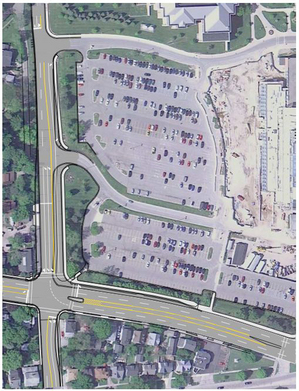
An aerial view of the intersection of Washtenaw Avenue and Oakwood Street near Eastern Michigan University.
Courtesy of the City of Ypsilanti
Among other changes at the intersection are the addition of a right-turn lane on westbound Washtenaw before Oakwood, numerous pedestrian safety improvements, and striping and signage to help prevent cars backed up on southbound Oakwood from blocking driveways.
Officials still aren’t certain where to place crosswalk signals, Gillotti said. The placement of the signs near Golder’s porch was one of his many concerns with the project. He also said the sidewalks are 5 feet wide, which means there would be 5 feet less of a buffer than what officials say.
Construction is expected to start in June and conclude by mid-August.
The project failed to receive the planning commission’s support in November, and its opponents have questioned why EMU wasn’t first addressing the Huron River Drive and Oakwood intersection. That intersection sees more accidents and some officials say tackling problems there could alleviate congestion at the Oakwood corridor's south end.
Some residents and planning commissioners also argued that the university should have planned to improve the entire Oakwood corridor while it was investing more than $200 million in capital improvement projects in recent years. Those projects have heavily increased traffic along Oakwood Street, which borders the campus’s west side.
Several City Council members have said the project wasn’t the perfect solution to the traffic problems created by the university, but the council voted unanimously to approve the plans at the Dec. 7 meeting.
Council Member Mike Bodary said he agreed with a resident's description of the project as a Band-Aid to the traffic problem around campus, but said he believes the plan will provide some relief.
"It may not be as much of an improvement as all residents wanted, but for the overall situation and whole neighborhood and this side of town it’s a help," he said. "It's going to get us a step closer to much better traffic management."
Leigh Greden, executive director of government and community relations for EMU, underscored that the university is covering any design costs the city incurs and has worked closely with the council and city staff on the project.
“We’re pleased that the project continues to move forward because this will be a dramatic improvement for that intersection,” he said. “In fact, MDOT is confident these new changes will reduce traffic congestion more than the original proposal.”
Greden said the university has also tried to address some of the neighbors’ concerns.
“We’re giving up some of our land in order to reconfigure the lanes and give Mr. Golder another 7 feet of right of way,” he said.
Golder said the changes still cause him and other neighbors problems. The corner used to be peaceful, he said, but now he has to deal with heavy traffic outside his house. He said no one in the city is helping him.
“City Council is now siding with EMU,” Golder said. “I’ve paid $50,000 or more in city taxes and I’m the one that pays for the right to access my driveway. EMU should have bought these two houses at the corner knowing what they were going to build before someone like myself came and bought one.”
Tom Perkins is a freelance reporter for AnnArbor.com. Reach the news desk at 734-623-2530 or e-mail news@annarbor.com. For more Ypsilanti stories, visit our Ypsilanti page.
Comments
Angela Barbash
Thu, Feb 10, 2011 : 10:41 p.m.
Thank you anonymous Washtenaw neighbor (aka: ?) for your 6 part series on the facts of the case -- it's helpful to those of us who live outside your neighborhood, but who are daily or weekly submerged in EMU traffic hell going East or West bound on Washtenaw by campus. What are you planning to do next? and how can some of us help you and your neighbors resolve this issue?
joe golder
Fri, Feb 11, 2011 : 1:38 a.m.
Angela thank you!!!! You are the first person from the community who has ever offered any support beside State rep Smith and that seems to have backfired seeing she signed on this recent grant giving EMU and the city more money to buy band aids.
?
Fri, Feb 11, 2011 : 1:07 a.m.
@Angela. Thanks for your comments and your offer to help. You are the first non-governmental person to make any offer of assistance in the many years that our neighborhood has been suffering from EMU's actions. Most people are either uncaring or afraid of EMU/city hall. How thoughtful of you! Unfortunately, EMU is the 800# gorilla in the room and is allowed to destroy neighborhoods with no fear of reprisal. Mr. Golder has suffered the most and is the one home-owner who is really getting screwed by our own government and by EMU! His damages are very severe and it now seems that his only available option is to seek legal redress for damages caused by Inverse Condemnation.
joe golder
Thu, Feb 10, 2011 : 6:33 p.m.
I am tired of being treated like one of the peasants living outside the walls of the castle. Being unfairly treated by the leaders of my village. leaders who seem to fear the queen and her court. Are these leaders afraid of reprisal from the the Queens supporters in our village. who is really looking out for us peasants. Maybe the leaders of the village are worried they will be removed from there position if they anger the queens supporters.... or they will not be let into the castle for parties and favors. I for one am ready to go Robin Hood on them and take back control of our village. Before our village falls apart due to the queen and our leaders foolish, selfish plans. Will any of my fellow villagers join me in this fight.
?
Thu, Feb 10, 2011 : 3:02 a.m.
Part 6 Another more comprehensive plan was put forth by an EMU official and presented to the President of EMU and its Board of Regents Planning Committee. This was presented as the best possible long-range plan to improve the Oakwood/West Cross/Washtenaw intersections and construct the proper main entrance for the university. This plan provided for a boulevard(s), proper setbacks, proper landscape screening of adjacent properties, and also better traffic flow and increased safety. It would have required the purchase of several adjacent and nearby properties. This plan was abandoned because of cost and EMU/City of Ypsilanti political issues. There are many more facts and opinions which could be reported by me and others. The facts speak for themselves and all are well-documented. I own my opinions and I respect your right to disagree. I do leave you with an excerpt from a recent letter sent by one of my neighbors to MDOT (Michigan Department of Transportation) and City of Ypsilanti officials: "…That brings me to what YOU have now done to the neighborhood of our residence on Washtenaw where we are raising our family. It is disgraceful! When we heard about the possible changes to this corner, ONLY because our neighbor informed us, we really thought you would do the "right" thing here, particularly after the 1999 fiasco when Oakwood was last widened! I received no notice from you, no request for input, and really no regard for the safety and quality of life for my family living here who has been an integral part of this city for decades! VERY similar to what went on in 1999. You should be ashamed of yourselves."
?
Thu, Feb 10, 2011 : 3 a.m.
Part 5 The council support for this "Band-aid" is understandable given that the majority of their constituents (voters) are minimally, if at all, adversely affected by the current traffic mess created by EMU. That does not mean that their decision is wrong or evil. It is merely politically expedient. It does, however, point out again that the city is at a disadvantage with respect to negotiating with EMU. EMU sold the bill of goods that this was the "best that they could do" and the City of Ypsilanti acquiesced. This was done, in spite of the City of Ypsilanti Planning Commission not approving the proposed construction. Fact: Plans to improve the EMU Main Entrance traffic problems were not initiated by EMU. Discussions were initiated by Mr. Golder several years ago and other affected neighbors subsequently became involved. Many meetings were held with EMU officials, State of Michigan officials, and City of Ypsilanti officials over several years. Several plans were proposed. FTC&H, the engineering firm employed by EMU, and MDOT's preferred plan was to close the short section of Oakwood between West Cross and Washtenaw. This met with the approval of several neighbors in the immediate area. It was, however, deemed "politically unacceptable" as it might inconvenience through traffic for those who were not affected by the problem and resided many blocks away.
?
Thu, Feb 10, 2011 : 2:57 a.m.
Part 4 Fact: The City of Ypsilanti is at a severe disadvantage when negotiating with the professionals at EMU. (The low-ball sale of the Fletcher school property is a notable recent example.) In all fairness, it should be noted that the City of Ypsilanti is virtually powerless to force EMU to do anything which EMU does not want to do on EMU property. The Oakwood/Washtenaw intersection is a notable exception because it involves a city-owned roadway (Oakwood) and a major artery (Washtenaw) administered by MDOT. This is one of the few opportunities that City of Ypsilanti officials have had and will have to require EMU to address a more complete solution to help make the Entire Oakwood corridor safer for the residents of Ypsilanti. Some neighborhood residents have made the point that EMU would be forced to sooner address and try to fix the Entire Oakwood corridor if the current Washtenaw/Oakwood plans as presented were opposed by the city. Instead, the majority of elected and appointed officials have been in favor of what several council members have termed, "a Band-Aid". One council person expressed his "hope" that EMU would do the "right thing" in the future. I think it pertinent to note that none of the council members reside in the immediate neighborhood adjacent to the Oakwood/Washtenaw intersection. Other Ypsilanti residents residing only a few blocks away from the Oakwood/Washtenaw/West Cross area also are minimally affected by the traffic, noise, pollution and dangers which the immediate neighbors are forced to endure on a daily basis.
WashtenawMom
Thu, Feb 10, 2011 : 2:56 a.m.
I'm one of those neighbors directly affected by this debacle. I am raising a family here and I'm ready to move. Anyone want to buy here now????? Thank you City Council. You are so gracious and considerate. You had the power to halt this project, require EMU to come up with a better overall traffic plan, and YOU DIDN"T. We residents have tried to work with you and encourage you to do the right thing. I'm ashamed of our city council. You are politicians playing the political game for gain. You will answer to someone higher one day. You could have made a difference. Sleep well.
?
Thu, Feb 10, 2011 : 2:54 a.m.
Part 3 Fact: The most accidents in Ypsilanti occur at the intersection of Oakwood and Huron River Drive. The current construction plan does absolutely nothing to help fix this dangerous situation. In fact, no plans were ever presented by EMU or its hired contractors to allow for the much needed improvement to this intersection. EMU officials did acknowledge that the intersection was dangerous and that the entire north end of Oakwood "should be re-engineered". I think it reasonable to predict that a "re-engineering" of the Huron/Oakwood intersection coupled with improvements to corresponding throughways would do a lot to help alleviate the problems at the southern end of the Oakwood corridor. Fact: Past police statistics show that the combined accidents at the Oakwood/Huron River Drive intersection and the Oakwood/Washtenaw intersection occur at a rate of approximately once per week on an annualized basis. Several of these accidents are pedestrian/vehicle accidents. Fact: The current construction plan does not provide any proposals for bicycle paths. Fact: The former EMU Main Entrance on West Cross Street next to the current McKinney Hall was closed by EMU and has not been reopened. At the time of the closure, EMU officials stated that the closure of their Main Entrance was only to accommodate construction and that it would be fully reopened to traffic once that construction was completed. This closure has continued despite requests from nearby residents and others that it be reopened to help alleviate the traffic problems at Oakwood.
?
Thu, Feb 10, 2011 : 2:52 a.m.
Part 2 Fact: The current traffic problems were caused by EMU. EMU was aided and abetted by the City of Ypsilanti officials and the laws of the State of Michigan. EMU is exempt from many laws and regulations that would normally govern, for instance, a private developer who invested many hundreds of millions of dollars in new construction and improvements. (Tom continues to report "$200 million" while verifiable published reports indicate that almost three quarter of a Billion dollars have been invested on EMU construction in the past 10 years.) One good example of new private construction took place in Ypsilanti Township a few years ago near the intersection of Huron-Whittaker and Stony Creek roads. The Paint Creek Crossing developers were required by the township to install and pay for several hundreds of thousands of dollars for the addition of turn lanes and general improvements to the roadway. These improvements were required by the township to help alleviate the anticipated increase in traffic and to also design and plan for the safety of its residents. It is also important to note that all of these developer commitments were required before the first shovel was placed in the ground. EMU is not held to the same standard!
?
Thu, Feb 10, 2011 : 2:51 a.m.
First of all, my thanks to Tom Perkins for more comprehensive reporting on Ypsilanti issues than have been seen in many years. I don't always agree with Tom's emphasis as various differing points of view are left out or accentuated, but I believe that Tom has no particular axe to grind and reports as accurately as possible. I think it a better use of our time if our opinions are backed up with at least a few verifiable facts as our comments are posted on AA.com. I offer a few facts. FACT: There is widespread agreement that the Entire Oakwood corridor is a traffic nightmare. The northern intersection of Oakwood & Huron River Drive is the most accident-prone intersection in the City of Ypsilanti. The Oakwood/Washtenaw intersection holds the dubious honor of causing the 2nd highest number of accidents. The Oakwood/West Cross intersection also suffers from EMU traffic congestion and numerous accidents. The accidents at this intersection are frequently unreported and are almost always less severe than at the aforementioned intersections because the posted traffic speed is much lower at West Cross/Oakwood. Part 1 ...
whatsupwithMI
Thu, Feb 10, 2011 : 1:34 a.m.
I'm not sure what this will address. Won't it just widen and move the backup mere, and literally, mere 10's of feet? If the backup is still a result of inadequate access to lots or parking structures on the main campus, I don't see how widening one intersection and adding a lane or so will do more than-- make the backup 2 lanes wide not a single lane. I am disappointed in my local councilcritter for going along with this. You can't even call it a band-aid on the issue.
joe golder
Thu, Feb 10, 2011 : 1:30 a.m.
I didn't own the house at the time. I moved in 2 months after the widening and bought the house in 2001. They never used eminent domain they just took 12'. The folks I bought the house from were told nothing was taken that shouldn't have been taken. I found out all this 6 years ago. It surprised me how far down they moved this post.
Angela Barbash
Thu, Feb 10, 2011 : 12:05 a.m.
Wow Joe, that's ridiculous that they took that part of your property by eminent domain and didn't even bother to compensate you. And furthermore that there is no place for people to pull over so they end up in your driveway. How can anyone live under those circumstances?
joe golder
Wed, Feb 9, 2011 : 8:59 p.m.
I frequently Have people break down and pull into my drive blocking access because there is no place to pull over. I have even had a mother who pulled in to breast feed her baby. No gas, flat tire, Engine blew up, Antifreeze, oil you name it. I hate it when I have to wait for them to call a tow truck and then worry about strangers on my property. Its really an uneasy feeling when you wake up in the middle of the night to find strangers in your back yard.
ofodie
Wed, Feb 9, 2011 : 8:55 p.m.
Obviously, over the past 20 years or so, E.M.U. and the City of Ypsilanti have been negligent in planning for these changes. Eastern Michigan University has grown and changed it's attitude toward the surrounding community. Eastern Michigan University's old moto when it was a teachers college was "We are part of this community".That has changed and it seems their moto now is, "We are our own community" (and can do what we want) and disregard the surrounding neighborhood, City of Ypsilanti and tax paying residents.
ofodie
Wed, Feb 9, 2011 : 8:54 p.m.
Eastern Michigan University's student population increase over the past 20 years has overall, greatly influenced the traffic, air pollution and noise surrounding the current intersection and neighborhood. A majority of students no longer live on campus and parking is restricted on city streets. Everyone driving to campus is funneled toward two main intersections. During certain times of the day, traffic backs up at those intersections. I can walk past the congested traffic on Washtenaw and Oakwood and get to my destination before the people who are driving and trying to get on E.M.U.'s campus to park.
joe golder
Wed, Feb 9, 2011 : 8:42 p.m.
They used a MIR grant in 1999 Michigan Institution Road fund Grant) This can be found in a news letter put out in April 1999 issue of the vehicle put out by semcog (South East Michigan Congress of Governors). It says widening of oakwood on EMU campus. This was used on public property. They actually took a chunk of my property and put utilities and light pole on my property with no compensation. There were no public hearings that would have given the residents a chance to ask EMU what there intentions were. Ask the city. There were no impact or traffic studies done. Ask EMU and the city. These studies would have exposed the problems we are experiencing here today. EMU would have had to restructure the whole intersection then. You may bump this but check it out. All the facts will check out. Ann Arbor News was given this info several years ago. They were doing a story then when EMU announced the Mark Jefferson Renovation.
ofodie
Wed, Feb 9, 2011 : 8:35 p.m.
This " intersection problem" is only one facet of the overall community relationship between E.M.U. and Ypsilanti residents. For thirty five years I've observed the changes at the corner of Washtenaw and Oakwood as I walk to and from work each week day. I've watched the volume of traffic along Washtenaw change over the years and am more fearful now of the drivers who speed toward me as I cross at the traffic light and crosswalk. Accidents at the intersection seem to be more frequent these days. I watched the construction a few years ago at the North corner of the intersection and noticed that the original curb on the west side was moved further west, toward the house, to widen the street. I no longer was able to walk on that side. There was no sidewalk and I had to cross Oakwood to the E.M.U. side where there was a sidewalk.
treetowncartel
Wed, Feb 9, 2011 : 7:10 p.m.
Or better yet, a Roundabout around the water tower.
Cash
Wed, Feb 9, 2011 : 7:35 p.m.
LOL...from tot to 5 year old...back in the day! I love that! I think the idea was "a walking campus", not a "drive-thru" campus. And that they did accomplish. How they did it, is up for discussion! LOL
treetowncartel
Wed, Feb 9, 2011 : 7:27 p.m.
@ Cash, my 5 year old used that term the other day in reference to her toddler years, I was quite amused. My memory doesn't go back that far. I do wonder what the impetus was back in the day for changing the traffic flow in the area.
Cash
Wed, Feb 9, 2011 : 7:19 p.m.
Back in the day, as they say, Forest Avenue used to go through campus to meet Cross St. I wonder how many people remember that! You could almost reach your arm out to touch Briggs Hall...then it merged into Cross Street. That would have been in the late 1950s.
treetowncartel
Wed, Feb 9, 2011 : 7:09 p.m.
There was some discussion a week or two ago by Paula when she was reporting on the purchase of Teds Pills and things to turn Cross street back to a two way thorough fare. Why not go with that plan, and move the main entrance to campus at the intersection where Summit and Cross street converge? You could have a drive that meanders west and north to take you into the parking areas. Think of how easy it would be to give directions. You would just tell people to turn right or left at the Big (fill in the blank).
joe golder
Wed, Feb 9, 2011 : 7:29 p.m.
The city needs this opened and going through campus for the residents in Normal Park to access Huron River dr. They also use it as a pressure release for traffic coming from leforge. They don't want the cars, trucks, school busses going down cornell. A nice turnabout around the water tower would be the thing so a two way on cross would work. EMU doesn't want the traffic close to the buildings and loose anymore much needed parking places. We have been sacrificed for the good of others.
Cash
Wed, Feb 9, 2011 : 7:24 p.m.
That idea was turned down by MDOT several years ago, I believe. They may take it back to them again now, I don't know. The "compromise" was to remake W Cross from a 3 lanes one way to a 2 lane (one way) with a parking lane in front of businesses....all the way to the tower and then back into 3 lanes with no parking lanes, as it is today.
Edward Vielmetti
Wed, Feb 9, 2011 : 6:23 p.m.
A comment was removed because it was a personal attack, because it didn't add to the conversation, and because it speculated about something which would have been material to the story which couldn't be verified. I'm also disappointed that no one used the word "roundabout" yet, since that appears to be de rigeur for new intersection design in the county.
joe golder
Wed, Feb 9, 2011 : 7:13 p.m.
There was never enough space for this volume of traffic. What was EMU or The city thinking? They built 4 Wall Marts in a neighborhood and then tried to make the infrastructure work. So not right!!!! An institution of higher stupidity????
Cash
Wed, Feb 9, 2011 : 6:36 p.m.
Ed, wasn't that discussed somewhere regarding this intersection, but determined there was not enough space? I'm not sure but I thought I read that.
Angela Barbash
Wed, Feb 9, 2011 : 6:18 p.m.
I can empathize with Joe -- my husband was in Civil Engineering for 10 years and I've learned through his experience that civil planners would normally never plan for a residential area to be 20 feet from a commercial use area, especially one that receives as many vehicles per day as a major shopping center. It's unfortunate that the residents around that intersection are stuck between public officials who are making what they probably feel are the best compromises, and a housing market that doesn't allow for them to sell their homes for a fair market value. I know a couple of you have tried to imply that people like Joe are just vying to be bought out, but really what other rational solution is there at this point? EMU making it their main entrance has killed any other option. In the meantime, Joe if you do get bought out, I can point you to the only neighborhood in Ypsi Township that has brick 4-bedroom homes for $20,000 all because of a few bad apples and a bad reputation... deal of the century... ;)
Jen Eyer
Wed, Feb 9, 2011 : 6:02 p.m.
Just a friendly reminder to please avoid name-calling and personal attacks. This conversation is teetering on the edge.
ofodie
Wed, Feb 9, 2011 : 8:31 p.m.
CONTINUATION Obviously, over the past 20 years or so, E.M.U. and the City of Ypsilanti have been negligent in planning for these changes. Eastern Michigan University has grown and changed it's attitude toward the surrounding community. Eastern Michigan University's old moto when it was a teachers college was "We are part of this community".That has changed and it seems their moto now is, "We are our own community" (and can do what we want) and disregard the surrounding neighborhood, City of Ypsilanti and tax paying residents. Ofodie
ofodie
Wed, Feb 9, 2011 : 8:31 p.m.
CONTINUATION Obviously, over the past 20 years or so, E.M.U. and the City of Ypsilanti have been negligent in planning for these changes. Eastern Michigan University has grown and changed it's attitude toward the surrounding community. Eastern Michigan University's old moto when it was a teachers college was "We are part of this community".That has changed and it seems their moto now is, "We are our own community" (and can do what we want) and disregard the surrounding neighborhood, City of Ypsilanti and tax paying residents. Ofodie
ofodie
Wed, Feb 9, 2011 : 8:26 p.m.
This " intersection problem" is only one facet of the overall community relationship between E.M.U. and Ypsilanti residents. For thirty five years I've observed the changes at the corner of Washtenaw and Oakwood as I walk to and from work each week day. I've watched the volume of traffic along Washtenaw change over the years and am more fearful now of the drivers who speed toward me as I cross at the traffic light and crosswalk. Accidents at the intersection seem to be more frequent these days. I watched the construction a few years ago at the North corner of the intersection and noticed that the original curb on the west side was moved further west, toward the house, to widen the street. I no longer was able to walk on that side. There was no sidewalk and I had to cross Oakwood to the E.M.U. side where there was a sidewalk. CONTINUED Ofodie
?
Wed, Feb 9, 2011 : 7:53 p.m.
I am new to post here. Perhaps you may help clarify a point or two for me (and others). Upon reading a few comments on Tom's recent article, I noticed that a comment or two were removed while I was actually in the process of reading. One removed comment was directed at an individual and referred to him(her) as an EMU "suck-up". Another comment, directed at the same individual asked, "Are you out of your mind?" The "Are you out of your mind?" was allowed to remain while the EMU "suck-up" comment was deleted. Both seemed to be personal attacks. I am confused as to why one comment was removed while the other remained. Is it because one comment was formed as a question (Are you out of your mind?) while the other comment was formed more as a statement of fact (EMU Suck-Up.)? Another question. If the "EMU suck-up" comment had instead been written such as, "You are obviously an EMU supporter and are blind to the validity of any private citizen's rights.", would that comment have been allowed to remain posted? Clarification on your part will be appreciated.
ofodie
Wed, Feb 9, 2011 : 7:12 p.m.
I have a comment but don.t seem to be able to post it. I will send it in the next reply. My name is Ofodie. I am logged in but it doesn't send when I click submit. Please help to post my comment. thanks
toofmullets
Wed, Feb 9, 2011 : 1:44 p.m.
I would like to commend Tom Perkins on his thoroughness in reporting and writing. He does a great job, thanks!
City Confidential
Wed, Feb 9, 2011 : 12:44 p.m.
Thank you, Joe Golder, for representing the neighborhood. If the meeting wasn't held during the middle of the afternoon, when most residents were at work, I'm sure a few more may have attended to express our concern about this issue. Not only is traffic growing by leaps and bounds, but so is honking at the intersections and police whistling to direct traffic. I feel like I live in New York City sometimes, with all of the noise. Also, access to both Washtenaw and Oakwood is seriously hampered from 8am-10am for those of us who also have to leave our homes. Joe definitely gets the worst of it, so I hope something can be done to improve his situation.
Cash
Wed, Feb 9, 2011 : 12:32 p.m.
Tom, Thank you for covering all sides in this story. Good job! Smaive, Amen. It sounds like this person wanted EMU/taxpayers of Michigan to buy his house. Well, if he walks away from it, they might be able to buy it cheaply. Sad, but true. Reading the article it seems that EMU and MDOT have tried to resolve all concerns...way beyond what could be deemed necessary. I have lived near EMU and Ypsilanti for 65 years. I never saw that corner as peaceful. Granted traffic has increased over the past 20-30 years. But peaceful? Never. When you own a house that is mere feet from the campus of a major Michigan university, you're not going to get "peaceful". For the good of the entire community, that intersection needs to be corrected.
Cash
Wed, Feb 9, 2011 : 6:12 p.m.
I do not give any poster my physical location, nor should you be asking for it. And name doesn't really add any credibility to anything.
joe golder
Wed, Feb 9, 2011 : 5:02 p.m.
Cash when I bought the house they were just building the library. Its was very peaceful compared to now. Then they built the villages, Student center, 90 million on MJ increasing the traffic by 10x. Most of the things you post here make sense. But I have to ask if your experiencing memory problems. My neighbors to the north walked away two tears ago after living there for 10 years because they could not enter or leave their property. They had no way to leave there property without walking into the main entrance of a major university. Your shallow knowledge on this subject shows your a EMU hugger. What part of ypsi do you live cash?
SMAIVE
Wed, Feb 9, 2011 : 12:05 p.m.
Peaceful corner? When exactly was that? I remember the intersection being a headache 30 years ago when I attended school.
joe golder
Wed, Feb 9, 2011 : 5:34 p.m.
Just ask the folks who live there now. Traffic gets backed up to the shell station. For the past 8 years you have to go west then turn and go east. Just ask anyone on fairwiew. The remarks made by smaive are not with the facts todays reality .
toofmullets
Wed, Feb 9, 2011 : 5:28 p.m.
I can't believe there hasn't been a substantial increase in traffic @ this intersection w/ the plethora of new EMU buildings on Oakwood. I lived a block west, on the corner of Washtenaw and Fairview around 1997 and it was pretty easy to get and out of Fairview Street.
joe golder
Wed, Feb 9, 2011 : 4:41 p.m.
The traffic has increased 10x since 1999. I have lived within 500 yards of this intersection for over 30 years. I have lived within a mile and a half of this intersection for close too 38 years. It has become as busy as 4 Wall Marts. There is close to 12,000 vehichles most days turning 15' from my house. The lack of involvement from the city and community goes beyond laughable. Shallow, pathetic statements like this back it up.
joe golder
Wed, Feb 9, 2011 : 4:29 p.m.
Are you out of your mind!