

Q&A: How does the Washtenaw County Road Commission decide which projects to fund?
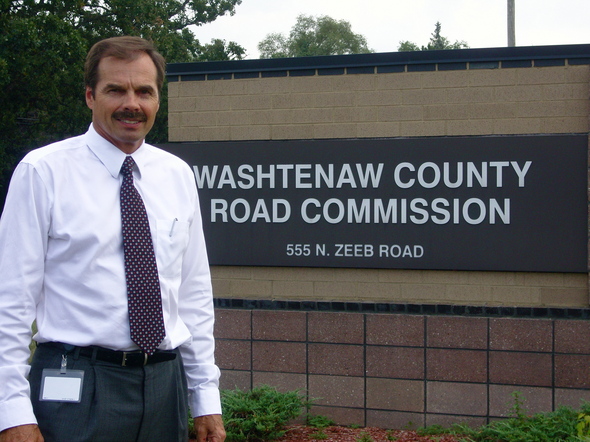
Steven Puuri is the Washtenaw County Road Commission managing director.
Heather Lockwood | AnnArbor.com
Ever wonder how road work is funded and how the Washtenaw County Road Commission makes decisions on which projects to undertake each year?
Steven Puuri, managing director for the Road Commission, sat down with AnnArbor.com to answer a few questions.
Q: How does the Washtenaw County Road Commission decide which projects will be funded?
A: Well, we start with a pavement evaluation and also, on the gravel roads, we rely on the recommendations of our operations department led by the foreman, who is in charge of a certain district. The paved roads first — we have annually been assessing the condition of the paved roads based on the state-established system of evaluating pavements. So every segment of pavement is given a rating (from 1 to 10).
Puuri added: Our staff uses those pavement evaluations, comes up with a balance between how much money is available, and what type of fixes would be appropriate to preserve the road conditions.
Q: How long is a segment?
A: Typically at least a half a mile, but it can depend on the condition of the road. If a road changes at a given point, that's usually where a new segment will start.
Q: Can you give an idea of the timeline over which this all takes place?
A: I'll use this this year as an example. We're going to be doing the pavement evaluations in October. We'll have a summary of those conditions through the late fall and winter months. Our board will be establishing a budget by the first of the year. And then through the course of the winter months, we will be developing maps like we did last year. We started out in March with a draft version of this (map) ... and by mid-May, we brought in all of the federal funds identified that would be available, and we identify the right fix and the needs of the roads with the amount of money we had. Some of the money, just as a little side note, is regionally distributed, but it comes to us in that fashion.
Puuri distinguished between funding for roads in urban and rural areas in the county.
He said: There's urban money right in this black line (points to map) - all the area outside of it is rural. So that's a limitation on what we can do out in the rural area, you know? We can't take urban money and move it to the rural, or vice versa. So, we try to get the most bang for our buck in the two areas.
Q: Is the pavement evaluation always done in October?
A: No, the pavement evaluation is not something we have total control over. To basically add more credibility to it, we have a person from the (Washtenaw County) Road Commission, a person from the Washtenaw Area Transportation Study, and a person from (the Michigan Department of Transportation).
MDOT comes down with a van with electronic support instruments in it, and the three people ride the roads and come to an agreement on what the evaluation will be of that given segment of road. This is done around the state, and clearly they can't do every mile, every year. The intent is to try to do every mile, every other year. So that over a two-year period, we have every road — city or village, county, MDOT — all evaluated. ... The (MDOT Asset Management Council) just put out a news release to all the legislators that describes the condition of the roads for every senate district and every house district.
Puuri added the individuals who conduct the pavement evaluation "drive every mile of federal aid (funded) paved road in the county. So they drive city, village, MDOT and the county road system."
Q: How much federal aid does the county receive for road work each year?
A: Not all roads are on the federal aid system. ... There's $4 million in urban (federal funds), but it's shared. The road commission won't get $4 million each year, we will get somewhere near about 45 percent of it. So we proportionally split that (funding among) the agencies. (Among) the road commission, Ann Arbor, Ypsilanti, Saline, Dexter, Barton Hills.
And then in the rural area, there's a companion pot of money, that's on the order of $350,000 a year, and that is shared between the road commission and the rural transit providers.
Those are the standard pots of money that come to the road commission, that kind of speaks to why in the rural area these (projects) are mostly crack sealing and chip sealing, because we can get a lot more resurfacing done. ... Most of the pavement, where there's asphalt pavement placed, is in urban areas because we had access to a bigger pot of money.
According to the county Road Commission, sealcoat, or "chip seal," is a cost-effective form of preventative maintenance used to preserve roads. The cost to sealcoat one mile of a two-lane road is $17,000, and it's expected to last five to seven years. That compares to $98,000 to pave one mile of a two-lane road with bituminous asphalt, which has a life expectancy of about eight to 10 years, according to the road commission.
Q: Is the county further subdivided beyond being either rural or urban, in regard to road work?
A: Well it is ... we just did a project along Ellsworth Road ... that was a road commission project and it was an urban project. Certainly Pittsfield Township was supportive of our advancing it, but that was our project.
Q: So really, it comes down to whether the project is in a urban or rural area, and then which agency is responsible for it?
A: Yes.
Q: How long is the process, from deciding which projects will be funded, to completion?
Puuri said preventative maintenance projects, such as sealcoat, are a "pretty short process." There is also a "five-year maintenance plan," which is updated annually and consists of projects that would each cost $100,000 or more to complete.
A: Every year we have money set aside to some pavement overlay, and this goes into pavement preservation ... and then we have this county-wide seal coat program. ... So our board has established this five-year capital improvement plan, and in addition, we have federal aid dollars that we pretty much count on. Every year, we reassess how many funding categories will be set aside in the upcoming five-year window of time. This has it's own process and schedule.
After we've worked all these out with the townships, usually what comes out of this is something that couldn't be accomplished. And starting in June, we update this plan once a year, and we say, 'Of those projects that are $100,000 or more that you would like to see accomplished, give us your proposals. And then we evaluate them, and we put them in, they end up in one of two places - they either end up on the funded list ... these are all funded in that five-year window of time, or, in this booklet is (also) an unfunded list.
Q: How significant of a role do gas taxes play in funding roads?
A: The full fund is called the Michigan Transportation Fund, it's made up of gas tax, diesel tax, and vehicle registration fees. The gas tax component is about 50 percent, registration fees are close to 50 percent, diesel tax is a very small percentage relative to the other two.
Puuri said the Washtenaw County Road Commission budget for 2010 was about $33 million.
He added: In this particular year, we're overspent. We're in the red. ... It was known coming into this year that we have to continue to reduce expenses to get this to balance. It's going to be something that is dealt with by our board this year. Are they going to reduce the capital improvement plan as one way? Are they going to reduce routine services — you know, road maintenance? Are they going to reduce staff? So far, we've reduced staff by about 17 percent, which ultimately reduces how much work we can do, too.
So the bigger picture of what's going on is we, like other road agencies, are seeing this pinch where costs continue to go up, we're not meeting the needs, so that's something we're falling further and further behind, and yet the revenue is just not there to keep up with expenses.
Q: What road work currently underway should people know about?
A: There's still about 20 percent of the preventative maintenance work that needs to be done.
(The Washtenaw County Road Commission plans to place 59 miles of sealcoat this year.)
We have a major intersection job going on at Carpenter and Willis (roads), and we're completing an intersection — that would be a widening and new signal at Carpenter and Willis (in York Township) — and there's some turn lanes and a signal being added at Rawsonville and Bemis (roads) that's ongoing but it's about complete.
(Last) week, we're completing and reopening the Dexter-Pinckney (Road) Bridge, it's been closed all summer, really since spring, so it's a big week for us getting that bridge reopened. It's a replacement of the old bridge, it increased the clearance so pontoon boats can get under it, and the road was built with a wider surface so there's some paved shoulders for walkers to walk across and bikers can get across more safely. There's a Geddes non-motorized path that is being built in Superior Township. Oak Valley Drive is a project that's going to be started after Labor Day, that's going to be a resurfacing and pedestrian crossing (in Pittsfield Township).
Q: How can residents lobby for road work to be done, express concerns, ask questions?
A: To our road commission directly. We have meetings twice a month, first and third Tuesday of the month at 1 p.m. People can send us an e-mail through our website, they can call us, if they can't be here, they can send a letter, and that gets presented to our road commission — so there's many different ways people can get their comments or requests in."
Q: Do you have any other final comments or thoughts?
A: I would just emphasize that we put a lot of effort into keeping our website up-to-date ... one tab called "road work" quickly leads you into either a listing of projects by township, or a map that shows all the major projects.
Puuri also encouraged area residents to follow the Washtenaw County Road Commission on Twitter.
Heather Lockwood is a reporter for AnnArbor.com, reach her at heatherlockwood@annarbor.com or follow her on Twitter.
Comments
flygande_jakob
Tue, Sep 7, 2010 : 9:39 a.m.
this was really interesting. thanks to annarbor.com and heather lockwood for doing the story.
Cash
Tue, Sep 7, 2010 : 5:15 a.m.
@AlphaAlpha, "Government employees today are upper class...and, by your assertions, should pay much higher tax rates. " That statement is absolutely false. We have government employees in higher ed in Washtenaw county that are considered low income and qualify for assistance. The fat cats at the top in government positions make too much, yes. The bottom makes peanuts, just like in the private sector. And this follows the Republican philosophy...let it trickle down. I'm still waiting for Reagan's trickle down idea to pan out 40 years later.
AlphaAlpha
Mon, Sep 6, 2010 : 10:29 p.m.
"it's time for the well-heeled to sacrifice some of that great excess of wealth they've amassed," Would you advocate higher taxes for those earning at the 90th percentile? How about the 94th? If so, then the public employees can be the first in line to pay higher taxes. Government employees today are upper class...and, by your assertions, should pay much higher tax rates.
Vivienne Armentrout
Mon, Sep 6, 2010 : 7:17 p.m.
Speechless for mayor, or maybe governor.
Lew Kidder
Mon, Sep 6, 2010 : 7:07 p.m.
To David Briegel & TruthMan: All decisions - whether on size, design, funding, timing, or the actual work itself - on segments of local roads which cross directly over (or under) portions of the interstate highway system are not within the jurisdiction of local authorities. The size of the Scio Church Road crossing was considered a mistake by local authorities - but what they thought didn't count. The pavement has indeed become terrible on the Ann-Arbor Saline Road crossing, but again, the timetable for repair will not be determined locally.
Speechless
Mon, Sep 6, 2010 : 6:58 p.m.
"... Property prices, property tax collections, wages, assets in general (other than cash), have all fallen in price recently, and the trend will likely continue... public wages will fall...." To follow on what Dave Briegel and EMRG wrote earlier, attacking the livelihood of county road employees, or the middle class in general, won't do much for our local roads in the long run. Taking such an approach involves aiming squarely at our collective feet and then choosing to pul the trigger. As David indicates, it's time for the well-heeled to sacrifice some of that great excess of wealth they've amassed, since they can't possibly live long enough, anyway, to spend it all on themselves — that would take centuries. As the high-end federal income tax rate has plummeted to 35% from 91% since the radical socialist days of the Eisenhower administration, bringing that rate even half-way back up to the level during Ike's presidency would go a long way toward significantly increasing the amount of federal aid available for road repair in Washtenaw County.
Speechless
Mon, Sep 6, 2010 : 6:45 p.m.
From the article: "...The cost to sealcoat one mile of a two-lane road is $17,000, and it's expected to last five to seven years. That compares to $98,000 to pave one mile of a two-lane road with bituminous asphalt, which has a life expectancy of about eight to 10 years, according to the road commission." Well, that brief passage certainly does much to help explain recent decisions to sealcoat paved roads nearer to the town. It can be hard to pass up the opportunity to patch roads for a fraction of the cost of asphalt paving. As this method of repair creates several months of seriously dangerous conditions for those riding motorcycles and bicycles in the immediate aftermath, it would seem the users of two-wheeled vehicle lost out when cost-benefit calculations were made. Leaving behind all that loose material afterward for cars and trucks to eventually pack down makes both types of cycling very risky, yet that seems to be considered a very worthwhile trade-off for all the money saved. For a year or more, the resulting dangers chase cyclists off some of the few remaining, relatively safe roads they can use when riding away from town. For motorcycles, the period of danger is likely much shorter, although even more frightening due to riding over the loose gravel near posted speeds. If nothing else, it'd be nice if the county applied some of the savings from sealcoating toward using road equipment to pack down all that gravel.
David Cahill
Mon, Sep 6, 2010 : 6:31 p.m.
Let me see if I understand the basic budget picture. The Road Commission's total budget is $33 million per year. It receives about $2 million of this from the feds for urban aid and a small amount of this for rural aid. Is the rest of the money from the Michigan Transportation Fund? That would mean about $30 million from this fund.
AlphaAlpha
Mon, Sep 6, 2010 : 4:13 p.m.
"Of course, pay cuts, whether in the private sector or in the public, means less money to spend, means less economic activity, means businesses seeing less income, means workers receiving pay cuts or being laid off. And so the vicious circle perpetuates itself. Talk about cutting off one's nose despite [sic] their face." When the alternative is bankruptcy, regretably, the choice must be pay cuts; all will suffer a bit so that all don't suffer a lot. In a credit collapse induced deflationary depression, the 'rules' we are accustomed to understanding and following are a bit different than the rules which are applicable during most of the economic cycle. Property prices, property tax collections, wages, assets in general (other than cash), have all fallen in price recently, and the trend will likely continue for several years before reversing. Like it or not, public wages will fall, either due to enlightened city management, or due to bankruptcy judgments.
AlphaAlpha
Mon, Sep 6, 2010 : 4 p.m.
Pay cuts in the public sector mean more money for the private sector to spend.
TruthMan
Mon, Sep 6, 2010 : 3:45 p.m.
For many years I have wondered why the main entrance to the city of Ann Arbor, Main Street or Ann Arbor/Saline Road, at the intersection of I-94, has been left to deteriorate to the point where it is one of the worst sections of road in the county. It is THE MAIN ENTRANCE TO THE CITY!!!!!!!!! The largest crowd ever to see a football game just drove over that intersection. Every day thousands of people commute over it. And it is nothing but potholes that have been patched and repatched for at least a decade, if not more. I would like to know when that section of road, from Eisenhower to Lohr Road was last resurfaced, and why it has been left to languish for so long unattended. IT IS THE MAIN ENTRANCE TO THE CITY. Please give it a new surface!!
David Briegel
Mon, Sep 6, 2010 : 3:26 p.m.
stunhsif, Similar to my situation. The sad part of it is that the ruling class keeps it all to themselves as they gut the business and pick the carcass of the middle class. History will record that it was that same middle class that was the Goose that laid the Golden Eggs! Henry Ford understood that as economics 101. How much "innovation and technical genius" does it take to move the "engine of our economy" to China? Oh, it's for the child labor, slave labor and prison labor, plundering the natural resources and polluting the environment. You know, America's contribution to "civilization"! Our Values! It is reasonable to ask for shared sacrifice in times like these. I don't see much sharing from the top end. They won't even pay the same amount as they paid under Reagan or Clinton. Please cut their taxes more! Ghost is correct on this one. The downward spiral as we consume ourselves and our neighbors! Vicious circle, indeed!
stunhsif
Mon, Sep 6, 2010 : 1:16 p.m.
DB said : "stunsif, what have you given back" I paid around 25 grand last year in taxes, excluding property taxes. Make that an even 30 grand with property taxes. What have I given back? David, I've given a lot back to help keep my company in business. No pay raise in 4 years, no more 401K contribution from the company I work for, doubling of my weekly pay toward healthcare to just under 80 bucks a week and on top of all that a 5% paycut for the past year and a half. That is why I believe it is reasonable for public sector workers to give back and take cuts like the rest of us have taken to help keep their employer's ( the taxpayers in business). By doing this, they can help reduce the number of their fellow workers that will have to be laid off though with the way the economy is, more layoffs will happen despite givebacks because we have not yet seen the worst of things in this state.
AlphaAlpha
Mon, Sep 6, 2010 : 12:16 p.m.
"so far, we've reduced staff about 17%, which ultimately reduces the amount of work we can do, too." Average 2010 total compensation for WCRC employees: $91,182. Adjusting their pay to the US average of ~$58K would save over $4.5 million/yr. According to the 2010 WCRC budget, compensation is distributed like this: 89 Operations folks share $4,761,000 = $53,494 each + $33,832 extra = $87,327 total 2010 compensation 39 Engineers share $2,330,000 = $59,744 each + $33,832 = $93,578 total 9 Administrators share $766,000 = $85,111 + $33,832 = $118,943 total. The $33,832? 137 WCRC folks share $4,635,000 in benefit compensation averaging $33,832 each. These figures are summaries; a few smaller line entries were omitted for clarity and brevity; their inclusion would result in compensation levels marginally higher than those shown above. Commissioner token compensation was excluded as well. Normalizing compensation would save the county ~ $4,500,000 each year, enough to pay for many overdue projects. All that is needed is political will to deliver competitive wages.
Cash
Mon, Sep 6, 2010 : 12:09 p.m.
For the 10,000,000 time....North River St at Clark Rd. People drive on the grass because the road is impassable. Nuff said.
David Briegel
Mon, Sep 6, 2010 : 10:29 a.m.
How did you decide to replace the bridge at Scio Church/I94 with a traffic clogging 2 lane rather than a 3 or 4 lane? You had to have known the volume from Oak Valley/Maple would clog the intersection. Especially with the under road signals. One small break between two vehicles and the light changes. These are problematic at many intersections.
David Briegel
Mon, Sep 6, 2010 : 10:25 a.m.
stunhsif, what have you given back?
stunhsif
Mon, Sep 6, 2010 : 9:39 a.m.
"so far, we've reduced staff about 17%, which ultimately reduces the amount of work we can do, too." Rather than cut more staff or raise taxes, how about cutting staff pay 5% to 10% and reduce their "cadillac" benefits to match the private sector. It would seem the unions would want to protect their brothers jobs rather than seeing more of them get cut. Reasonable givebacks in this day and age are the right thing to do for everyone, the public sector employees and the taxpayers.