

Ann Arbor weighs termination of RecycleBank contract
Eleven months into its existence, a rewards program that encourages Ann Arbor residents to recycle is in a fight for its life and must prove its worth to city officials.
The Ann Arbor City Council is contemplating axing the program provided by New York-based RecycleBank, which costs the city about $150,000 a year.
"I question if it's right for Ann Arbor," said Mayor John Hieftje. "I think we gave the program a try and I don't think it's going to work to the extent it's worked in other communities."
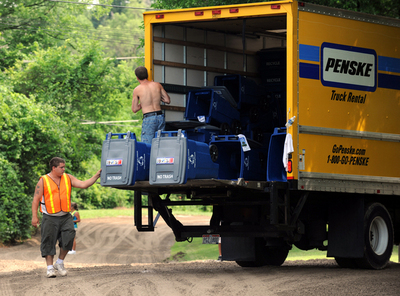
RecycleBank operates rewards programs in more than 300 communities across the country, including three cities in Michigan. It was rolled out in Ann Arbor on Sept. 1, 2010, two months after the city switched to a new single-stream recycling system.
RecycleBank incentivizes recycling by rewarding residents with points that are redeemable at retail outlets and restaurants.
Since its launch, the program has encouraged more than $240,000 in spending at local businesses through rewards coupons, which have helped residents in Ann Arbor save about $80,000 on purchases, said Scott Lamb, chief operations officer for RecycleBank.
"We believe for the $150,000 it costs to run our program that we've provided more than that on an annual basis in terms of value to the city and value to the constituents," Lamb said.
Weighing the issue
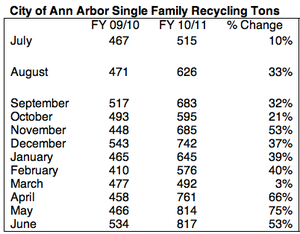
Since the launch of the RecycleBank program, recycling tonnages collected in Ann Arbor have ticked up, but some council members, including Sabra Briere, D-1st Ward, question how much RecycleBank had to do with producing those results.
Briere said none of the data she's seen so far proves for a fact that RecycleBank — and not merely the switch to single-stream recycling — is changing recycling behavior. She posted a survey online on Thursday to find out what residents think of the program.
The RecycleBank rewards program is available right now only to single-family homes and duplexes in Ann Arbor. Lamb said the city asked RecycleBank to delay deployment to multi-family units — such as apartment buildings — for a year or two due to budget constraints.

Scott Lamb
Earlier this week, the company released the results of an analysis that looked at September 2010 through January 2011, compared with a year earlier. It showed stronger growth in single-family recycling (36 percent) compared with multi-family and commercial (11 percent).
"We do know there's a correlation between signing up for our program and recycling more often, and that will translate to higher tonnages," Lamb said.
Lamb said the average single-family household in Ann Arbor was recycling about 500 pounds of material per year before RecycleBank launched. Now that figure has gone up to about 680 pounds per household per year, he said.
In addition, RecycleBank has identified Ann Arbor households that have signed up for the rewards program set their recycling carts out for collection about 73 percent of the time, while households not signed up set their carts out a little over half the time.
Briere said she's still not convinced.
"People who are dedicated recyclers sign up for RecycleBank but are already dedicated recyclers," she said. "So the fact that they put their carts out every week doesn't mean they're putting their carts out every week because of RecycleBank."
While the growth in single-family tonnages can't be fully attributed to the rewards program, it likely had a strong influence, said Tom McMurtrie, the city's solid waste coordinator.
McMurtrie said there appears to be a correlation between RecycleBank registration rates and tonnages collected, which suggests the program is working.
He's asking the council to hold off next week on canceling the RecycleBank contract until city staff has more time to evaluate what impact the program is having on recycling behavior and tonnages collected. McMurtrie said he also wants to conduct a city-wide survey asking residents what they think about the program and report back to council in December.
"We really haven't done any surveying yet," McMurtrie said. "The initial signs are encouraging, but I think we'd like to find out from the public if RecycleBank is having an impact on their recycling behavior and if they're recycling more because of RecycleBank."
Balancing the books
The RecycleBank program wasn't on the chopping block until council members were presented with information earlier this month that showed the city's new single-stream recycling system wasn't working out quite as planned. While recycling had increased 20 percent since last July, the total tonnages collected were still 40 percent below expectations.
As a result, the council has been asked to approve a $107,000 increase in annual payments to Recycle Ann Arbor, the nonprofit group responsible for curbside collection of recycling carts.
The over-projections and subsequent shortfalls have left a $337,527 hole in Recycle Ann Arbor's budget. And some council members see canceling the contract with RecycleBank as a way of balancing the city's books while helping Recycle Ann Arbor.
Though it was a company called Resource Recycling Systems that originally presented the business case for single-stream recycling to the City Council in October 2009, city officials say RecycleBank provided some of the data used to make the overly optimistic projections. But RecycleBank says it wasn't involved in making any of the overall tonnage projections.

John Hieftje
Hieftje said the fact that nearly half the city's residents are renters and many of them are transient — such as University of Michigan students — makes Ann Arbor a less than ideal candidate for a program that rewards households for how much they recycle.
"We need to find another method to increase recycling rates in those multi-family units, particularly with education," he said. "And I question whether RecycleBank is the way."
But there are costs involved with canceling the contract.
Before launching the rewards program in Ann Arbor, RecycleBank assumed the $150,000-plus upfront cost of affixing radio-frequency identification tags to recycling carts and installing technology on recycling trucks to read those tags and track recycling behavior.
The city and RecycleBank are now one year into a 10-year contract. If the city breaks the contract now, it would be required to pay a $120,000 penalty fee to RecycleBank to help recoup some of those costs. There is no penalty for canceling after the third year.
Continuing outreach
Figures provided by the city show just short of 10,000 households — out of nearly 24,000 — had signed up for the RecycleBank rewards program by May, about a 42 percent subscription rate. RecycleBank's goal has been to get 50 percent signed up by Sept. 1.
But he said RecycleBank continues its work to educate residents and get them signed up. So far this summer, RecycleBank has added nearly 1,000 new members to the program.
Lamb said RecycleBank has partnered closely with the city on outreach efforts that have ranged from door-to-door member sign-ups to tabling events at festivals and other places.
RecycleBank also has recruited 39 rewards partners for the Ann Arbor program. To date, Lamb said, more than 13,000 rewards have been redeemed — and about half of those have been at local establishments, as opposed to national retail partners.
The top local rewards partners include Zingerman’s Deli, Plum Market, Elephant Ears, Arbor Farms Market, the People’s Food Co-Op and Downtown Home & Garden. Other partners that have benefited from recycling rewards include Arbor Brewing Co., WeCare Organics, Buhr Park Pool, Green Pawz Pet Supplies and Whole Foods Market.
In response to a request by AnnArbor.com, RecycleBank provided five examples of actual rewards coupons residents have earned for recycling:
- 15% off any purchase at Plum Market
- $5 off $25 or more at People's Food Co-op
- $25 off $50 or more plus a reusable tote bag at Elephant Ears
- $2 off $15 or more on any purchase at Arbor Farms Market
- $10 off $50 or more at Downtown Home & Garden
Briere said the $120,000 penalty fee the city would incur if it broke its contract with RecycleBank now is still less than what the city would pay if it waited two more years until there was no penalty. She said she's not swayed by RecycleBank's claims about economic impact.
"The whole purpose of doing this is that it's an incentive program. It's not an economic investment program," she said. "This is not about getting people to spend money by spending those coupons. It's supposed to be an incentive program that increases recycling."
Ryan J. Stanton covers government and politics for AnnArbor.com. Reach him at ryanstanton@annarbor.com or 734-623-2529. You also can follow him on Twitter or subscribe to AnnArbor.com's e-mail newsletters.
Comments
Aaron Wolf
Sun, Jul 31, 2011 : 5 p.m.
Recyclebank is a total waste of money. Making recycling about personal gain is completely irresponsible. Recycling needs to be about RESPONSIBILITY. As soon as you make it about personal rewards, then it becomes calculated: "is the Recyclebank coupon worth the time to think about recycling?" We do NOT want citizens deciding to recycle based on what is in it for them. People need to recycle because it is their DUTY to be responsible citizens and not throw recyclables in the trash. We need to SHAME people who do not recycle. Now that the single-stream system makes things so convenient, there's no excuse not to recycle. Recyclebank is an obnoxious marketing scheme. I can't believe that we PAY for it. What an atrocious waste.
Dog Guy
Sat, Jul 30, 2011 : 7:14 p.m.
Hieftje is the man behind the curtain at Recycle Ann Arbor as well as at DDA. The rule appears to be that if tax money is silently floating away, hizzoner's is the invisible hand. Who controls those who spread around the greenbelt slushfund? Who decides what charities to which we all shall contribute? Who decides what candidates are nominated? Ann Arbor has progressed predictably from one-party rule to on-person rule. How very efficient this system is.
Mick52
Sat, Jul 30, 2011 : 6:31 p.m.
My $.02 on this is: Was this program properly promoted? When implementing a new program/policy where it's success depends on wide use, it should be promoted so that people are aware and then can at least review it and make a decision. The comments that point out that the benefits are not worth the effort are interesting. If that is true, why make the effort? The "rewards" noted are iffy. I don't use any of the businesses listed. Ten dollar itunes card is attractive to me, (should be ten songs since they hiked up to $1.29 for many songs) but not a $10 Best Buy card unless I was planning on buying something there and I don't because of their restock policy.
Kai Petainen
Sat, Jul 30, 2011 : 6:13 p.m.
"Hieftje said the fact that nearly half the city's residents are renters and many of them are transient — such as University of Michigan students — makes Ann Arbor a less than ideal candidate for a program that rewards households for how much they recycle." Good point.
David Paris
Sun, Jul 31, 2011 : 1:55 a.m.
Absolutely! Since the University has only been here since 1837, I can see how it could be overlooked. However, I am surprised that the RecycleBank consultants let that one slip by, but they were probably just hoping that nobody would notice. (No offense Kai, I was just trying to facetiously point out a glaring error by our elected & appointed officials ; ) )
Jon Saalberg
Sat, Jul 30, 2011 : 5:54 p.m.
We have used the RecycleBank discounts a bit, but there are significant shortcomings, in my opinion: 1) The system is wholly un-Mac friendly, which seems absurd in a town that certainly has a much larger percentage of Macs than most cities. 2) If I cannot print a coupon, I have to have it snail-mailed to our home, which takes TWO WEEKS. That is an absurd amount of time to wait for a coupon. 3) The benefits have not significantly changed. And a pretty good one, a "buy one, get a similar pizza free" offer from Cottage Inn was promptly yanked after one month, I assume due to too many people taking advantage of the coupon.
Jojo B
Sat, Jul 30, 2011 : 1:44 p.m.
I have to admit that I must have been living under a rock. I didn't even know there was a RecycleBank program, but judging from the comments here, it sounds like I'm not missing much. So fine by me to get rid of any useless recycling for discounts program, just PLEASE KEEP THE SINGLE STREAM RECYCLING PROGRAM!!! Making it easy makes people do it and A2 can be proud for trying to be one of the greenest towns in the area. I don't need any 15% discount at Plum Market.
snapshot
Sun, Jul 31, 2011 : 3:06 a.m.
The two bin system was working just as well as single stream. The "single" stream recycle project IS the problem.
snapshot
Sat, Jul 30, 2011 : 1:37 p.m.
I think this is another example of mismanagement of taxpayer dollars due to conflict of interest positions, good 'ole boy contract and consulting awards, and a lack of accountability for public employees and officials. Now the County is considering the same type of program.
Brad
Sat, Jul 30, 2011 : 11:57 a.m.
No problem - just pay them off with $120K from the FAIL bucket. It always seems to be full.
HappySenior
Sat, Jul 30, 2011 : 11:34 a.m.
I seem to remember from several college 101 classes that "correlation does not prove causation." I wish more people had learned that. In the 40s, my parents saved metals for the war effort. I remember going door-to-door collecting newspapers in the 1950s when recycled newsprint was $.02 per ton. We did it for the money. We got earth conscious when Rachel Carson's book came out in 1962. We saved our recycles and drove them to the nearest collection point and those bins got emptied on a set schedule. There was a "cause" behind our efforts. Shopping is not a cause. Recycling so you can buy more stuff seems counterproductive on its merits. The coupon concept is a marketing scheme that intrigues fewer people as time goes on. The commenter who pointed out that the coupon is no better than the advertised on-sale price. It reminds me of the take-a-survey-for-money scam that turns out to be thousands of points earned can be exchanged for a percentage off on select merchandise. In 2009, as reported by annarbor.com [<a href="http://www.annarbor.com/news/city-council-considers-single-stream-recycling-proposal-monday-evening/">http://www.annarbor.com/news/city-council-considers-single-stream-recycling-proposal-monday-evening/</a>]: "Traditionally, tipping fees for hauling trash have been low in Michigan, but are expected to rise as landfill space becomes scarce in coming years, said Mayor John Hieftje. Finding ways to reduce overall waste disposal fees by diverting more trash would be a benefit, he said." The mayor isn't wrong on this point, but he and the Council were wishing rather than analyzing. Signing a 10-year contract may not have been the smartest move on the city's part. Good money chasing after bad money is just dumb. Hindsight is 20-20. "Briere said the $120,000 penalty fee the city would incur if it broke its contract with RecycleBank now is still less than what the city would pay if it waited two more years until there was no penalty. " City Council should pay the $120,000 and get out of the contract.
treetowncartel
Sat, Jul 30, 2011 : 4:19 a.m.
I recylce for those that will walk this wonderful planet whenI am 6 feet under.
John B.
Sat, Jul 30, 2011 : 2:58 a.m.
"Since its launch, the program has encouraged more than $240,000 in spending at local businesses through rewards coupons, which have helped residents in Ann Arbor save about $80,000 on purchases, said Scott Lamb, chief operations officer for RecycleBank. "We believe for the $150,000 it costs to run our program that we've provided more than that on an annual basis in terms of value to the city and value to the constituents," Lamb said." Personally, I don't believe these numbers any more than any other numbers/projections that RecycleBank has provided previously. It's sounds like more phoney-baloney to me, sorry.... Terminate that contract ASAP (would be my recommendation). Make darn sure that the only termination costs are that $120K number, and then be done with them. Don't make additional bad decisions on top of what now seems highly likely was a bad decision. Let's move forward, and not waste any more money.
MyOpinion
Sat, Jul 30, 2011 : 12:50 a.m.
First, kudos to Pat Lesko for her analysis of RAA. She was a lousy mayoral candidate, but does a good job of digging out details. I like single stream recycling, but mostly for lazy/convenience reasons: (1) I don't have to worry about putting out newspapers, etc on rainy days (2) I recycle more paper than cans/glass so I just mix my products in my old totes and take them to my big bin once a week. (3) I am a homeowner so the giant cart is not an issue for me (4) I put out my bin when it is full; not every week to gain rewards (5) I never signed up for rewards; it goes against the philosophy of using less, being aware of packaging etc. when I buy products; trying to consume less Have I increased my recycling? Yep. But, not proportional to the amount the city is paying for this contract. I think I'm pretty typical.
Carolyn
Sat, Jul 30, 2011 : 12:03 a.m.
I find the RecycleBank program pretty much useless and it did not in any way incentivize me to recycle more than I had in the past (other than taking advantage of the increase in types of plastics that are now collected). NOW, I read that in order to discontinue the RecycleBank progam the city would have to pay a penalty of $120,000. Unbelievable. I wasn't really happy when we went to single stream since by keeping recyclables seperate, the overall monetary value is more and then there was the huge cost to switching over to new bins, etc. And now, we get to pay more in penalties. UnBeLIEVABLE.
Susan Beech
Fri, Jul 29, 2011 : 11:49 p.m.
I have not used the Recycle Bank rewards at all. I have not found anything that is worth "purchasing" with my rewards. I guess that if you are a recycler you will recycle whether or not you get the points. I am a recycler. I am proud that I separate my trash from my recycles. It is not that hard, and it is a small thing I can do to keep the earth in better condition for my children, and grandchildren.
Patricia Lesko
Fri, Jul 29, 2011 : 10:02 p.m.
Ryan, You write: "The over-projections and subsequent shortfalls have left a $337,527 hole in Recycle Ann Arbor's budget. And some council members see canceling the contract with RecycleBank as a way of balancing the city's books while helping Recycle Ann Arbor." You are repeating what Michael Garfield claimed in a recent Ecology Center email, and what city staffers presented as a convenient story to Council in July. A2Politico asked an accountant to examine Recycle Ann Arbor's 990 tax returns and most recent audit from the Michigan Attorney General's office. The financial statements, audits and tax documents reveal a completely different story. RAA has lost $700,000 in the past 3 years alone. The loses were triggered by RAA's purchase of Calvert's assets in order to get into the roll-off cart business. It was an investment that has forced RAA to write off several hundred thousand dollars. The contract with RAA costs taxpayers $800K more per year to have RAA employees pick up 30K recycling bins than it does for city employees to pick up 28K garbage bins. Elected officials entered into a no bid contract with a company whose financial statements showed quite clearly it had been losing money hand over fist. The RAA Board (on which Garfield sits) gave the RAA CEO Ms. Uerling hefty raises in each of the previous 3 years in which RAA lost money. That's not sound management or board oversight. Now, Garfield wants a taxpayer bailout for RAA. To view the forensic accountant's analysis of the Recycle Ann Arbor finances visit this link: <a href="http://www.a2politico.com/?p=9464" rel='nofollow'>http://www.a2politico.com/?p=9464</a>
unrulyfan
Sat, Jul 30, 2011 : 12:10 a.m.
Pat, could you please post the audit, the name of the CPA, and the documents you used to make such an evaluation.
tomnspats
Fri, Jul 29, 2011 : 9:55 p.m.
The first problem I see is the city using consultants to start this whole program.They are clueless yet we all know the city will pay them over and over again.Next time ask me I will give you a guess for free.Then Mr. Mayor you can use that money to keep our firefighters and police on the job.
Tom Whitaker
Fri, Jul 29, 2011 : 9:29 p.m.
"Lamb said the average single-family household in Ann Arbor was recycling about 500 pounds of material per year before RecycleBank launched. Now that figure has gone up to about 680 pounds per household per year, he said." First off, households do not "recycle." Households put material out at the curb on blind faith that it actually goes someplace to be recycled--that is, made into new products. Secondly, the amount of material collected at the curb is not the same as the amount recycled. Where are the figures on how much material collected as recyclable was actually recycled? How much went to the landfill anyway due to contamination, lack of a buyer for the material, etc.? I'd like to see this figure for both before and after implementation of single stream. Have we just shifted some of our landfilled waste collection from one bin to another? Third, because Recycle Bank and single stream were both initiated at the same time, who's to say that the entire increase in collection was not attributable to the new additional types of materials accepted by the single stream program and NOT the Recycle Bank incentives? This is the kind of data misrepresentation that was used to sell single stream and Recycle Bank to Council in the first place. Ann Arbor had a very high recycling participation rate beforehand. Has that improved? That data could be very informative. Lastly, in terms of RAA, how is it that a company hired to collect material on a per ton, per cart basis (using City-owned equipment) did not see a corresponding decrease in costs when they collected fewer tons and fewer carts? I hear the City refuse collection is more cost efficient than RAA. Why not keep this service in-house? Clearly privatization is not always the answer to City budget problems.
Carole
Fri, Jul 29, 2011 : 8:30 p.m.
Recycling has been a part of my life for many, many years. Placing a recycling bin on the curb on trash day was as easy as 1,2,3 -- trash and recycled stuff gone poof. What behooves me with this whole ordeal is 1) why did the city even consider much less enter into a contract with an out-of-state company? I believe strongly that our city dollars should be spent within at least the state. 2) Why not instead provide those funds to Recycle Ann Arbor to continue doing the work that they were already doing ? Now, Recycle AA appears to be in arrears and it would cost the city $120,000 to break it contract with the out-of-state contractors. In my opinion, just another way for the city to waste the tax payers dollars. Support recycling and support Recycle AA.
Carole
Sat, Jul 30, 2011 : 1:16 p.m.
I did and "it makes me ill" is the definition that I chose although there are many to choose from. Thank you for your comment.
John B.
Sat, Jul 30, 2011 : 2:49 a.m.
Carole, it would behoove you to look up the definition of the word 'behoove.'
Allen Leibowitz
Fri, Jul 29, 2011 : 8:27 p.m.
Could you fix the survey to allow for answers AND comments?
Sabra C Briere
Fri, Jul 29, 2011 : 8:50 p.m.
Sorry - it's a one-answer-per-question survey. BUT I'll read all comments and tabulate the answers (if someone gives a response and a reason, I'll record the response). I'll also provide the raw data to anyone who wants to see it. Sabra
Brian Kuehn
Fri, Jul 29, 2011 : 7:45 p.m.
Hindsight is always 20:20. Still, was it that hard for the City officials that approved purchasing the incentive plan to see that the program would fall short of its promises? It takes about 12 months of point accumulation to qualify for a $10 gift card for Best Buy or iTunes. Does anyone think that a $10 gift card at the end of the year is going to modify anyone's recycling behavior? It seems the one behavior the RecycleBank system encouraged was the counter productive practice of putting out the recycle bucket every week whether there was anything in it or not. It is time to put an end to this program, assuming the buy-out really is $120,000*. Chalk this up as an idea that didn't work and move on. The $150,000 annual savings certainly can be used for something more beneficial to the City. * My fear is that someone will now read the fine print and discover that the buy-out cost is much more than anyone thought.
Robert
Fri, Jul 29, 2011 : 7:21 p.m.
I find the talk about stopping the RecyleBank Rewards frustrating and disappointing. There are benefits like $10 gift cards but you need to bank points. I'm currently 100 points shy of 2500 to get a Best Buy Card. I recycle and will continue without rewards. Just Don't offer incentives and then pull them before people have had a chance to redeem them.
deb
Fri, Jul 29, 2011 : 8:07 p.m.
just curios, how long to rack up that many points?
HPD
Fri, Jul 29, 2011 : 7:19 p.m.
I first heard about the Recycle Bank program when I was asked to be in a focus group prior to the 1-cart-to-fill recycle program began. The concept appealed to me, but in practice I don't see any value in it for me. If I could earn a free item it would, but to get $1 off some grocery store product or an already-available-elsewhere discount at a local business has no value to me. When I sold coupon advertising years ago, we talked in terms of what kind of deal would get someone off the couch. Recycle Bank deals don't do it, especially in the context of Groupons, Living Social, restaurant.com etc. Todays context makes Recycle Bank's approach obsolete.
Jeff Gaynor
Fri, Jul 29, 2011 : 7:17 p.m.
I had originally thought that RecycleBank paid Ann Arbor to use their program. Sigh.
Alice Ralph
Fri, Jul 29, 2011 : 7 p.m.
Being veteran recyclers and re-users at our house, the single-stream program took some getting used to, but we do put our recycle cart at the curb for every pick-up day, just like we did with the old bins. (We also compost, so we don't put our trash cart out every time.) I signed up for Recycle Bank only to qualify for the coupon for free entry to the drop-off facility. The website said "It's so easy" and it was one of the mostly ghastly (okay, unwieldly) registrations ever. Then, the free [$3] entry coupon was not available for weeks, if not months. And, it is still hard to find among the other rewards, which are of no interest to me. And, only two per year per household. Why not just use free entry to the drop-off facility as incentive? No extra cost. Or print a coupon on the tax bill that pays for our solid waste program. Thank you for recycling... Ann Arbor has been pretty good about recycling in the past. We can do better. In fact, whatever happened to the "reduce" part of the three R's--reduce, recylce re-use? What about that plastic shopping bag ban? What about commercial composting for the biodegradable plastic products that are now being used? And what about those plastic lids on the re-usable milk bottles? I just can't seem to get around to making them into a room divider or a bathroom wall hanging, etc.
jns131
Sat, Jul 30, 2011 : 3:29 a.m.
When I read about a convent in Montana who recycle more then we do, I was ashamed. After reading that article, I now look at every single thing we open in the kitchen, use in the bathroom and laundry and anywhere else we can to make sure we are recycling everything. Ypsi told us if we take apart our old appliances they will take them. How wild is that? I think we recycle more than anyone I know. Sometimes we have no trash on our pick up day. But end up borrowing the neighbors recycle bin because ours over flows. Congrats on a good recycle home.
glenn thompson
Fri, Jul 29, 2011 : 6:49 p.m.
Recyclebank is simply a coupon marketing scheme that costs the city Ann Arbor and only profits recycle bank. Mr McMurtrie has been managing the contract for nearly one year but now states he needs more time to evaluate it. That does not demonstrate good oversight of the contract. Council should be very careful that any delay does not obligate the city for another full year. Of course people that participate in the Recyclebank program put their carts out more frequently that others. Putting a cart out every week with only a few items in the cart generates more "rewards" than waiting until the cart is full. Unfortunately this also increases the collection cost. Time is spent, fuel is burned every time the truck stops to lift a cart. Council should terminate the Recyclebank contract before it costs another $150,000. Council should also review the Recycle Ann Arbor contract. I believe that it is possible that Recycle Ann Arbor does not need additional funds if there is no longer a motivation for citizens to place partially full carts out for collection.
Rob T
Fri, Jul 29, 2011 : 6:42 p.m.
The truth is that RecycleBank rewards just aren't that rewarding. 15% off at Plum Market is no better than you'd get in the store's circular, so I wouldn't consider it a powerful incentive to recycle.
Jon Saalberg
Sat, Jul 30, 2011 : 5:49 p.m.
The next time you receive one of those circulars, I think you will see that the discount is 10%. If you are a Rewards member, I think the discounts are more.
breadman
Fri, Jul 29, 2011 : 6:32 p.m.
Just do not belive it! they are talking about this program already... My daughter moved and where she moved too does not have a recycle program. So she has a big tote out side her door that fills up every week and fills my tote when she comes to visit. And saves her on trash bags. Then recycle picked up it took much more numbers in the plastic which was nice.
glenn thompson
Fri, Jul 29, 2011 : 6:53 p.m.
Terminating the Recyclebank program would not have any effect on the collection of the recyclables.
xmo
Fri, Jul 29, 2011 : 6:29 p.m.
Failure is a Resume enhancement for Liberals and this looks pretty good on the Mayor's and City Council member's resume!
David Paris
Sun, Jul 31, 2011 : 2 a.m.
As a Former Republican I assure you, you have no idea what you're talking about. I know, I've been on your side of the aisle, and right now it is FUBAR!
aes
Fri, Jul 29, 2011 : 6:20 p.m.
Thank goodness! This idea of changing behavior by rewarding for increased recycling is childish, counterproductive, and completely environmentally incorrect. The satisfaction that comes from reducing/reusing/ recycling should be its own reward for civic-minded individuals. On should use less so one has less to recycle.
beau
Fri, Jul 29, 2011 : 5:52 p.m.
First, let me preface this by saying I'm rather ambivalent about the RecycleBank program as I was an avid recycler beforehand. This program has not changed my behavior one bit, but I can see how some might be enticed by the rewards program (which I have no interest in). What concerns me are statements like the following: "In addition, RecycleBank has identified Ann Arbor households that have signed up for the rewards program set their recycling carts out for collection about 73 percent of the time, while households not signed up set their carts out a little over half the time." This is a very POOR way to evaluate the effectiveness of the RecycleBank program (or any recycling program). Many people who care about recycling also care about reducing their consumption of goods... which means they have less to recycle. I know many people in AA (myself included) who purposely wait to put their recycling at the curb until the cart is full, as it reduces the number of times the trucks have to stop and idle. I would also bet that many of these same people don't feel the need to be "rewarded" for doing something that seems like the right thing to do. I hope as this issue moves forward that City Council will consult some outside experts in waste management and behavior change. It seems this program is in dire need of someone who understands how to properly evaluate a program (and someone who doesn't have a conflict of interest, like Mr. Lamb).
Stan Hyne
Sun, Jul 31, 2011 : 2:32 p.m.
I recycle, although I am not convinced it has a cost based value. I program with possible rewards is a waste of time and money. I put my cart out when it is full. It would be stupid in both cost and effort to put it out every week.
Tom Whitaker
Fri, Jul 29, 2011 : 9:09 p.m.
beau is on the right track. The only reason people who've signed up for the incentive program put their carts out more often is that they only accumulate points when they do so. The chips in the carts are used to record which households' carts were emptied each week. Households that put their carts out are then included in that week's divvying up of points based on the total weight of material collected in that neighborhood that week. If you don't put out your cart, you will not get points. On the flipside, you could put an empty cart out each week and still collect points based on the neighborhood average assigned to your household. Also, putting out material to be collected at the curb is not recycling. Recycling is what happens when old material is made into new products. Where is the data on material actually recycled before and after the single stream program, that's what I'd like to see.
Ben Connor Barrie
Fri, Jul 29, 2011 : 5:31 p.m.
My $0.02: I think convenience is one of the biggest barriers to recycling. In Ann Arbor taking out the recycling is as easy as taking out the trash. You just take your two lil' toters to the curb on "trash day." Incentivizing environmentally responsible behavior is important, but I've never really felt like the RecycleBank prizes were worth the hassle of creating an account and learning how to navigate another website. The convenience of curbside recycling in Ann Arbor is sufficient incentive for me to recycle.
jns131
Sat, Jul 30, 2011 : 3:23 a.m.
That is interesting because in Ypsi they won't take #6 recycle yet they take the 3. I guess there is a difference in recycling. I just wish my neighbors did more then we do.
Greg M
Fri, Jul 29, 2011 : 5:46 p.m.
Yes, and frankly with single-stream now it couldn't be much easier. All they need to do is slowly remove the exceptions (#3 plastic, lids, etc) as it makes financial sense to do so. In our house we're already recycling more than 50% of our weekly waste with very little effort. RecycleBank seems like a gimmick to me - lots of extra effort for little additional upside. Take the savings and rehire some police officers, or use it to remove the last of the recycling exceptions to drive up the convenience.