

Ann Arbor school district's total revenue debated
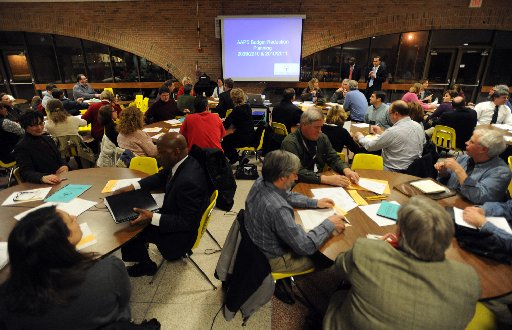
Parents, teachers and school board members gather for a recent Ann Arbor school district budget town hall meeting at Huron High School. Melanie Maxwell | AnnArbor.com
It seems like a simple question: How much money does the Ann Arbor school district have to spend each year?
But coming up with an answer everyone agrees on can be surprisingly tough.
Some think the district should count every dollar in revenue in every fund toward that total figure.
Ask district administrators that question and they’ll focus on the general fund: about $181.2 million.
But ask the same administrators a few questions and you'll learn about additional revenue they get through things like federal grants and how they're able to use that to supplement the general fund money. That elevates the total budget by $53.4 million.
The difference, they say, is that they control the general fund - and those other revenue streams can only be used for certain projects or programs.
The issue of district spending - and overall revenue - has surfaced in recent months as voters turned down a countywide schools millage and the state cut hundreds of dollars in per pupil funding slated to go to the district.
Administrators are currently working to slice $20 million from the district's budget - 11 percent of the general fund or 8.5 percent of the total revenue, depending on which figure is used.
The big picture
The money the district spends can be divided in a number of ways, but if you throw it all in one big pot, you’ll end up with slightly more than $234.6 million spent by the district in the 2008-09 school year.
That includes the general fund, the 2004 bond fund, the 2006 bond fund, the 2008 bond fund and a grouping of funds the district calls the non-major governmental funds.
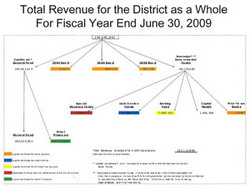
The district spent $195.5 million in the combined general fund in 2008-09, records show. That included the $181.2 million general fund that pays for the day-to-day operations. The other component of that combined general fund is a $14.2 million fund made up of grant revenues.
The district also uses money from three different voter-approved bond program funds. Those funds - which were a combined $804,944 in 2008-09 - can only be spent on items allowed by state law, including construction of buildings.
The district's revenues classified as "non-major governmental funds" are made up of special revenue funds, debt service funds, the sinking fund, capital needs and prior years bonds. That’s another $38.3 million.
“It seems to me that if you’re talking about how much money the school district can spend, you should include all that money,” said parent Philip Dale. “The district chose to ask voters for the bonds and are using money to repair buildings that would have come out of the district’s operating (general) fund to make some of those upgrades.”
District officials say if voters had turned down those special bonds, they wouldn't have embarked on several projects that money is paying for - like building Skyline High School.

Spending it
The disagreement over which overall budget figure to use - general fund versus overall revenue -highlights the crux of the dispute between some parents and administrators.
The district's user-friendly budget posted to its website included a chart of “total revenue for the district as whole for the fiscal year end June 30, 2009.”
Nestled in the notes below a graphic of the revenue and funds is a note: “Total revenue available for AAPS operation $183,112,900 (general fund and capital needs).”
That’s an accurate representation of the money the district has direct control over, said Robert Allen, the district’s deputy superintendent for operations and top finance person.
“We are legally restricted on what we can spend that money on,” Allen said. “It’s not like we can transfer bond money to pay for teachers.”
Not everyone agrees only the general fund and the capital fund should be counted as available for district operations.
“Look at the athletics fund (which is part of the nonmajor governmental funds),” said parent Walter Ramsey. “They are proposing to get savings from that fund by cutting back on busing kids to events and adding revenue by adding pay-to-play. Seems like they control those funds and (those funds) should also be counted as paying for district operations.”
District officials themselves sometimes reference other funds when asked about spending.
For example, when asked about lower district spending per student at Mitchell Elementary School, Superintendent Todd Roberts and Allen both were quick to point out the district spends more - thanks to a couple of federal grant programs and district decisions on how to spend that money.
Why it’s important
The disagreement over how much money the district has to spend goes deeper than a simple squabble.
It comes as the district is facing a projected $20 million shortfall over this school year and next.
Roberts has repeatedly said his administration is looking to keep as many of the cuts as possible away from the classroom.
That’s led several people to suggest the district look at transferring as many costs as possible out of the general fund, where the budget deficit resides, into other funds.
The district is doing that as much as possible, officials say, and they're also lobbying in Lansing to expand laws governing how they can use some funds, like the sinking fund. Their goal is to use those funds on such items as technology instead of general fund dollars.
“We’re really focusing on high student achievement and are trying to look first at non-instructional items," Roberts said. "We’re also looking at new revenue options. It’s going to take both to solve this deficit.”
David Jesse covers K-12 education for AnnArbor.com. He can be reached at davidjesse@annarbor.com or at 734-623-2534.
Comments
DagnyJ
Sun, Jan 31, 2010 : 9:55 a.m.
sbuilder: I agree that other countries have better education systems. But what are the features of those systems that work? First: they don't offer dozens of different flavors of education. France, Germany, Japan have centralized systems with a single curriculum. Second: they have high-stakes tests at various points in schooling that sort students and place them in different tracks. Most notably, 8th grade tests (or the comparable age) are key. Many nations are not committed to ensuring that disadvantaged students have the same opportunities to succeed and learn. We do, and that's one feature of education in the US that I support fully. Affluent, advantaged students do quite well in Ann Arbor and the nation. It's those with less, that struggle, who need more resources.
sbbuilder
Sat, Jan 30, 2010 : 5:27 p.m.
Jack Thanks for answering my question. While I don't share your level of unconcern, I feel like I'm in the company of many others of like mind. The last several months have been one long process of discovery, to use a legal term. We'll see if down the road there are further curious clarifications. A little of my background: grew up on five continents, went to military (DoD), private, international, parochial and public schools. One school was in tatters financially, but managed to squeek out some incredible students. Another had princes and princesses, Middle East royalty, kids whose parents were worth hundreds of millions. In fact, one princes' dad was the Saudi oil minister. One school had 57 nationalities (13 in my chem. class, 12 nationalities.) My education was so diverse, that Bill Bennett (while Sec. of Ed.) caught wind and requested that I, along with my mom, have a sit down in his office. We were grilled for over two hours. Two hours where I felt my brain going 600 mph. What's this got to do with this thread? Or AA schools in general? Just this: I believe we've got to think much further outside the box. Trash the box. Junk it. I think our educational system is slowly grinding to a halt. Other countries have fantastic systems where the students literally fly along. I could write for pages and pages, but will just say that I think that a little financial adjustment here, a little tweaking of classrooms there, will leave us completely inept on a world-wide footing. Cheers
snapshot
Sat, Jan 30, 2010 : 5:05 p.m.
Well Jack P. I appreciate the clarification. This is an opinion column but I find I learn a lot from the opinions. There is a certain irony that you were a litigator in the first capitol of the United States. A place where the members of the First Continental Congress signed the Declaration of Independence, which was written in pretty simple lanquage for all to understand, especially King George. Maybe we really need to get back to that kind of simplicity. In regards to Mr. Norton's comment regarding respect and reality. I wonder what Ben Franklin was thinking when he was riding horseback on those long winter journeys as our first Postmaster General to visit the Post Offices which were fragmented and inefficient until he invested his time and energy to reorganize them into a more cost effective and efficient organization. He didn't just demand more money for operating funds while defending their inefficientcies. He fixed the problem. In reality Mr. Norton, I think it is the average taxpayer who deserves more respect.
Steve Norton, MIPFS
Sat, Jan 30, 2010 : 2:06 p.m.
I had not meant to comment again, but I need to be clear on one thing: I do not work for, and do not represent, AAPS in any way. I am self-employed, and also working to build a parent-founded advocacy group that focuses on adequate funding for public schools in Michigan. Please visit the Michigan Parents for Schools site ( http://mipfs.org ) if you would like to find out more. Ann Arbor-specific information can be found at http://aapfs.org Our funding, such as it is, has come from private donations of individuals. We will be working to broaden our contribution base soon. We are not funded by any school-related entity or labor union. As a result, my postings should be seen as purely personal opinions and in some cases the position of the MIPFS Board of Directors, on which I serve as the organization's Executive Director. I welcome Jack Panitch's comments here, as a fellow parent also interested and involved in our public schools. I also applaud his willingness to serve, as one of the people who had stepped forward to be considered for the vacant Board of Education position. He deserves to be treated with more respect, I think. As far as I know, only a handful of teachers have posted on these items, and they have identified themselves as such. I have not seen any postings by AAPS administrators in a long time. So fear not: they are not using public time to comment here. However, sometimes I wish they would, if only to inject some reality into these discussions.
Jack Panitch
Sat, Jan 30, 2010 : 12:26 p.m.
sbbuilder: The last paragraph of my last comment -- re: no affiliation with the AAPS -- was not directed your way. Sorry. It was directed at readers generally.
bornblu
Sat, Jan 30, 2010 : 12:20 p.m.
DonBee: My thanks also for plowing through what I could not. Your information is certianly appreceiated. Jack: Thanks you also for your input, while we have, and I believe will continue to disagree, I respect your opinions and am greatful that there are individuals such as you who so adamently support the educational process (this is not meant to imply DonBee does not). I have no financial background and must admit trouble following all the examples provided. What I do know is that if I have $100.00 to spend and what I want costs $150.00, I need to make choices (whether I have restricted, unrestriceted, sinking, general, etc., piggy banks at my disposal). The discussion needs to find a common ground on how to spend and/or budget what we have. Again, to me it's quite simple, if there is a deficit, what do we have to eliminate or reduce costs or expenses? Unless there is another milleage request to be voted on, we have to make do with what we have. As mentioned before, my spouse and I are retired (she as a teacher) and we live on a FIXED budget. Any increase in milleage is a significant reduction in MY PAY. I do not feel that all of our deficit needs to be corrected through reduction of teacher salary, but we need to look at all avenues including consolidation, reduction of activities/services, reduction of adiminstration and costs, etc. My hope is that anything that would need to be done would be temporary. Finally, while I would agree that there needs to be a reduction in the teacher area salary/staff, let me say that my wife was up many nights grading papers, spending many hours weekends preparing lesson plans for the following week (required) and changing her room to reflect new areas of emphasis. Many days during the summer were also spent in preperation for the following year in making displays for centers, etc. In fact, I believe after 7 retirement years we may have just finally disposed of the last "reading tree, snoopy doghouse, etc.). I sincerely do appreciate your work and committment!
Jack Panitch
Sat, Jan 30, 2010 : 12:16 p.m.
snapshot: Looks can be deceiving. My last paycheck said City of Philadelphia on it. As in City of Philadelphia Law Department, (where I litigated tax cases). My connection to the Ann Arbor Public Schools? No different than the other players here. I think we are all just concerned parents with markedly differing views. I'm sorry you feel the way you do. I will be happy to try to explain anything I have said that you do not understand. You kind of lumped Mr. Norton and I together, and, while I would be proud of such an affiliation, I am not his rep, and I won't put words in his mouth. sbbuilder Do I have concerns about the Districts financial reporting? None whatsoever. In fact, I believe the District has done a fabulous job! Let me go one step further: I believe the User Friendly Budget document was an excellent effort to give the community the level of conversational understanding we needed to start a very difficult discussion and keep it going without a derailment. Through my experience litigating complex tax cases, dealing with financial experts, and building cases from the ground up based on evidence, I understand financial documents for their intended purposes, keep my focus on the broader picture, attempt not to draw rash conclusions and dont worry much about unlikely bad intent. What some might perceive to be rose colored glasses is confidence, pure and simple. Confidence in my own abilities and confidence in the abilities of the professionals serving our public schools community. But please do not attribute my words to the Administration of the Ann Arbor Public Schools. Any such attribution has no basis in fact. And I don't clear or even discuss my commentary with anyone before posting it.
stunhsif
Sat, Jan 30, 2010 : 11:23 a.m.
@snapshot, Wow, could not have said it any better and could not agree more. I also wish to thank DonBee for all his hard work and dedication to providing all the info he has over the past months to show and educate us as to how the money is spent in the AAPS. Also, I am a bit confused about how many hours all the AAPS employees say they work each week. From reading the posts on A2.com, it appears they have way too much free time. I was led to believe they were all grading papers until midnight every night or planning lessons for the next school day.
snapshot
Sat, Jan 30, 2010 : 8:14 a.m.
Wow! Great discussions and rhetoric. Here's my take. Donbee appears to be a normal citizen taxpayer not tied to the AAPS and seems very knowledgable and objective in his analysis. He puts forth what I consider to be very valid questions. Steve Norton and Jack P. appear to be AAPS school employees, also very knowledgable, and are doing their best to discredit DonBee and validate the schools use of the funding they get. I get it. I'm a taxpayer, not as knowledgeable as any of you guys but I have some input. 1. You AAPS guys seem to lay some blame on voters for approving bond issues. Voters did so by depending upon AAPS rhetoric that funds were needed. How can you then hold voters accountable for managing that funding? 2. Do you bring up all these theories and other stuff when doing your income taxes? I don't think so, you have income and you declare it. What's wrong with us "uneducated" folks knowing where the money comes from and where it goes? 3. How much money do you need to make things work the way "you" want them to? 4. Why is AAPS so agreeable to taking money out of my pocket and not their own? 5. Have you AAPS guys looked around? St Joe layed of some 300 folks, businesses are closing all over the place. Borders is on the verge of bankruptcy. The auto industry is tanking. Commercial vacancy rates are at their highest ever. And your Salaries and benefits are 70 to 85 percent of revenue compared to the financial industries 50 percent which includes the bonuses Americans are so angry about. What's your problem AAPS guys? You don't have the money you use to have. I don't have the money I use to have. People don't have the jobs they use to have. And you guys don't want to give anything up and you have way more than anybody else and you don't even want folks to ask questions. To Donbee and others who are putting forth an enormous amount of effort to help educate and protect us from those that would take advantage of our ignorance with their confusing rhetoric, I say thanks. Numbers don't lie, people lie about numbers. I'm really tired of the AAPS not wanting to give anything up and so willing to continue to take money from the taxpayers.
Steve Norton, MIPFS
Sat, Jan 30, 2010 : 12:33 a.m.
DonBee, I will make this my last comment here. I included actual data in my response, which you choose to ignore. Nevertheless, it is not up to me to "prove" that benchmarking does not work. I did not suggest the process of comparing AAPS with Plymouth-Canton. You did. So it is your responsibility to show that the comparison is valid and meaningful to AAPS residents as we consider how do deal with our own budget crisis. I was never discussing the relative costs of two new high schools, and as far as I can recall, neither were you. You were comparing costs of maintenance and repair, which come from operating dollars. I proposed one possible reason why those costs might differ, given what I know about AAPS buildings. On the other hand, if you want to debate the merits of building larger or smaller high schools, and what to spend on building them, that is a different discussion. I am glad Skyline is not geared for a huge capacity; my own willingness to keep my kids in AAPS for high school is largely motivated by the fact that our high schools will be getting smaller as time goes on. Until Skyline, Pioneer was the largest high school in the state. I don't think I am alone in thinking that was a dubious distinction. At what point did I ever say that the majority of districts have bonds, a sinking fund, and a regional special ed millage? I would never make such a claim since I know it is not true. However, you assert that I did in order to impeach my other arguments. Given the pattern of your arguments, what earthly reason should I have to believe that you are making any attempt at an honest assessment? Data can lie, too, if you use it selectively. Lastly, I do not work for AAPS, and they do not work for me. I am a parent and a self-employed professional who has taken on the responsibility to alert communities to the challenges our schools face and to encourage everyone to remember why our nation values public education. If you have questions you would like AAPS officials to answer, I encourage you to ask them, rather than continue posting open ended questions that imply the district is unwilling to provide real information. I have found them to be quite willing to provide detailed information to interested citizens.
DonBee
Fri, Jan 29, 2010 : 6:25 p.m.
Steve - Ball is in your court - prove to me that benchmarking against Plymouth-Canton does not work. Prove it with data, not just blowing it off with specious comments and arguments. to my knowledge Plymouth-Canton re-opened grade schools and middle schools and only built one new High School, a year after Skyline - with more capacity for students and for fewer dollars. prove that the benchmark is invalid Steve. Show me there is a significant difference in the buildings? You could not prove your statement that "Most school districts had bond funds, sinking funds and special education millages" - turns out that only about 1/3 of the districts have all three. AND that AAPS does better than most of those in the dollars per student captured. Come on Steve - facts, you have the whole AAPS team to back you up, me I am just a parent with a full time job who takes his free time to figure this stuff out.
Steve Norton, MIPFS
Fri, Jan 29, 2010 : 5:58 p.m.
DonBee, I'm sorry you don't think my objections are valid. I do. Since student outcomes are what I care about, it seems to me that this should be the ultimate arbiter. But, ok, let's talk physical plant and custodial. You are right, I have not read the community materials for Plymouth-Canton; I am sure they made a wonderful effort and I look forward to seeing what they found. However, your effort at benchmarking without taking into account background variables makes the comparisons suspect. As I argued elsewhere (in that same posting on AA.com), it should not be a surprise that districts which have grown rapidly and/or have had their funding grow rapidly will find that they can go back and find efficiencies and savings. That was certainly the case for the Miami-Dade district described in the article. How should we compare AAPS with Plymouth-Canton? Let's look at student counts from fiscal 1998 and 2008, the latest available from MDE bulletin 1014. District-----1998 FTE-----2008 FTE------Growth AAPS-----15,819-----16,357-----3.4% Plymouth-Canton-----15,940-----19,047-----19.5% Someone described P-C as having grown "slowly," but I'm not sure that nearly 20% growth over 10 years is slow, especially compared to the AAPS figure of just over 3%. Now with our current funding system, that also means that P-C saw their budget increase 20% as well, changes in the per pupil allowance aside. That's a fair amount of growth, especially when you consider that the added revenue from one child is more than the marginal cost of educating that child. Growing districts have options that other districts do not. Given the rapid growth, I'll bet that they have built a lot of buildings over the last 20 years. I remember from the sinking fund campaign that the AVERAGE age of AAPS buildings, including Skyline, is 50 years. What is the average age of the buildings in Plymouth-Canton? Do you really think P-C's maintenance and custodial costs would not rise if their buildings were 50 years old on average? That's the hazard of benchmarking: there is too much in the error term. School districts are constrained by time, place and path dependence more than most businesses; using metrics developed in the business world to evaluate them is fraught with problems. Not least of which is that the goal of school districts is not maximizing revenue and minimizing costs. It is educating children. Even services provided outside the classroom can affect the overall educational environment. I'm not saying that we should throw up our hands and give up. School districts are responsible to the people, and they need to be accountable for their spending. But, in turn, the people need to take into account the special mission and structure of the schools when we go to judge them. Oh, and about sinking funds: I'm surprised that you had not heard about all this. Expanding the use of sinking funds has been a rallying cry of the MASB for years now, and there is a bill introduced in just about every legislative session to allow districts to buy all the things with sinking funds that they can buy with bonds. Just as predictably, the MI Chamber of Commerce and other groups come out to oppose the bills, arguing that it would be an end-run around Proposal A and encourage districts to ask their voters for sinking funds. Imagine that. So far, the bills have died every session. (Apparently, html code for tables does not work here. Sigh. How about allowing some markup, guys?)
DonBee
Fri, Jan 29, 2010 : 1:54 p.m.
Steve - I am sorry I said computers, I looking at the note the Principal of one of the grade schools sent home last year indicating that the sinking fund had paid for the computers. I went out on your note and found a list of what can be paid for - it is pretty extensive (for others: http://www.msbo.org/library/SinkingFund/Table_Contents_A_D_.pdf). Neither Buses or Computers are in the list either way, so I have to assume that they are a known no-no. As to benchmarking - Steve your comment is not valid - sorry. i can benchmark a purchasing organization against any other - there are standard metrics for cost effectiveness and an organization that does that. Same for building maintenance. Both are out of line on the benchmark with Plymouth Canton. Not all benchmarking has to start with student outcomes just because it is a school. Steve I highly doubt that you have looked at the community budget ideas from Plymouth-Canton, but you could surprise me. David Jessie - Has AAPS provided the data that you requested of them on Consultants, and other topics yet? Can you provide status on what data requests you have made and what the status is? To All - There was a promise made by Dr Roberts at the first budget meeting to post all the ideas from all the budget meetings on the AAPS website. I looked this morning and could not find it, does anyone know where it is?
sbbuilder
Fri, Jan 29, 2010 : 12:58 p.m.
Jack My last comment was evidentally just over the annarbor.com editorial line, so was omitted. Too bad. Nice bid of rejoinder, there. But since some of your acid pen was allowed to leak onto this thread, I suppose by referring to I am within bounds. So, re that I'll get 'confused again', that is like asking if you still beat your wife. Sorry, won't get pulled into that kind of argument. I am confused about one thing, though. If you have no apparent concern about the AAPS's reporting of its finances, then why not just say so and be done? Why the continued following of this thread? I still have an unanswered question put to you from previous: are you satisfied with the reporting of the school's finances? Simple enough, and completely germane to the discussion of the article. With regard to specifics, I have only to point you to, for example, DonBee, and his many, many post over the last month or so. It is becoming quite the digest of concerns. Lastly, after tip-toeing to the edge of incivility, let me be the first to step back, and take a breath. My concern here is for the health of the school system, and ultimately for the education my children, and others, receive. The rest is hot air.
Steve Norton, MIPFS
Fri, Jan 29, 2010 : 10:11 a.m.
I'm not sure who is still reading this, but I really need to correct a few errors, both major and minor: AAPS funding is higher than the districts around us, and higher than most of the state, because back when we the voters had the option (until 1994) we chose to commit higher funding to our schools. We also had the tax base to make that possible. Without Proposal A, had our school taxes as of 1994 simply continued to today, we would have considerably more funding per pupil than we currently have. Benchmarking only works if the product and outcomes are the same, and standardized tests are a woefully inadequate way of measuring outcomes. They also don't get at the question of program depth and variety at all. Some of the repairs and renovations might have happened in any case, but I am willing to bet that a bond would have been involved regardless. Certainly, without the 2004 bond, little if any of the major construction that has happened in many buildings would have taken place. (Otherwise, why wait for the bond?) As to special ed, the county millage does not "bring in" money; it makes a pool of money available for any district in the WISD area to ask for reimbursement of a percentage of their special ed expenditures. Legal requirements have increased over the last decade, and AAPS special ed enrollment has increased dramatically (in large part because of the programs the expanded millage made possible). Without that enrollment jump, our share of reimbursements from the county millage would be much lower. The ONLY point of all this fuss over the size of the budget is to do what the opponents of the Washtenaw Schools Millage did during the campaign, which is to trumpet how much the total AAPS budget had grown since 2002. But take out the bond, which started in 2004, and increased special ed reimbursements from the county millage (also 2004) and the jump in special ed enrollment that followed, and the numbers are much less dramatic. So much less dramatic that they show a consistent decline after you subtract inflation. One last thing: to DonBee, please note that by law sinking funds cannot be used for things like computers and most other technology spending; likewise, they cannot be used to purchase buses. These are quasi-capital items (useful life of several years) which can be purchased with bonds but not with sinking funds. Efforts to change the law to allow these purchases have failed in the state legislature several times over the past few years.
Jack Panitch
Thu, Jan 28, 2010 : 10:03 p.m.
sbbuilder: Your "fan dance" comment about the district's revenues only had a basis in fact for someone who hadn't bothered to read the audited financials. Now, again, if you are going to tell me that you have found holes in the 2008-2009 report, I'm all ears. I'm not talking about the User Friendly Budget document, so don't get confused again. Some ideas just don't work out. Sorry. It was a nice piece of writing, but it just had no arguable basis in fact. I finally found something to think about in AMOC's last comment. So, I'm going to think about that and pointedly ignore the stuff that has no real value in the marketplace of ideas.
sbbuilder
Thu, Jan 28, 2010 : 9:36 p.m.
Jack Somehow I don't think you really do. Just a simple question: are you completely satisfied with the AAPS reporting of their finances? Where others have noted numerous concerns, discrepancies, etc. you manage to find no fault. Rose coloured glasses, perhaps? Back in your court, kiddo.
AMOC
Thu, Jan 28, 2010 : 9:15 p.m.
Steve Norton - You said "The school construction dollars, 60% of which went to additions and renovations in every district building, and only 40% to building Skyline, cannot legally be used for any operating expenditures. Moreover, almost none of those projects would have been started without voter approval of the bond millage." Your comment that 60% of the construction bond money went to renovations and improvements in every district building is very telling re. the district's strategy to make that construction bond important and attractive to the maximum number of people possible. In 2004, many school buildings were in desperate need of maintenance or repair projects that had been deferred past reason, because larger and larger percentages of the general fund money available was needed to pay the salaries and benefits for AAPS staff. Even if a voter didn't want a new high school, to get work funded in their neighborhood school, work that they personally knew was needed, work that the building principals carefully briefed the PTOs to emphasize the importance of when talking to their neighbors, he or she had to vote for the construction bond that also funded a third high school. AAPS has now spent almost all of that money We have fancy electronic signs, new boilers, re-paved parking lots, renovated handicap-accessible toilets, some new ceilings, new multi-purpose rooms, and most significantly of all, an elaborate new comprehensive high school on an environmentally-sustainably landscaped site. Which was originally planned to open one year past the projected peak enrollment for the next 15 years, and instead opened 2 years past that peak. After the closing of Pfizer led to an additional drop in student population. If the bond had not passed, much of the repair / renovation would eventually have had to be paid for from general fund moneys. And if electronic marquee signs for the high schools weren't a good idea if the money came out of the general fund, what makes anyone think they were a good idea to put in the bond projects list? Your claim that AAPS has shown sound stewardship of the buildings and moneys they manage are suspect. First the district deferred regular maintenance until, in your words "we had ceiling tiles fall on kids' heads". Then they larded the bond proposal with "something for everyone" projects at every school building. And now they find we don't have enough money to operate a third high school using the same top-heavy administrative structure as the other two without the enhancement millage. That millage was soundly rejected by the county as a whole, which was a surprise "only in Ann Arbor", to steal a phrase. It doesn't sound unfair to me that the taxpayers are having some difficulty believing that the district isn't trying to play accounting shell games with the general and the restricted funds available to meet the educational needs of students.
DonBee
Thu, Jan 28, 2010 : 7:28 p.m.
I spent the evening analyzing the state forms that each district fills in and compared Plymouth-Canton to Ann Arbor. To come up with the numbers I am posting I took the per-pupil amounts and multiplied the difference by the number of students in Ann Arbor. I am going to post the areas where the difference is more than $500,000 using that method. I am not suggesting we want to make cuts in these areas, but I suggesting someone should be asking why is there this difference between the two schools. Some background - Plymouth Canton has 3 comprehensive High Schools, they run magnet programs in the schools, they have good sports teams (though not as many sports as AAPS), they have about 2,000 more students than AAPS and they are growing slowly. Like AAPS they built a new high school recently and have a bond issue. They spend on average about $4,000 less on a per student basis than AAPS does. So here are the areas they spend less on per student and here is the number that it would mean to AAPS if we could get to their level of spending. Again I am not suggesting these are the right cuts, only that for comparison here are some facts. These are from the schools 2007-2008 state filings, the latest comparison data available. - instructional salaries $18 million - instructional benefits $5 million - instructional purchased services $ 3 million - Instructional supplies $ 943 thousand - Student support services salaries $ 8 million - Student support services benefits $ 3 million - purchased services $ 1 million - support services salaries $842 thousand - School administration salaries $ 2 million - School administration benefits $ 1 million - Operations and maintenance salaries $ 500 thousand - Operations and maintenance purchased services $3 million - Operations and maintenance supplies $2 million - Transportation purchased services $658 thousand - Other support services property $3 million There are many smaller categories where there are differences, but I though this list was long enough to start a real discussion on. The document that I pulled this from was posted yesterday. On the other side of things are the areas where Plymouth Canton has more revenue that AAPS (by category not in total). Again the same method is used, the difference per student times the number of students in AAPS: - Food Services $ 1 million - Grants from the Federal Government $730 thousand
mmggttnn
Thu, Jan 28, 2010 : 6:29 p.m.
"District officials say that if voters hadn't approved the bond issue for the Skyline High School,they wouldn't have embarked on this project that they're spending money on". Whoever said this should be fired immediately! It was these same school officials and the school board who approved this project and asked the voters to support it. What a lack of responsibility, or maybe it's just plain stupidity! The school authorities should never have proposed a new high school when enrollments and population were in decline. Yes, it's the blame game. Blame the voters for the stupidity of the school officials and the school board! The solution? Fire these irresponsible school officials and vote this school board out of office.
Lynn Lumbard
Thu, Jan 28, 2010 : 6:07 p.m.
DonBee, About the 50 plus teachers and the 3 principals that are unaccounted for....I don't know that we can "suspect they are doing real work". The questions here should be: where are they, what are they supposed to be doing, and are they doing it. Each member of AAEA and each principal should be able to be accounted for. Are they? There's some research for you.
Jack Panitch
Thu, Jan 28, 2010 : 5:54 p.m.
I feel your pain, sbbuilder.
sbbuilder
Thu, Jan 28, 2010 : 5:35 p.m.
Jack Before posting any more 'I don't get it' comments, why not do as DonBee suggests and peruse the data yourself. My guess is that you haven't dug very deeply. Sure, the AAPS has published a set of numbers. On the face of it, it looks like clear transparancy. But DonBee, myself and many, many others find this document bordering on determined misinformation.
Jack Panitch
Thu, Jan 28, 2010 : 5:33 p.m.
Donbee -- Heavens, no! Data is critical; ideology, not so much. But different documents are created for different purposes with different levels of review and testing. Moreover, since neither one of us is an accountant, we need to remember that there may be accounting conventions for public schools that differ from the norm, and something that might look funny without additional information, might be easily explained. And then think of how quickly the user friendly budget was put together and how comprehensive it is. I got back into the fray today primarily because I would like the news organization I have been a faithful follower/subscriber of since I arrived in town -- an organization which, by the way, has done a fantastic job overall this week -- to work out some strange kinks and mature and get a little better, so we don't all go off tilting at windmills. Moreover, the concept that the District is showing us only what it wants us to see appears to me to be completely unfounded.
DonBee
Thu, Jan 28, 2010 : 4:59 p.m.
Jack Panitch- In going thru the audited document it does not seem to contain all the revenue sources and seems focused on the operating funds. The level of detail leaves a lot to be desired. I can not find out what the sinking fund was used for - only that it was. I can not see what the reimbursement was for special education, only that there was some. None of the grants are really accounted for in the document that is the "audited report". In the user friendly budget I am missing where $20 million was spent and the subtotals don't match the line items for income. I am not an accountant so maybe there is some magic math that accountants use Jack. But if I buy what I am reading in the documents and close my eyes to the math issues and missing numbers - then you should sell me a bridge in Brooklyn. While you may have no problem with the budget and the numbers in it, I found errors just reading it that made no sense to me. If they publish a document for their tax payers with those kinds of errors and omissions you have to wonder how real the numbers are. I have linked to or given to David Jessie all my working documents that I am drawing information from. I do not want to hide anything that I am doing. I guess my question is do people what to find and fix the places that need fixed or is it pure ideology that we are about here? If it is ideology, I guess I can quit now.
Jack Panitch
Thu, Jan 28, 2010 : 4:42 p.m.
Donbee -- I'm missing something again. I observed that the original number subject to nonexistent "debate," subject to accusations of a shell game -- total revenue -- was contained in the audited financial statement. Are you having similar problems with that document? We should all be very afraid if you are.
J. A. Pieper
Thu, Jan 28, 2010 : 4:22 p.m.
The extra administrators in the district, do you know for sure they are doing "real work"? What exactly would that work be? Why is there at least one elementary building that needs a consultant to help the current administrator do the job expected? Has the district been "transparent"? about the consultant costs?
DagnyJ
Thu, Jan 28, 2010 : 4:06 p.m.
DonBee, I absolutely would not pin the potential bus throwing on you. And I so appreciate your comments to try to focus the community on alternative ways to contain expenditures. You are bringin' your game, DB.
DonBee
Thu, Jan 28, 2010 : 3:59 p.m.
DagnyJ - Don't put the "throw Clemente and Stone under the bus" on me. My place to look is in: 1) Purchased services (more than double state average per student in several categories) 2) Administration (we are high vs Plymouth-Canton and the state average) - rough guess about $5 million high 3) Purchasing and HR 4) Maintenance supplies - rough guess here is about $500,000 I would be interested in seeing what would happen if we used 1 principal for both Stone and Clemente and if we are wisely using the real estate we have. But then I want to know why we need a full time principal in each elementary building too? Lots of districts use a lead teacher in the elementary as the principal (I went to one of those). I have been digging so hard trying to find the things that don't hit the classroom. I am not having much luck. I see people taking the easy answer - close this, fire them, outsource this other thing. If as a community we dig in, I think we can find the places where we have gotten used to not having to watch the budget. I note, that Plymouth Canton makes more than $1 million a year on adult education and AAPS only about 100,000. Why is there a difference? These are the kinds of questions no one seems to ask (maybe they are just too hard).
DonBee
Thu, Jan 28, 2010 : 3:43 p.m.
Jack Panitch - I wish it were true that the user friendly budget all adds up Jack. It does not and there are a lot of things that still don't make sense. The building by building numbers miss Title 1 and Title 2 in them, the Principals and the Custodians are in the same line as the secretary. If they had used the same format they file with the state, it would have been easy to track and compare with other districts. They did not do that. In the revenue areas, if you add the numbers that are given, most don't add to the totals shown. The expenses come to $223 million on $243 million revenue. In short someone did not do a good job of QA on the budget document, which only adds to the confusion. In 3 different places they give 3 different numbers for the cost of administration. Which one is right or should I add them all together to get the cost? Spend some time in the report and you will find enough math errors that if you were taking a 5th grade math test the teacher would flunk you. I keep finding issues in the numbers as I dig to get an understanding of what is really spent. Take teacher counts - the I get 856 teachers in the buildings, based on the tables in the budget, but the union has over 1000. Now there about 100 more in the special ed page, but there are around 50 teachers I can not account for. There are at least 3 Principals I can't find in the numbers either, maybe more. 50 teachers is about $ 5 million in cost (benefits, retirement, salary, overhead) and the 3 principals is probably another $0.5 million. I suspect they are doing real work, but I do not know that for sure, so if as an outsider, I was cutting - there would be an easy cut to make my $4 million and no impact. I KNOW it is wrong, but I can not figure out where they are. This is why it is not easy Jack.
DagnyJ
Thu, Jan 28, 2010 : 3:35 p.m.
Wow DonBee! That is very powerful recounting of the financial evidence. Yes, AAPS had a lot of money, which explains the district's inability to confront the structural changes required to be financially healthy into the future. And it's brought out a kind of unattractive side of the district and voters. Like, save Community at all costs, but throw Clemente under the bus. We are accustomed to being fat and happy and rich here in Ann Arbor. But the salad days are gone and we need get real about our finances.
Marcia W
Thu, Jan 28, 2010 : 3:27 p.m.
It was nearly impossible to get the cost per student at various locations ten years ago. Some fair method must be agreed upon in order to do this. Also, when considering athletic budget cuts, it might be helpful to know that the revenue earned by various sports goes into the General Fund and is not earmarked for the sport that contributed or even to the Athletic Budget. When money is produced for the district by the various athletes, one would expect that this revenue is returned to their budget. The same would apply to other co-curricular activities. Since physical exercise is both important to the mind as well as the body, physical education classes and the athletic program remains the best dollar for dollar value in the district. The case can be made for all the co-curricular activities afforded students. When looking at the General Fund, it is important to factor in the revenue gained from all sources and not allow the district to focus on the expenditures. If student are truly our priority, then it is important for the community to have all the facts before suggesting budgetary adjustments or cuts.
Jack Panitch
Thu, Jan 28, 2010 : 3:27 p.m.
Just arrived back home to find the Thursday print edition of Ann Arbor.com in my driveway. Wouldnt you know it? The headline to the print article is completely different from the online version. The title of the print article is How Much is Spent? What should be a simple question for the Ann Arbor School District to answer isnt simple. Now Im really left scratching my head. All the numbers are published by the District, and you dont have to do any digging. The User Friendly Budget is linked from the first page of the Districts web site just above the 2008-2009 annual financial report. There has self-evidently been no attempt to confuse or obfuscate or even spin anything. Revenue and expenditure figures are right there in the report. When they ask us, we'll just tell them that we were head-faked by all that transparency. Still looking for the issue here.
DonBee
Thu, Jan 28, 2010 : 2:49 p.m.
AAPS has one of the best levels of funding in the state. It has a locally approved special education millage that brings in about $18 million a year - freeing unrestricted funds to be used elsewhere It has a sinking fund that buys capital equipment (e.g. computers) that frees unrestricted funds to be used elsewhere It has a bond fund (that has been close to constant for the last decade - the old bonds expired about the time the Skyline bonds were floated) that frees unrestricted funds to be used elsewhere AAPS gets the highest amount of unrestricted funds under Proposal A and the hold harmless per student of any district in the county. AAPS cut the library loose after Proposal A and kept the money that had been funding the library, the library went after its own millage successfully It has $1 million a year parking franchise thanks to the UofM that is unmatched in the state. AAPS has been very good at getting grants (Title I, Title II, etc) that brings in another roughly $8 million a year in restricted funds to free up unrestricted funds. While the restricted funds can not be used elsewhere - they do free up unrestricted funds for other uses. I note that our Intermediate School District (according to http://www.michigan.gov/documents/mde/PA63LegislativeReport_236231_7.pdf) is in the top 5 for revenue per student in the state (this includes the special ed millage) and that they have kept their internal costs down, so they do a very good job of providing money to the local districts. Most districts (http://www.michigan.gov/documents/lea_millage_39045_7.pdf ) do not have a sinking fund and many do not have bond funds (https://treas-secure.state.mi.us/apps/findschoolbondelectinfo.asp) - yes Steve - I did my research. So we are a very lucky district with more money than most. It disappoints me that the schools do not want to count the local money (Special Education, Sinking fund, Bond funds) that the local voters passed. I may have to think twice about voting to renew any local funds since they "DONT COUNT" for running the schools. AAPS should acknowledge all the money they get and admit they use it all. The total budget - all restricted and unrestricted funds is more than $243 million dollars. Up 27 percent since 2002. Yes, Steve some of it would not have been spent if the sinking fund and the bond fund and the special education millage did not exist. But a lot of it would have. So please don't just hand wave and say "we would not have done...and we would have deferred..." I will admit some of the building would not have happened, and that maybe some of it should not have (e.g. Skyline, the pre-school rooms, etc) but some of it would have had to have been done anyway - roofs, boilers, etc - there is a limit to deferral. Now that the district has gotten used to being cash rich - richer than any other district in the county, they have to figure out how to trim down. having lost 40 percent of my personal income thru pay reductions this year, I know how hard that can be. You get used to doing things in a particular way and it seems that not doing that way is impossible. In looking at the state averages and the comparison to Plymouth Canton on a per student basis, several items jump out that people don't seem to want to discuss. Purchased services of all sorts are higher than average for AAPS - why - I have seen no discussion of this point in any school forum Administration cost both at the district level and the building level are out of line with both state and Plymouth-Canton - again why? Our cost of purchasing services is high, so are the HR costs. Again why? Our busing costs and lunch costs are in line, but purchased supplies for maintenance are way out of line with both state and Plymouth Canton. The document is posted in yesterday's thread. It is from a state filing the school make. There are areas outside the classrooms and teacher salaries that we can work on, but it does not seem AAPS wants to do the detailed digging. I look at the parent committees setup in Plymouth Canton and the savings they found (document is on the P-C web site) and there are a lot of good ideas that should be invisible to students and to a large extent staff in that document. I don't see the same will to fix things here. Only the easy way out - cut staff, outsource. We have great people in the community that are willing to dig in (look at the turn out for the forums) - put them to work AAPS, not just for 30 minutes at the end of a session for brain storming, but really put them to work. Lets find the way to get the 20 million with no teacher layoffs, no teacher salary cuts and no impact on the classroom.
sbbuilder
Thu, Jan 28, 2010 : 1:37 p.m.
Jack Here's a little help from the cognoscenti: Restricted funds can be used for a limited purpose. Let's call that purpose 'x'. Unlimited funds can be used for just that, anything. Let's call that purpose 'y'. Let's call the total aggregate 'z'. The misunderstanding comes in where, although 'x' can't be used for anything outside of a defined boundary, 'y' can be used for any portion of 'x'. So if 'x' goes completely away, for example, 'y' could, in theory, absorb all of it's purpose. The same could not be said in reverse. If 'y' goes away, then all we have are a limited set of purposes being funded. AAPS, like many districts, has come to rely heavily on the restricted funds to balance out their spending. 'Hey, we don't need to allocate funds for this or that out of our general fund anymore, because we can now get that from a different source.' This wasn't always true, but has become the norm. So when that other source begins to dry up, some of that burden has to be re-absorbed back into the general fund. 'z' is shrinking fast, because both 'x' and 'y' are shrinking simultaneously. Does that help?
Jack Panitch
Thu, Jan 28, 2010 : 1:36 p.m.
Oh, and about that "fan dance." I, too, prefer full, frontal financial. You can get it on the first page of the District's web site. Just click on the button for 2008-2009 annual financial report. Now how about that for transparency?
Jack Panitch
Thu, Jan 28, 2010 : 12:44 p.m.
Contrary to the headline of this story, there is no debate over the Districts total revenue. Neither District officials nor any other source has represented that the $181 million figure represents the Districts entire revenue. Full stop. Whole story left on cutting room floor if thats the headline. So how could we change the headline of this story so that it (the headline) would be factual and the story relevant? I have read the piece twice now, and cant decide what my take away should be. Should the headline be changed to School District officials may be mistaken about restrictions on some funding sources? Hmmm. Anyone care to take any bets on the administrations ability to distinguish between restricted and unrestricted funds? Should the headline be changed to confusion abounds over why Districts focus is on unrestricted funds when the whole revenue pie is significantly larger? Now were getting somewhere. But wait a minute. Is anyone really confused? (sinking feeling in pit of stomach) O.k. Having entirely missed the point more times in my life than I can count on 4x5 appendages, I always wonder whether there is a level of conversational awareness that the cognoscenti have not broken down for me, sometimes because they just dont know how truly unenlightened I find myself, and sometimes because they dont have the time and could care less about who gets it. So let me put myself out there again and try to stumble through this, Columbo-like: As I understand it, there are restricted funds and unrestricted funds. Restricted means limited as to permissible use. Unrestricted means (relatively) unlimited as to permissible use. Stop me if Im wrong, but we can use unrestricted funds for any legitimate function of a public school district, but we can only use restricted funds in a way that does not violate the restriction placed thereupon by the funding source. We have been spending x dollars per year in unrestricted funds for unrestricted purposes, i.e., expenditures the district needs to make to run the schools that restricted funds cant be used for. In the blink of an eye, the State says to us you now have $21 million less over the 2009-2011 years in unrestricted funds. Now we have to figure out what expenditures well have to cut to absorb this $21 million hit. And I ask the following question to the cognoscenti: how does it make any sense to say look over here at this other pile of money that District officials arent telling us about!??? First of all, they obviously arent trying to hide it, and second of all, its just irrelevant. Wheres the story? What, exactly, am I missing? Help, please.
sbbuilder
Thu, Jan 28, 2010 : 11:30 a.m.
We have one big umbrella under which is one entity: education. Monies come from many sources, some with strings attached, others not. All that money gets tucked under that big umbrella. Count every dime. Why the fan-dance? We get a little peek here, a little peek there. Why is the bias always to show as little as possible? Shouldn't the district be proud of the vast sums spent on education? Hasn't that been the goal of the citizens of our State and of our city for decades now? I would imagine a lot of chest thumping would be in order: 'See how much we spend on OUR students.' Thump thump. But no, alas, what we have here is a propensity towards disinformation, obfuscation, Jesuitical parseing. COUNT ALL THE MONEY.
DagnyJ
Thu, Jan 28, 2010 : 11:05 a.m.
Steve, I think you made a key point that we need to focus on spending we can control. The bond money for construction has already been approved and allocated. Special Ed money, Title I money, there isn't a lot of flexibility in how we can spend these dollars. So what about the general fund? We spend it to operate five high schools, five middle schools, and 21 elementary schools. Oh, and a preschool. We pay for utilities, buy supplies, pay salaries and benefits. Within that, there are categories: instructional salaries, athletic stuff, books, buses, electric bills, and so on. These are areas we can control. And there are only three possibilities to change spending so we spend $20 million less. 1) We can cut things, through reductions layoffs, decreases, 2) we can reorganize they way we deliver education so it is less expensve (this as opposed to just shrinking salaries, or cutting out book purchases), 3) We can increase revenue. I would like to try doing #2. But that means change, and it means schools might consolidated, programs merged, grades moved, etc. It will yield long term savings. And it will be initially painful but ultimately better.
Steve Norton, MIPFS
Thu, Jan 28, 2010 : 10:31 a.m.
Just read the remarks about how these other funds should be counted because they otherwise would have come out of the general fund. Really? Does anyone believe that we would have built Skyline with general fund dollars? Or done all the other work to district buildings? At best, they might have used some sinking fund dollars to build a few more portables at the high schools. (Please recall that the original proposal was to expand the existing high schools, and that was turned down by voters and did not proceed. The 2004 bond proposal was a reaction to the defeat of the alternative proposal in the previous year.) And has anyone heard of deferred maintenance? We had ceiling tiles falling on kids' desks at our school because of roof leaks. A lot of things had not been done for years because funds were not available. Thanks to the bond and sinking funds, I think they have fixed all the roofs in the district. Among other things. As to special ed, the county millage is used to reimburse local districts for the majority of their special ed costs. If the special ed enrollment had not grown so much, the spending would not be where it is today. Does it "count"? Sure. Would we be spending at the same clip without those extra funds? Not a chance. We all need to get real here and acknowledge that sometimes less is just... less. There will be no miracles.
Steve Norton, MIPFS
Thu, Jan 28, 2010 : 10:15 a.m.
Well, I would add an important amendment to this story. From what I have read, this disagreement is important because the different views of the AAPS budget gives us different views of how much the budget has grown over the last decade or so. While I don't have the numbers to hand, critics of AAPS hold that the overall budget has grown tremendously over the period. This came up in the millage campaign, and has been repeated many times since. On the other hand, as I have argued elsewhere (http://www.annarbor.com/community/news/education/reality_trumps_rhetoric_when_it_comes_to_painful_choices_about_our_schools/), looking at the entire revenue stream ignores some "inconvenient truths." The period usually examined covers years when a large bond for school construction was approved, and expanded funds for special education were approved, both by voters. The school construction dollars, 60% of which went to additions and renovations in every district building, and only 40% to building Skyline, cannot legally be used for any operating expenditures. Moreover, almost none of those projects would have been started without voter approval of the bond millage. So to argue that all this would have come out of the general fund is simply nonsense. The only component of regular operational spending to have increased against inflation over the period is funding for special education. Those dollars are legally earmarked only for special ed purposes, and most of them may not legally replace existing general fund spending. Special ed spending is up both because legal requirements have increased over the period, and because special ed enrollment in AAPS has increased dramatically. I think this is a good thing, both in that we are meeting our responsibilities to a group of students with special needs, and that people come to Ann Arbor because of the excellent programs offered for these children. But, we would not have this funding if those children were not coming to AAPS. All this is completely separate from the general education portion of the general fund budget. The point is that what appears to be a dramatic growth in the school budget is really an artifact of national and state policy changes that have driven some priorities and have sometimes provided earmarked funding to accomplish those priorities. To hint, as critics of AAPS consistently have, that this is evidence of irresponsible spending by the district simply flies in the face of the facts. If we want to judge the abilities of the school board and AAPS to manage money, we should focus on the spending they control. If money was invested in construction, it was because the voters approved the program. That money was spent only for that purpose. As to operational spending, the district has faced available funds which have fallen way behind inflation, with the exception of earmarked special education and some Federal dollars. The district does not control their use, but they do help us fulfill our commitments to students facing challenges in our schools. Debates about the details in the numbers are fine, but they must not distract from the broader picture. Nor should they encourage the conspiracy theorists among us. Instead, we should focus on how to live with the greatly restricted resources we have available since the voters did not approve the county millage.
YpsiLivin
Thu, Jan 28, 2010 : 9:43 a.m.
The airlines measure their on-time record by comparing the time the airplane pushes back from the gate to their published flight schedule. If the two times match, then the flight counts as "on-time." The fact that the airplane then sits on the tarmac for an hour before taking off or has to circle its destination for 45 minutes before it can land is irrelevant to this measure because the plane left the departure gate as scheduled so technically the flight is "on time." If the administration wants play the same sort of shell game and quote the $181.2M figure while insisting that the $53.4 million "doesn't count", that's fine. Take the $53.4M away and find out just how much it "doesn't count."
AMOC
Thu, Jan 28, 2010 : 9:42 a.m.
It looks from the graphic as if you left out the county-wide Special Education millage, which is used to cover some of the cost the district incurs to educate students with special needs. The vast majority of those students are in general education (regular) classrooms almost all of the time, either with a classroom aide or receiving some pull-out therapy / support. The Special Education tax money is used by districts throughout Washtenaw County instead of paying for these legally-mandated services from their district General Funds. Like Ann Arbor's Bond and Sinking Funds, the Special Education Tax makes more un-restricted money available for other district programs, and it should be counted among the district's total expenditures.