

University of Michigan President Mary Sue Coleman questions state's education funding priorities
A tax levied on bottled water companies could help save the slashed Michigan Promise scholarship program, Michigan Lt. Gov. John Cherry said Thursday at a University of Michigan-hosted panel on higher education and economic growth.
But it was an idea University of Michigan President Mary Sue Coleman all but rejected, questioning the state's educational funding priorities.
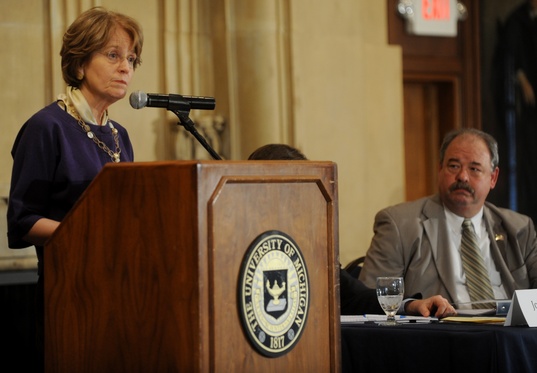
University of Michigan President Mary Sue Coleman and Lt. Gov. John Cherry participate in a panel discussion on higher education and economic growth in Michigan.
Melanie Maxwell | AnnArbor.com
"By conservative estimates, a water bill of 10 cents per bottle paid by bottling companies that operate in Michigan would raise $118 million per year and likely more," Cherry said. "Proceeds from the water bill could fund education for young people."
That funding would include reviving the Michigan Promise scholarship program - an idea Coleman said has seen its day.
"Financial aid in the state of Michigan should be need-based," Coleman said. "The Promise scholarships are not need-based."
Need-based aid is the key to encouraging social and economic mobility, she said.
"I think the state missed an opportunity to make that argument," she said.
The Michigan Promise scholarship program provided up to $4,000 to 96,000 in-state students in merit-based aid before it was cut out of the state budget Oct. 30 to save $140 million. The program, in place since 2007, replaced former Michigan Gov. John Engler's Michigan Merit Award Program, which provided up to $3,000 for college in merit-based aid.
Cherry didn't provide details on the status of any bottled water tax legislation when he spoke Thursday at the panel discussion in the Michigan Union. He left before panelists and audience members could discuss what he said or ask questions.
Other panel members included Coleman, Michigan Community College Association President Michael Hansen and Mark Murray, the president of Grand Rapids-based Meijer, Inc. and a former state treasurer.
A bottled water tax is not the first idea floated to save the scholarships. Gov. Jennifer Granholm recently proposed scaling back the Michigan Earned Income Tax Credit, a refund meant to help the poor.
Among the hundreds of audience members in attendance were education leaders and policy experts from around the state, as well as students and the general public.
The panelists came together to discuss progress 5 years after the Lt. Governor-led Cherry Commission made 19 recommendations on the future of higher education and economic growth in Michigan. The 40 Cherry Commission members included representatives from business, labor, education and higher education as well as civic leaders. Coleman was part of that commission.
Cherry said programs like the Michigan Economic Development Corp.'s 21st Century Jobs Fund, a program that aims to spark new investment and create high tech companies, are evidence of success.
Coleman agreed progress has been made toward the commission's recommendations "despite dwindling funding from the state."
She noted several of U-M's successful efforts to foster an entrepreneurial culture among students. Initiatives like the TechArb - an incubator for student-led businesses - are right in line with the goals set by the commission in 2004.
And then there is the University Research Corridor. The partnership between U-M, Michigan State University and Wayne State is intended to produce patents, business and graduates with high-tech degrees. It represents a good example of the commercialization of research and of collaboration among state universities for economic growth, she said.
"The goal of the partners is to align our resources to transform, strengthen and diversify the state's economy," Coleman said. "We are seeing results."
Panelists tried to remain positive, but noted throughout the discussion that the future of funding from the state looked grim, and some of the Cherry Commission recommendations were impossible without huge tuition increases.
"Michigan faces an uphill battle," Coleman said.
"I don't think anyone could have predicted in 2004 what resource limitations really meant." Michael Hansen said. "We are in a long economic downturn, and I don't think we're at the bottom of the trough yet."
Others were more blunt.
At a related conference earlier in the day, Macomb Community College President Jim Jacobs called state financial backing of the recommendations in the 5 years since the commission made them "very wimpy."
One of the commission's 2004 recommendations was to double the number of college graduates in 10 years.
Five years later, Coleman and Murray agreed the state has given no indication of how to pay for this initiative in light of drastic drops in funding.
"Frankly, to ask the universities to double the number of graduates, with not only no increase in funding, but decreases in funding - that's a big challenge," she said.
If such a goal were to be implemented, she said, students would likely end up paying for it through their tuition bills.
Juliana Keeping covers higher education for AnnArbor.com. Reach her at julianakeeping@annarbor.com or 734-623-2528. Follow Juliana Keeping on Twitter
Comments
MjC
Sat, Dec 12, 2009 : 8:21 a.m.
Those high salaries for professors noted by comments here are a direct result of old fashioned American competition. The UM strives to employ the brightest and most hard working academic and research professors in the world. When you employ the best, other universities will take note and try to recruit your folks away, thus, higher salaries. The fact that the State of Michigan created one of the most outstanding public universities in the world is simply incredible when you think about it. I'm proud that Mary Sue Coleman is speaking out. Our State needs to restore funding for education at all levels.
The Grinch
Fri, Dec 11, 2009 : 8:41 p.m.
A2biotechy: thanks for making my point, which is that there is no corrolation between a state's tax burden, whether or not it is a right-to-be-poor state, and its unemployment rate.
a2biotechy
Fri, Dec 11, 2009 : 7:44 p.m.
Grinch- South Carolina-- really? Do we aspire to be South Carolina? Why not pick a state with comparable education achievement (i.e. middle of the pack) like Texas? Try these stats: Texas: Lowest per capita Taxes ($1368 total tax burden per capita) #21 in unemployment (8.3%) Right-to-work state #19 Education expenditures per capita ($1330) Michigan: 10th highest tax burden ($2381 TTB) Highest unemployment (15.1%) #9 Education expenditures per capita ($1549) But let's aim higher. Let's look at a state with the highest school performance. Maryland: 15th highest taxes ($2214 TTB) 14th lowest unemployment (7.3%)-- half of Michigan! 13th Education expenditures per capita ($1417) It seems to me that both of these states are getting more bang for their buck. In fact, if you plot educational expenditures by educational performance you will find that Michigan gets a below average return on investment. I am neither anti-tax or anti-union, I am anti-wasteful spending. I would like to see our government agencies (federal, state, local) do a better job with the revenues they have before they raise taxes.
dswan
Fri, Dec 11, 2009 : 4:31 p.m.
Lt. Gov. Cherry, Thanks for bothering to show up and promote the same failed ideas of your boss. There's nothing like making budget cuts to the bone, then travel around the state promoting ideas for new revenue that will never make it thru the Legislature, only to reverse the cut in 11th hour after 'finding money.' Departing before anyone had a chance to ask questions was a nice touch. Your campaign for governor will be nothing more than insurance for the Republicans that they'll win in 2010. Give up now so the Dems have a chance!
dswan
Fri, Dec 11, 2009 : 4:15 p.m.
We have to ask ourselves and our lawmakers why tuition at public universities in the State of Michigan surpasses that of many other states. Mary Sue, how is that your former employer, the University of Iowa' is able to maintain the lowest tuition in the Big Ten? Can this be attributed 100% to State funding differences? If the goal is to improve our economy in the long term, and we agree that the cost of tuition plays a big role; let's look for improvements both from the State in funding and from the Universities in their budgets. Perpetually putting the blame on State funding while raising tuition year after year (beyond inflation) and making marginal cuts is not a recipe for progress. Check out The Michigan Daily's Salary Supplement for data on U-M salaries. You will find Professors making nearly $200K/year (while many classes are led by GA's). While you're there take a look at the prior years' salaries and you'll see a pattern of healthy raises; all while tuition increases and our economy continues on its downward spiral. EMU was able to enact a freeze on the salaries of it's highest earners this year. A step in the right direction that has yet to be emulated by our other state univerisities, to my knowledge. The Brain Drain is a huge issue. Why can't our state develop policies that encourage graduates to stay in MI? Perhaps a program that forgives a portion of student loan debt if you stay in MI for 3 years following graduation. It's hard to compete with States that have more jobs, some without any state income tax; but this would be a start.
The Grinch
Fri, Dec 11, 2009 : 3:19 p.m.
VERY impressive, TrueBlue. Of course, your protestations notwithstanding, you fed from the public trough when you were earning your degrees. Indeed, given the ever-shrinking state portion of the U's budget, you likely fed far more from the public trough than are today's students. And, depending on how your grad program ran, you likely took big gulps out of the public trough while earning that MSE, gulps well beyond just the average bite all students have with that ever-shrinking state subsidy. But I can see that you don't understand (and likely never will) that basic fact.
The Grinch
Fri, Dec 11, 2009 : 3:11 p.m.
Someone here noted that the state funding of the U of M (and, by implication, the state's entire K-12 and higher ed. system) is subsidizing other states' economies as many young Michiganders leave the state upon graduation. This is sad but true, but how to stop it from happening? Do we really think that young people will stop leaving the state if the state defunds its educaitonal institutions? If you think this, you are sadly mistaken. For all of you low-tax, anti-union folks out there, South Carolina is a right-to-work (i.e., right-to-be-poor) state, it is 45th in out of the 50 states in per capita tax burden, and it has the nation's 3rd highest unemployment rate. It also has one of the nation's most poorly funded and underperforming school systems measured by standardized test scores (not necessarily a good measure, but it seems to be the one of choice for those who are at war with teachers, their unions, and the schools in which they teach). So what to make of that set of facts?
The Grinch
Fri, Dec 11, 2009 : 2:30 p.m.
Mr. Cash, Yes, operating these new building costs money, as does operating the older, less efficient buildings that many of them replaced. Of course, the state's portion of the U of M's budget gets smaller every year even as the university's budget grows, so I guess I'm missing your point. But I do appreciate the sentiment, I really do. I think we ought to let the physical plant at the U of M revert back to what it was in the 1940s and 1950s, I really do. I mean, it was good enough then, right? Never mind the fact that those facilities will not prepare the university's graduates for the high tech information age into which they will graduate. Never mind the fact that the lab spaces won't be able to keep up with those at other universities where the state's citizens seem to understand that to have a future, one must INVEST in that future. Never mind the fact that all of the construction at the U for the last 20 years has provided thousands of jobs for construction workers in a state where there is damn little construction going on, thereby stopping even more skilled workers from fleeing the state. Never mind that much of the money that paid for those projects, both to their workers and to the companies for which they worked, stayed in the state and was spent in the state numerous times over, thereby providing economic gasoline in a state that was running out of gas. Never mind that so long as the University of Michigan remains one of the world's premier research instituiton, Ann Arbor and its surrounding communities will remain vibrant towns into which people move, insuring that property values won't plummet the way they have in, say, Flint or Jackson. Indeed, what is it, exactly, that makes A2 economically differnent from Jackson but for the U of M? No, you're right. A mid-20th century physical plant ought to be good enough for a 21st century university.
scooter dog
Fri, Dec 11, 2009 : 2:08 p.m.
Why is the state of michigan giving aid to a university with a 8 BILLION dollar endowment fund
PersonX
Fri, Dec 11, 2009 : 1:05 p.m.
I do not always agree with the current UM administration, but in this case they are making good points, and it seems to me that many of the nasty comments here are shortsighted, to say the least. Sometimes the U makes nonsensical decisions, as in the way they have restructured graduate school funding, but mostly they have been fairly good with money in a difficult situation. 1. the U is actually making great strides in cutting costs at every level and more cuts are coming, some of which are will have negative effects on education and research. 2. it is a mistake, to my mind, to think that vocational schools can easily take the place of a college education. We spend too much time trying to look back and to recreate what seems in hindsight a better world, while the rest o the planet is moving forward. There will be few manufacturing jobs for future graduate and probably less well-paying jobs in the service industry--students need to learn to be smart and flexible so that they can adapt to changing circumstances and be able to quickly acquire new skills as the world they will enter will be an ever-changing one. That is why learning to think and to acquire and manipulate new knowledge will serve them between than very specific skills that might quickly become obsolete. 3. I know it is difficult, but we have to stop thinking in terms of the past and allow kids to run into the future. So much of our current political thinking and "ideology" is oriented towards a mythical past. India and China are looking into the future, and we cannot afford to do anything less or we will become an obsolete nation rather than the great engine of progress that we once were.
Macabre Sunset
Fri, Dec 11, 2009 : 12:26 p.m.
What frosts my goat is the way liberals whine about the people not wanting to support education when they are already receiving a significant amount of tax money. It's never enough. How about a "thank you" instead? What if recipients of grants and welfare and other services actually wrote letters thanking the taxpayers who made them possible? Instead of raking a man who makes $1,000,000 over the coals because he "only" pays $250,000 in taxes, why not thank him for all the support his hard work provides for others? No. Not in left-wing America. His pay is called "excessive" instead - and then you whine because no one wants to work to create jobs any more.
Bryan123
Fri, Dec 11, 2009 : noon
Yeah, let's double the number of college graduates so that we can continue to subsidize the educational needs of other states. College graduates haven't been staying in Michigan because there are no jobs, so increasing the number of college graduates is just going to increase the number of people who are over qualified for their future jobs which don't require a college degree. There are plenty of well paying jobs which only need vocational training or other sorts of basic certificate training. This myth that everyone needs to go to college if they want to achieve social mobility needs to stop being spread by colleges and universities.
Cash
Fri, Dec 11, 2009 : 11:24 a.m.
Voice, Not to insult YOU in any way but here is a fact: That "operating budget" covers a myriad of items. GENERAL FUND budget, the budget used to hire the folks who work in the building, buy the supplies etc....GENERAL FUND budget for education is taxpayer funded and tuition supported. Higher education (my field) has MANY purses......and the GENERAL FUND purse belongs to us.
voiceofreason
Fri, Dec 11, 2009 : 11:16 a.m.
Cash, The contribution to the University of Michigan for this year was about $327M. The total operating budget for the school this year is $1.34B. To say that the residents of Michigan are providing all the funding for school operations is misinformed.
whateverhappenedtoA2
Fri, Dec 11, 2009 : 11:12 a.m.
Trublue, well said! Getting control of their spending. Fulfilling their responsibilties to the communities they occupy. This is what Universities should be talking about. They overcharge students. Encourage them to switch majors which coincidentally keeps them in school longer. Many end up with degrees which hold no value in todays job market. State universities are a resource thats begging for better management. Colman aught to give that a go.
TruBlue
Fri, Dec 11, 2009 : 10:15 a.m.
Grinch I am well aware of where the money comes from I just don't agreed with it. I love how people without anything to say just attack a poster's intelligence. PS: I have a BSE and a MSE from the U, neither in Feeding from the Public Trough.
Cash
Fri, Dec 11, 2009 : 8:29 a.m.
Mr Grinch, The cost of operating those new buildings after construction and decades beyond....comes directly from us.
uawisok
Fri, Dec 11, 2009 : 7:39 a.m.
With the financial challenges of our State I wonder how many students are going to stay here post graduation because their degrees are "under water"??
The Grinch
Fri, Dec 11, 2009 : 6:59 a.m.
Funding for university construction comes from state and federal funds and from private donations, all of which is earmarked for those projects, none of which can be spent on other areas. The complete ignorance of the anti-government, anti-tax, anti-school crowd is quite amazing. Perhaps had they paid attention in school rather than hating it.....?
Cash
Fri, Dec 11, 2009 : 6:58 a.m.
From PellGrantdotcom: "most Pell funding goes to students with a total family income below $20,000." I guess that would be if they can make it to college age and haven't starved to death by then.
FreedomLover
Fri, Dec 11, 2009 : 12:58 a.m.
Why does all financial aid need to be "need-based?" We already have Pell Grants, Subsidized Stafford Loans and hundreds of scholarships that are need based. I think hard working students from middle class families deserve some financial aid that is not need based but performance based. Doubling the number of college graduates is a waste of money. What are all of these college graduates going to do with their education. Not all jobs require a degree. Learning skilled trades in a community college makes more sense for many students.
Thick Candy Shell
Thu, Dec 10, 2009 : 10:08 p.m.
@truBlue the U will always be under construction and rightfully so. the U has hundreds of buildings and according to the standard of 75 years between major renovations/reconstruction/rehabilitation. That is the way to go. They are still and hopefully will continue expanding and employing more people across the City.
TruBlue
Thu, Dec 10, 2009 : 9:39 p.m.
Thanks for your opinion Mary. How about you get the University spending under control. I think it has been under construction ever since I came to this town 18 years ago.
DonB
Thu, Dec 10, 2009 : 9:38 p.m.
Coleman is exactly right. Need-based aid is the key to encouraging social and economic mobility, in education and in society in general.