

Ypsilanti bus service in jeopardy again as Ann Arbor Transportation Authority rates rise
The City of Ypsilanti may not be able to afford full bus service, and the news comes exactly one year after voters approved a charter amendment to fully fund busing from the Ann Arbor Transit Authority.
The 2010 charter amendment levies 0.9879 mills, or $292,000 in fiscal year 2012, but the AATA is charging $321,000 for full service in federal fiscal year 2012 — a difference of $29,000.
Next year, the millage is only expected to generate $272,000.
City Council tabled a service agreement with AATA at its Oct. 18 meeting, and Council Member Peter Murdock says council will have to discuss whether or not it can afford the new rates.
“We’re pulling our hair out to provide any service whether it’s buses or police; this is not fun stuff,” he said.
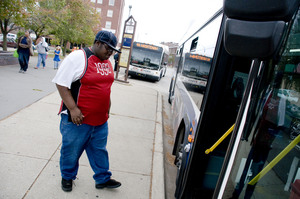
An Ypsilanti resident boards an AATA bus at the Ypsilanti Transit Center.
Tom Perkins | For AnnArbor.com
A nine-month contract would mean council would pay only $262,000 for service this fiscal year. Regardless, a year of service now costs more than the transportation millage generates.
The city is discussing how to close a $10.69 million budget deficit projected for 2017, and council will have to make a decision whether or not to use general fund dollars for bus service in the next budget.
The cost of bus service for Ypsilanti has been partially offset in recent years by $200,000 in federal stimulus money.
The AATA’s cost of providing service in the city rose from $253,000 to $321,000 from 2008 to 2012. But with relief from stimulus funds, the city paid $133,000 and $66,000 less than what it would have without the funds the last two years.
The service agreement rate is based on a cost per hour of bus service in Ypsilanti. That cost went up from $81.29 per hour in fiscal year 2008 to $112.43 per hour in fiscal year 2012.
But the real cost of providing service in Ypsilanti during that time fluctuated between $99.30 and $112.43, according to the AATA. The difference was covered by Ann Arbor taxpayers, but the AATA is moving away from having Ann Arbor residents pay for service provided to other communities.
Chris White, manager of service development for the AATA, said the formula for figuring the cost per hour of bus service includes drivers’ salaries, fuel, maintenance, administration’s salary, upkeep of the Ypsilanti Transit Center and other operating costs. White said he didn’t have a breakdown of the costs.
Some council members are upset that the AATA is spending significant money promoting its new countywide transit plan. The AATA is pushing an extensive new master transit plan that would expand service countywide and require voters to support a countywide tax millage to fund it.
In April 2010, the agency entered into a $399,805 contract with international consultants Steer Davies Gleave to help develop the plan and authorized CEO Michael Ford to spend $350,000 over three years to market the plan.
White said money dedicated for the transit plan is for “planning and not included in the fixed-route cost per service hour.”
Council Member Mike Bodary said White is only “shuffling money” when saying that cash spent on consulting and marketing the plan doesn’t affect municipalities’ hourly service rate.
Bodary said he felt the city can only give the AATA what the millage generates and questioned how the AATA could cut service while spending heavily on developing and promoting its countywide transit plan.
He also asserted that the agency has done little to cut costs in recent years.
“The fact is, they’re not efficient,” Bodary said. “It’s time for everyone to share in the cost-saving efforts and we don’t need to be funding their advertising, promotions, TV commercials, studies and consultants.”
Council Member Brian Robb said the council is cutting in all areas and busing is not “sacrosanct.”
“The AATA has to come back to us with service we can afford,” he said. “They need to evaluate their routes and develop a more efficient service that meets our needs.”
Mayor Paul Schreiber had a different view. He said he expected council would be able to work out a solution with the AATA.
“It’s certainly better to be putting in the difference than the full amount,” he said. “To me, the voters said overwhelmingly that transportation is important.”
Comments
Forest City
Fri, Nov 11, 2011 : 5:58 p.m.
The difference between AATA's costs and what Ypsilanti can afford to pay MUST be closed through cuts in expenses at AATA. Ypsi stepped up with more revenue, now it's their turn.
jjc155
Fri, Nov 11, 2011 : 5:40 p.m.
Ohhh I'm quite sure that city council will pick AATA over Police and/or Fire, just the way it is around here, LOL
Pete Murdock
Fri, Nov 11, 2011 : 3:20 p.m.
@Lorie – Sorry Lorie no miscalculation here. The reason we have the dedicated millage for public transit, is because the county or regional transit system with an independent funding source has failed to materialize. The Ypsilanti Headlee override charter amendment designated for public transit was the fallback position if no regional system was developed and part of a three year agreement for continuation of services with AATA with no cuts. It was the maximum amount we could levy. At the time the plan was developed, over two years ago, the amount raised was enough to cover the contractual costs from AATA. The millage raises what it raises. Increased costs and more importantly reduced taxable value have now created a gap between revenues and contractual costs. This is true with all the City budgets as general fund revenues from property taxes have declined by $2M over the last few years. But what the dedicated millage for public transit does do is guarantee an amount for public transit that might not be available if it competed with other budgetary items in the City budget. As the City looks to find $1.5M in deficit reduction next fiscal year, public transit will not be zeroed out. Because of the Charter amendment, Public Transit will have an amount of guaranteed funding to provide some level of service. And maybe, just maybe, a rational, affordable, regional approach will be forthcoming in the next year. As to service cuts, there are no service cuts thru our fiscal year ending June 30, 2012. In fact there will be some improvements to the #4 Washtenaw route financed by the AA DDA and others. As to FY 2012-13, we will know more when the City's taxable value is known and our budgetary process is undertaken.
Steve McKeen
Fri, Nov 11, 2011 : 4:46 p.m.
Haters gonna hate. <a href="http://funny-pictures-blog.com/wp-content/uploads/2011/03/haters-gonna-hate1.jpg" rel='nofollow'>http://funny-pictures-blog.com/wp-content/uploads/2011/03/haters-gonna-hate1.jpg</a>
pseudo
Fri, Nov 11, 2011 : 4:37 p.m.
yadda yadda yadda sounds like your admitting the math was off and we passed something that we should have known wasn't going to cover it.
belboz
Fri, Nov 11, 2011 : 2:33 p.m.
Lets not be hypocritical AATA. You charge riders in Ann Arbor only 11% of the actual cost of riding the bus. (Receipts from Transit Operations in 2009 : 3.1 million, Operating Expenses of 27.6) Charge riders 8 times more than what you are currently, and riders will bear 100% of the cost. Instead... The Federal Government covered $3.1 million. The State covered $11.1 million. Ann Arbor covers about $10.5 million Either work with Ypsilanti to help make the bus service affordable and in line with what you charge the people of Ann Arbor... Or, charge everyone the actual cost of using the bus. Frankly, AATA is a not a money saver or energy saver. A 3 mile bus ride for me is about $1.50, but the true cost is closer to $12 (8 times $1.5). That is $4 per mile. Compare that to me driving my car, which is about $0.55 per mile, from the national average. So, it is about 7 times more costly and inefficient to use AATA. And don't give me "But, if MORE PEOPLE rode the bus..." They aren't. So, time to deal with the reality.
Joe
Wed, Nov 16, 2011 : 5:47 p.m.
You're ignoring the fact that most of the cost of driving is a car is in fact subsidized by taxpayers, consumers and the general public. Off the top of my head, here are some costs not paid by the driver: Highway/road construction and upkeep Parking spaces Rainwater runoff from paved areas Greenhouse gas emissions Toxic air pollution Water pollution Healthcare/burial costs from car accidents Noise pollution Increased commute times War for access to petroleum Social isolation Increased dependency in childhood Misanthropic urban/suburban design I think it would be nearly impossible to calculate exactly how much it actually costs per mile, but I'd guess it's higher than the cost of bus service. Granted, buses do have some of the same costs, such as noise pollution, greenhouse gases, etc. However, they can move more people per unit of external cost than can cars.
jns131
Fri, Nov 11, 2011 : 2:54 p.m.
Actually they are riding the bus. From the last article this place stated that AATA is going to increase the #4 because ridership is up at its peak capacity and needs another bus. Ours has a 45 minute ride to school and back every day. Without it? One of us is going to have to go part time to get our child to and from school every day since there are no school buses in the area. That got cut last August.
Ron Granger
Fri, Nov 11, 2011 : 1:57 p.m.
Ypsilanti seems to be on the verge of bankruptcy, or "Flint". They have gambled wildly on real real estate development projects, and I do not want to bail them out. We should not be forced to bail "Ypsi" out. I don't live there, so don't make me live there by financial proxy. Is there any way we could redistrict the county to exclude them?
Murf
Fri, Nov 11, 2011 : 2:53 p.m.
Your beloved city doesn't seem too far behind!
Murf
Fri, Nov 11, 2011 : 1:43 p.m.
I thought voting on this and it passing, the problem would have been solved at least longer than a year. Silly me!
jns131
Fri, Nov 11, 2011 : 2:49 p.m.
That is why I voted for this. I also seem to remember AATA almost came to a close 20 or more years ago because of funding and Ypsi was a tag along in all of this. In the good economy days everyone was doing well. Now? Not so good. Detroit is also having its own brand of troubles as well. Scary.
dading dont delete me bro
Fri, Nov 11, 2011 : 11:46 a.m.
i'd like to get a 10% increase in my wallet...
pseudo
Fri, Nov 11, 2011 : 11:12 a.m.
Who didn't do their math or due diligence when we raised taxes on ourselves for this service? My guess here is Ypsi City Council. They have missed doing the basic due diligence on so many things. I'll remind the voters here that the language for this tax was rushed and wrong. We had to vote on this twice. Some fault for lay with the bad legal advice (guess who) and some lies with council for just not doing their homework. This is where the mismatch is between council and the people here is. We need more and better choices for leadership and we don't get them. As for AATA - I think the drivers are solid but there are always ways to run for efficiently and there are always going to be consultants but clearly AATA has paid far more than it should. If a service cut is needed - then blame both sides: AATA AND Ypsilanti City Council. The voters here did their part....twice.
murph
Sat, Nov 12, 2011 : 1:11 p.m.
Lorie, the millage was understood -- and stated -- at the time to be a stable base of funding for bus service in the city, not the be-all-and-end-all answer. Council never claimed differently. What we have is what was promised: a stable base of funding with the city and AATA left to negotiate over the difference of $29k. A whole lot better to be left worrying about the last 10% than to have to start from 0 and have to deal with the whole cost. (p.s. note the difference in user names - you've got a murph and a murf here.)
pseudo
Fri, Nov 11, 2011 : 4:27 p.m.
murf, part of the challenge here was something Council missed: getting AATA to say, in public, how much was enough. That way, this couldn't happen. btw...i think thats the result of a few who are way too chummy with some at aata and got their info privately instead of publicly and while that felt good to them at the time, they didn't cover US, their voters, very well.
Murf
Fri, Nov 11, 2011 : 1:44 p.m.
Good question, Lorie. I have a feeling that no matter how well the due diligence was done, AATA would have still somehow found a way to say it wasn't enough.
Vivienne Armentrout
Fri, Nov 11, 2011 : 2:51 a.m.
The Ypsilanti councilmembers are no doubt weary of struggling with financial issues, but their anger at the AATA is misplaced. As stated, Ypsilanti service has been subsidized by Ann Arbor taxpayers (we have a 2.0 mill tax) and others for some time. Part of the impetus to expand the regional reach of the AATA has been to serve the Ypsilanti area. If the countywide transit plan becomes reality, the entire county will be subsidizing Ypsilanti. This is because of the high population and the high need, which is recognized by just about everyone. It has been Ann Arbor taxpayers who are paying for the extra expenses associated with the countywide plan. As stated in previous reporting by AnnArbor.com, the work plan <a href="http://www.annarbor.com/AATA_Work_Plan_2012.pdf">http://www.annarbor.com/AATA_Work_Plan_2012.pdf</a> calls for over half a million dollars spent to expand service to Ypsilanti, including more service along route #4. This is an extra "regional" service. It is my impression that the Ann Arbor DDA is one of the contributors to that extra service, which has been justified by the notion that many workers are commuting from Ann Arbor to our downtown. Still, these are Ann Arbor tax dollars being spent in aid of Ypsilanti transportation. As I explained in a blog post <a href="http://localannarbor.wordpress.com/2011/10/29/aata-moving-us-where/" rel='nofollow'>http://localannarbor.wordpress.com/2011/10/29/aata-moving-us-where/</a> , the AATA is actually driving itself into deficit spending in order to anticipate the county-wide plan. Some of that is the expanded Ypsilanti service. Ypsilanti is the beneficiary here, not the victim.
kenUM
Fri, Nov 11, 2011 : 1:02 p.m.
@Vivienne, The point to this is that all of the taxpayers are the victim with this. The perceived benefit here is unclear, the expenses continues to mount. There is absolutely no reason why AATA has spent, and continues to spend the amount of money on consultants and does not have any type of concrete plans to offer. While I do not have the exact amount spent on consultants as to date, I am curious as to what type of service improvements could have been provided re investing this money for enhanced service. AATA has been aware for quite some time that Ypsi is in deep financial trouble, but the POSA continues to increase. AATA came back to Ypsi almost immediately after the millage passed touting the need for increased service. Chris White is more than capable of being creative and responsive to Ypis's needs given the amount of money available.
slave2work
Fri, Nov 11, 2011 : 1:28 a.m.
why is this no surprise. after a ped. x-crossing.. causing issues.. The whole city of A2 acts like they are above everyone else. makes ppl. feel like a red-headed step- child...( it's a old saying people.. not a slam)
Gramma
Fri, Nov 11, 2011 : 1:27 a.m.
Many people in Ypsi need bus transportation to get to work and to meet basic needs (grocery shopping, medical care). The county wide plan included Ypsi. How can it now be left out? The cost for consultants is ridiculous. AATA administrative staff is paid to do planning and management. There should be no need for outside consultants to do their job for them.
jns131
Fri, Nov 11, 2011 : 2:47 p.m.
Especially now that school buses are going private. Many routes have been abandoned or cut in half. Ours needs these buses to get to and from school. Once ours get the license to drive, then maybe we can use them a lot less. But during the winter it is easier to let them do the driving. I am also appalled that Blake Transit is going to rebuild their building when they just did this not more then what, 2 years ago? Frivolous spending I say.
EyeHeartA2
Thu, Nov 10, 2011 : 10:59 p.m.
"The fact is, they're not efficient," Bodary said. Shocking. Maybe they need to expand, so they can be more inefficient.
EyeHeartA2
Fri, Nov 11, 2011 : 2:03 a.m.
...so they can be as big as and as good as the Detroit busses?
Donald Wilson
Fri, Nov 11, 2011 : 1:31 a.m.
Or maybe they need to expand so they CAN be efficient.
a2chrisp
Thu, Nov 10, 2011 : 10:32 p.m.
Sooner or later the AATA is going to have to realize that they are squeezing water from a rock by holding the city of ypsilanti and its ridership hostage. If they had the money they would pay.
RUKiddingMe
Thu, Nov 10, 2011 : 9:36 p.m.
Is it normal that they're renovating 2 (or i it 3?) locations, talking about expanding service, looking for new millage, AND raising rates? Why is it that I'm seeing all the expansion and building and construction in the midst of the worst economy (and publicized financial crises at city/state levels), AND they're raising rates? This really seems kind of dumb and/or fishy. How about they don't rebuild and expand, and just keep rates as they are?
Joe_Citizen
Fri, Nov 11, 2011 : 5:46 p.m.
It is a formality. Snyder isn't worried about Ypsilanti, and A2 is where he wants to spend the transportation money.
kenUM
Thu, Nov 10, 2011 : 8:29 p.m.
No end in sight, this route has no end of the line! This was a given after Ypsi passed the millage, and AATA reported that Ypsi was in need of "enhanced" bus service. No argument, we need Transit Services for the area, AATA must become fiscally responsible and cut costs. This leads me to believe that even if we pass the Countywide millage AATA will be back for more money crying poverty and threatening service cuts. What AATA has spent on consultants should have been re invested in enhancing existing bus service.
free
Thu, Nov 10, 2011 : 8:25 p.m.
When spending outstrips revenue, businesses raise their rates, or cut their costs. Why can't that be done here?