

Obstacles, funding questions plague Ann Arbor-Detroit rail line, but progress is being made, planners say
Planners of a proposed Ann Arbor-to-Detroit rail line are slowly making progress, although the project still faces a list of obstacles and financial uncertainty.
That’s the message Carmine Palombo delivered to the Ypsilanti City Council during an update on the effort at council's regular Tuesday night meeting.
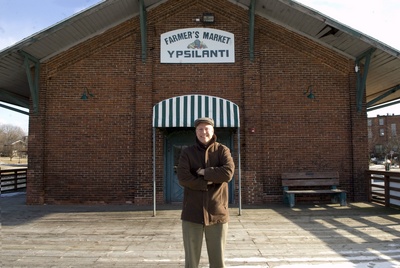
Ypsilanti Mayor Paul Schreiber stands outside the Freighthouse in Ypsilanti, which will be a stop on the Ann Arbor-to-Detroit rail line.
Tom Perkins | For AnnArbor.com
“Progress is being made,” Palombo said. “It’s not the kind of progress anyone wants — it’s slow and there are lots of hurdles. But the positive thing is we have overcome all the obstacles that have been placed in front of us so far.”
Palombo reiterated that the goal is to have four daily roundtrip runs on weekdays with stops scheduled in Ann Arbor, Ypsilanti, at Metro Airport, in Dearborn and at Detroit’s New Center area. But he added that goal might be attained incrementally.
He said he hopes a demonstration train might be available later in the year to take riders to a football game in Ann Arbor or Detroit’s Thanksgiving Day Parade, for example. But officials had similar hopes last year and Palombo declined to offer any timelines on when demonstration trains or a regular routes might be running.
Chief among the issues is how commuter and passenger trains will share rail lines with the freight train companies that own them.
In some spots along the 38 miles of rail, sidetracks need to be built that would allow trains to pass one another, but the largest obstacle is an intersection of tracks in west Detroit between the Dearborn and downtown Detroit stations.
As the route runs east past Dearborn, it turns north at an intersection that sees heavy freight traffic. In order for a commuter or passenger train to head north there, the trains are required to do a turnaround that significantly slows the route.
MDOT is funding a $12 million to $15 million project to add an extra track that would double the intersection’s capacity, alleviate congestion and allow for better flow.
Palombo said the project is funded by federal high speed rail grants, and he hopes it will completed by the end of 2011, though it could run into 2012.
Stations are already built in Detroit, Dearborn and Ann Arbor, and plans call for new platforms with required signs and lights at the Ypsilanti and Metro Airport stops.
Environmental studies are under way throughout the entire corridor, and the impact of the platforms must also be examined. Palombo expects those studies will be completed by the end of summer and said part of the process will include a public hearing at which residents can give their input on the environmental impact or on the project in general.
MDOT has $1 million to install a basic and safe platform, though Ypsilanti could be asked to contribute some money to the project or to enhance the platforms.
Three train cars are renovated, of which one is undergoing minor redesigns for safety issues. Full service would require three locomotives and nine cars, Palombo said, and funds to lease 24 cars are available.
Funding is still needed for an estimated $25 million to $30 million in remaining “smaller” capital improvement projects, such as signs and sidetracks. But complicating the situation are discussions between MDOT and Norfolk-Southern about MODT purchasing the tracks between Dearborn and Kalamazoo. If that sale goes through, some of the planned capital improvement projects might be unnecessary, so officials don’t want to start spending unnecessarily.
Question marks also remain over the source of the required $8 million to $10 million in annual operating costs. That money and capital funds could come via $150 million in federal high speed rail grants, which the state must match with at least $37 million of its own money. Palombo said SEMCOG officials have met with Gov. Rick Snyder to discuss the grant, and he is confident the administration is committed to offering matching funds
“He isn’t just going to leave $150 million sitting there unused,” Palombo said.
Florida recently turned away $400 million in federal funds earmarked for high-speed rail. Michigan was one of the states to apply for that money, but Congress didn’t include it in the 2011 budget. Palombo said he hopes those funds might materialize in the next federal budget, as some could be used for improvements that would help the Ann Arbor to Detroit commuter train.
Snyder previously told AnnArbor.com the fact that the state is seeking those funds doesn't mean he supports high speed rail.
The project has received broad regional support, Palombo said, and Ypsilanti Mayor Paul Schreiber noted Ypsilanti residents have also largely been supportive of the effort. Additionally, MDOT recently released statistics indicating rail ridership in Michigan is up overall.
The Amtrak Wolverine line that runs from Pontiac through Detroit to Chicago — with its busiest stop along the way in Ann Arbor — saw a 16.3 percent increase with 243,185 passengers from October through March. Ticket revenues went up 21 percent to $9 million.
Comments
Kai Petainen
Sun, May 15, 2011 : 12:13 a.m.
Excellent article! Why didn't I see this before???
Andrew Jason Clock
Thu, May 5, 2011 : 4:05 p.m.
You support trains because there has never, ever, been a successful revitalization of an urban area with out public transit. There has never been a successful state (or country) that has abandoned a major urban area. And by the way, a group of private investors including Illitch, Karmonos, and Gilbert have come together to fund a rail line joining the existing AMTRAK station at New Center (which isn't exactly the sticks. It's around the corner from Michigan's main government center, the Masonic Temple, Motown, and many thriving businesses) with downtown along Woodward. The line would eventually continue north into the suburbs. Does that solve your problem with destination? Oooo. Detroit is so scary! Who would ever want to go there! And what if they come for us! Man, I live in Ypsi, and I love to go out in Detroit. Want to guess where I see the most bums and panhandlers? Where I've had things stolen from me? It's on *your* side of the rail line, folks.
JSA
Thu, May 5, 2011 : 3:48 p.m.
Isn't this the same line that the Feds refused to give any funding at all to last year or the year before? How are you going to pay for it then as the ridership will in no way cover the cost?
Rick Neubig
Thu, May 5, 2011 : 1:30 p.m.
I'm looking forward to taking the train to Metro Airport (which I do several times a month). Also, if it stops near the DIA that's worth a visit as well! If you haven't seen the Diego Rivera murals there you should check them out. A unique asset for Detroit.
blahblahblah
Thu, May 5, 2011 : 1:17 p.m.
"He isn't just going to leave $150 million sitting there unused," Palombo said. Yeah, I also won a $250 sweepstakes prize in the mail but when I read the fine print it was actually going to cost me $89. So while we bemoan the governor for cutting school funding, he now needs to pull $37 million out of a hat and add at least $9 to $10 million in annual operating subsidies to the state budget for a rail line that will only benefit a very small minority of state residents. When he "walks away" from this not so free money, the recallers can add this to their list of grievances.
walker101
Thu, May 5, 2011 : 12:19 p.m.
47% of people who live in Detroit do not know how to read, why don't we use these funds to help them instead.
walker101
Thu, May 5, 2011 : 12:09 p.m.
Unfortunately I have to work in Detroit everyday, when you see homeless people urinating in public during the day, cars on cider blocks, and corrupt political figures spending embezzled funds at the local casino's, you'll think twice about taking your family to Downtown Detroit.
Awakened
Thu, May 5, 2011 : 11:32 a.m.
I have trouble with the concept of moving toward a permanently tax-payer subsidized boondogle as "progress." Perhaps "insanity" would be the word i would choose.
DBlaine
Thu, May 5, 2011 : 2:09 p.m.
I guess you must hate roads, too, then. All forms of transport are subsidied, whether you know about them or not.
markbn
Thu, May 5, 2011 : 11:06 a.m.
P.S. Can someone provide information on the extent and dollar value of the public subsidy for, you know, roads and cars? And the other costs of that system, pollution, etc. Thanks.
murph
Thu, May 5, 2011 : 9:28 p.m.
Sure thing - let's just look at direct costs to start: First, let's look at raw amount of subsidy: the Federal Highway Trust Fund has received appx. $30B in subsidy (transfer from the general fund) since 2008: <a href="http://www.gao.gov/highrisk/risks/efficiency-effectiveness/funding_transportation.php" rel='nofollow'>http://www.gao.gov/highrisk/risks/efficiency-effectiveness/funding_transportation.php</a> Next, ratio: according to Subsidyscope, a mere 51% of road spending comes from "user fees" like gas taxes and tolls; the rest is subsidized from sources like income tax, sales tax, property tax, etc. <a href="http://subsidyscope.org/transportation/highways/funding/" rel='nofollow'>http://subsidyscope.org/transportation/highways/funding/</a>
markbn
Thu, May 5, 2011 : 11:03 a.m.
Uhm, I commute in to Detroit every day of the week, and I would LOVE to take a train.
greenstriper
Thu, May 5, 2011 : 11:57 a.m.
And I do the same to Dearborn every day. The specific realities of raising my family don't make it possible to move closer, so bring on the commuter rail, so I can do something more useful than drive during the 400+ hours I spend commuting each year!
braggslaw
Thu, May 5, 2011 : 10:36 a.m.
It is a complete waste of money... There will never be critical mass. Nobody from Ann Arbor will park in Ypsi so they can travel to Detroit.
Steve Hendel
Thu, May 5, 2011 : 10:34 a.m.
Of course there is support for the Detroit-Dearborn-Metro-Ypsi-AA commuter line; that is because it's easy to support such a project in the abstract, when the benefits are touted and the revenue sources to support the continuing OPERATING costs hardly mentioned. Same principle goes for the AATA's master transit plan for Washtenaw County-hype the benefits and downplay the costs, or at least infer that they will be paid by somebody else.
rsa221
Thu, May 5, 2011 : 7:29 a.m.
Pleasantly surprised to read that this might happen afterall! Thanks so much for the coverage.
logo
Thu, May 5, 2011 : 1:31 a.m.
Halter: Detroit is not important for Ann Arbor. Ypsilanti is, thousands of people who live there work in Ann Arbor and they are stuck on the bus on Washtenaw every morning and evening. Metro will be a very important stop, Dearborn too, with the UM, Ford, etc. just a quick shuttle away. Detroit would be good to have at the end of the line, but not important to Ann Arbor.
Halter
Thu, May 5, 2011 : 1:09 a.m.
This project needs to be stopped -- it is absolutely senseless.... You know the Detroit terminal is three miles from Downtown Detroit....I can think of nobody that is going to want to go down to a Tigers game, for example, in Detroit on the train -- to be dropped off three miles from the Stadium, and then have to stand on the street to take a shuttle bus into downtown....then reverse that -- wait for a bus to get back to a train stop to wait for a train to come home....It doesn't matter what gas costs, it will cost the same to take the train, and it will take three times as long. During that you would have already driven home (it takes 35 minutes -- I do it twice a week during Tigers season)... it's misbegotten, ill-advised, a waste of money, and nobody is going to use it unless the train stops directly in downtown Detroit. What are they thinking??? They don't release enough of the details, and get everyone thinking this will somehow BENEFIT people of Ann Arbor -- there will be zero benefit to the people of Ann Arbor.
Barry
Wed, May 4, 2011 : 11:39 p.m.
Ah heck, I just have to say it - why in God's name would we want fast access to Detroit? Are you serious? Driving through Detroit is like looking at a bombed-out hellish wasteland. The most visible signs of prosperity are casinos and the court house downtown. Crime? Yeah, Detroit's pretty much the state's epicenter. Poverty? Got that too! Corruption? Absolutely! I know that this is incredibly impolitic to say, but I don't want fast access to and from Detroit. It's very nice that that we are isolated from the city.
John Q
Thu, May 5, 2011 : 2:26 p.m.
Now we know who's afraid of the dark. Oooh, big bad scary Detroit! We live in Ann Arbor to stay away from "those people". But if there's a train, the gangs will ride the train to Ann Arbor to rob us! You people need to get a grip on reality.
Halter
Thu, May 5, 2011 : 1:11 a.m.
There is a reason that people live in Ann Arbor -- and a lot of that is to NOT have ready access to Detroit and vice-versa... But all rhetoric aside -- what commuter is going to use a train that DOESNT STOP in Detroit but three miles outside....
Mick52
Thu, May 5, 2011 : 12:42 a.m.
Commuters. Sounds like a commuter train, four trips M -F round trip. Another stop in the western Wayne county area would boost commuters, but with too many stops, it would take forever. Need more rail lines. I fear expensive gas is here to stay
Jay Thomas
Wed, May 4, 2011 : 11:23 p.m.
The Democrats had '09 and '10 to funnel money to this if they wanted to (Democratic Congress *AND* the Presidency). So why didn't they? Much easier to now blame those mean stingy Republicans.
Linda Peck
Wed, May 4, 2011 : 10:40 p.m.
I hope am I will still be alive to ride this train!
logo
Wed, May 4, 2011 : 10:29 p.m.
Good story Tom: Of note on this issue is the conservative Michigan Chamber of Commerce recently joined the rail coalition with the Michigan Environmental Council, Transit Riders United, etc., to push for rail money. Given their pull with the Republican side of the aisle, this seems highly likely to happen. With gas heading toward $5 I can see why they want it.
Peter Jameson
Wed, May 4, 2011 : 10:05 p.m.
I hope this train has a stop right in the roughest part of detroit, because i bet people from ann arbor love to see places like that.
Awakened
Thu, May 5, 2011 : 11:33 a.m.
I bet people from the roughest part of Detroit would love to see Ann Arbor. (The train goes both ways.)