

Spring preview: With stability in Fitz Toussaint, Michigan looks to add to rushing attack
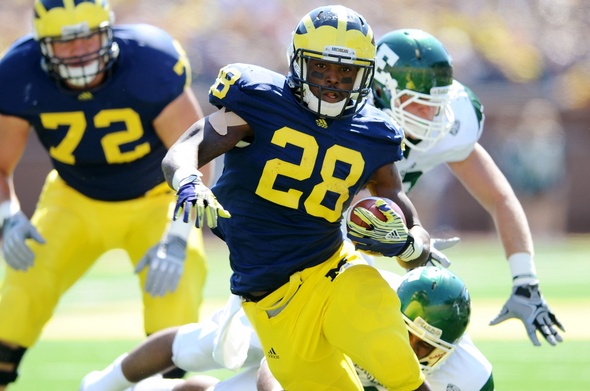
It took a while, but Fitz Toussaint (28) emerged as the featured tailback the Michigan coaching staff desired last season.
Melanie Maxwell | AnnArbor.com
Fitz Toussaint was the Big Ten's biggest surprises at tailback last season after boosting his production by 954 yards, and finishing with more than 1,000 overall. That was the largest bump in the league among tailbacks.
It also proved to be a key component of coordinator Al Borges' offense. He said from the start he wanted to feature a guy, and as Toussaint became that player midseason, the offense began to hit its stride.
Borges credited Toussaint's vision.
"If there’s one part of his game that has made a quantum leap from when we got here in the spring, it's that," Borges said last season. "That's playing. That's knowing where your help is coming on all the blocking, showing the patience to let things develop, then re-accelerating to bust into the open field, running through there 80 percent to see if it's there, then accelerating back up to 100 percent.
"When we first got here, the running game was different, just like the passing game was different for Denard (Robinson). He was running into people. He doesn’t do that much anymore."
It took a little longer than they thought, but Michigan coach Brady Hoke and Borges found their 20-carry lead tailback. But can Toussaint, who is entering his junior year, build on that momentum?
SPRING PREVIEW
Day 1: Receivers/tight ends
Day 2: Quarterbacks
Day 3: Offensive line
Day 4: Tailbacks/fullbacks
Day 5: Linebackers
Day 6: Defensive backs
Day 7: Defensive line
Day 8: Specialists
What they lose
Reserve Mike Shaw. He provided a senior influence at an otherwise youthful position, but his production (199 yards) will be easily replaced.
And that's it. Michigan returns 93.1 percent of the production from the Big Ten's No. 2 rushing attack.
What they have back
Toussaint was the fifth-best rusher during Big Ten play, despite not getting full-time snaps until the fourth game of the conference slate and being in his first season as the starter. He seamlessly blended edge-gaining quickness with a penchant -- sometimes, a preference -- for lowering his shoulder. His vision, once a weakness, sharpened throughout the season.
(Oh, and the guy can cut a rug. He's the total package.)
Toussaint battled Vincent Smith throughout fall camp and the first half of the season to claim the spot. Smith returns for his senior season, but now is the clear third-down and change-of-pace back. He still has an important role, as he's the team's best blocking back, and also dangerous on screens.
Thomas Rawls received praise throughout the season, even if he did not see the field much as a freshman. Now a sophomore, he appears to be the leader to become the third option in the backfield.
Stephen Hopkins is back at fullback, where he moved midway through last season and became a versatile threat at that position. He can run -- provided he figures out his fumble issues -- and look for him to add a dimension to the passing game.
Spring mission
Diversify the rushing attack. Part of what made Michigan so effective in the rushing game last year was the two-pronged threat of Toussaint and quarterback Denard Robinson. They fed off each other well, with Toussaint's growing threat helping to loosen up the attention paid to Robinson. At least, a little bit.
It was impressive that the Wolverines were so prolific on the ground last year, considering they went through spring, summer, fall and seven games before finally settling on Toussaint.
This time, Michigan has its featured back and needs to take advantage of that stability by adding layers and wrinkles to the game plan. That base will serve the team well next year, particularly if the passing game continues to be uneven.
Kyle Meinke covers Michigan football for AnnArbor.com. He can be reached at 734-623-2588, by email at kylemeinke@annarbor.com and followed on Twitter @kmeinke.
Comments
truebluefan
Tue, Mar 13, 2012 : 12:12 a.m.
If there's one thing Rich knew a lot about, it was definitely running the football. The strongest part of Michigan's offense during those three years was rushing. I believe Michigan had the #1 rushing offense in the B1G during Rich's last two seasons. It's not surprising that the same trend continues under Brady.
RWBill
Mon, Mar 12, 2012 : 5:56 p.m.
Ask Sam McGuffie how well a running game works without a good offensive line. That will determine how well the running threat develops or not. In the last 3 years the line suffered badly whenever Molk was injured, including the Sugar Bowl. How quickly can we plug in an effective replacement?
Terry Star21
Mon, Mar 12, 2012 : 9:43 p.m.
I know patience isn't what you want to hear after that 3 years, but Hoke is building a great OL, we'll be okay next year, but better each fall...
Robert Granville
Mon, Mar 12, 2012 : 4:44 p.m.
Running back is one of the few positions where Michigan is right on track in terms of player development. We're returning a redshirt junior starter and have 6 scholarship RBs battling for position behind him. It doesn't get much better than this folks. Well... unless Ty Isaac commits this week.
Hailmary
Mon, Mar 12, 2012 : 4:18 p.m.
The type of players that it appears to me that Brady and staff are looking for are not quite here yet especially at QB and running backs and that O-line is going to be a work in progress for at least a couple more years. I say running backs because my guess is, Brady and Borg. want fast , Big, bruising pounders and not just one but 2 or 3 that can rotate and with a big O-line (picked by Brady and Al) Those big backs will pound away at the rest of the Big 10 and its my assertion that our future Wolverines will be able to evenly compete with big fast teams like Alabama and USC. I believe that the 2012 season will be exciting with Denard at the helm but the particular style of play that Al will run with Denard in 2012 could be the last we see of that much spread attack although I do think Mich. will continue to use the spread but not as their main weapon rest assurred not after Shane gets here or at least not once Shane is a sophmore at Michigan. I think Brady Hoke has been very up front about what he is going to do at Mich. It is my opinion that Brady wants everyone to know that once he gets all his players in place the Michigan Wolverines are coming straight at you and there's nothing you can do about it.
AMaizing_Blue
Mon, Mar 12, 2012 : 4:06 p.m.
Don't get me wrong, I really like Fitz... He has great speed, acceleration and vision on the open field. I just wish he learns to hit the hole harder. It seems as if he does'nt have a hole wide enough to drive a truck thru, he stutter steps at the line and either loses yards or only gains 1, when he could lower his head and shoulder to gain 2-3. With the O-line taking a hit with Molk and Huyge gone, we are gonna need Fitz to "run angry" Just my .02
AMaizing_Blue
Tue, Mar 13, 2012 : 11:34 a.m.
Terry, I cannot wait for that day to come. Denard and Co. has been extremely fun to watch, but i'm ready to get some big boys on both sides of the ball and start playing Michigan ground and pound football again.
Terry Star21
Mon, Mar 12, 2012 : 9:40 p.m.
Yes AMaizing, but wait till Hoke's new OL gets strong and experience - we'll drive one of those Australian double truck through that line....
heartbreakM
Mon, Mar 12, 2012 : 3:04 p.m.
Michigan's running game needs to take a step up and be more consistent game-to-game. I saw flashes of it in the second half of the year, though Tech really shut it down. MSU certainly shut it down, and so did Iowa. DR running does not constitute a "running game" though he picked up the yards. A good running game requires multi-faceted runners, different styles, sort of like what Bo had in the 1980s and what Michigan had when Wheatley, Biakabutuka and others were here. A Good running game will pick up the team and control the ball, punishing the defense, and get stronger as the game goes on. That is not what we had for the last 3 years and even last year, to an extent. Fitz should get better; DR, Rawls, Smith, and Hayes should also be great. Will they give the ball to Hopkins w/o fumbling? Could be our best fullback play since Bunch or Floyd.
Terry Star21
Mon, Mar 12, 2012 : 9:37 p.m.
heartbreak....wait til Hoke's new OL gets strong and tough, we'll have openings you can drive a truck through...and with our guys speed.....stay tuned !
heartbreakM
Mon, Mar 12, 2012 : 5:34 p.m.
You are right Tally. The QB can and in this offense is a big part of the running game. It can't be the only part of the running game, though, as it was for the 3 previous years (before Hoke). That's a recipe for disaster and injury. Re: 2000 yards, yes that is right. Fitz and DR both had great running years, and even when Smith and Shaw got going, they did fine. But 2000 is not that good when you get 2-3 games of 350-400 yards and then the rest is split up. If you can get 200 yards per game, I'd say your running game is great (really hard to get) but I like to see it more even than skewed. As an example, if you score 63 against Del State but struggle to score 10 against Ohio and MSU, you may average 35 but that number is not what really happened.
Tally10
Mon, Mar 12, 2012 : 5:02 p.m.
The QB can be part of the running game, that's part of his function. A good running game is having the ability to move the ball on the ground, and Michigan did that last year for over 2000 yards and 2nd in the BT, in a new system, and also, return 93% of that production this year. In the Iowa game the backs only had about 10 carries total.
Matt Patercsak
Mon, Mar 12, 2012 : 2:38 p.m.
Thomas Rawls needs to work in with Fitz regularly. Smith is solid as the 3rd down back and I have confidence in him, I think Norfleet should see time at Smith's position as well. Hopkins will be a beast at fullback. I hope he gets up to 245
Terry Star21
Mon, Mar 12, 2012 : 9:35 p.m.
Agree 100%.....we need Rawls in there and Hopkins on the power....
MRunner73
Mon, Mar 12, 2012 : 2:25 p.m.
No doubt Fitz Toussaint will be the feature back. He's likely to pick up where he left off in 2011. I look for the two sophomores to step and have more carries. Drake Johnson will be a wild card because of his freshman status be he is likely to impress. The ability of the revamped O-Line to open up some holes will be the key to the success of the running game.
RJ12688
Tue, Mar 13, 2012 : 5:17 a.m.
what Robert said.
Robert Granville
Mon, Mar 12, 2012 : 4:31 p.m.
Drake Johnson won't be a wildcard... he'll be redshirted.
Scott
Mon, Mar 12, 2012 : 1:56 p.m.
Fritz is the main man provided he can stay healthy; injury always a factor at running back. A tale of two Flint kids. One never hears much about Justice Hays- who was so highly touted. Thomas Rawls, no where to be found on recruiting sites, played as a freshman, while Hayes was red shirted. Was Justice able to put on weight? Vincent Smith is a real burner on those screen plays- looking forward to seeing that every game.
Robert Granville
Mon, Mar 12, 2012 : 4:43 p.m.
Running back is one of the few positions where Michigan is right on track in terms of player development. We're returning a redshirt junior starter and have 6 scholarship RBs battling for position behind him. It doesn't get much better than this folks. Well... unless Ty Isaac commits this week.
Robert Granville
Mon, Mar 12, 2012 : 4:36 p.m.
Why are you expecting Hayes and Rawls to be making plays? Fitz has two years left. I'd like to see them in garbage time but other than that not at all. The best case scenario would be to see them make an impact after Fitz is gone. That would mean that Fitz made the gains he needed to in the offseason and was good enough to never be challenged by a younger, less mature and likely smaller back. That scenario would give Hayes and Rawls the practice time to hit the field with no measurable drop-off.
MRunner73
Mon, Mar 12, 2012 : 2:28 p.m.
Agreed, Justice Hayes and Thomas Rawls need to come into the picture. I like the potential depth of the tailback corps.
GoBlue1984
Mon, Mar 12, 2012 : 1:49 p.m.
Thank you Rich Rodriguez for these fine players!
Terry Star21
Mon, Mar 12, 2012 : 9:34 p.m.
You are right.
scott
Mon, Mar 12, 2012 : 1:40 p.m.
Ummm... had they lost their rushing attack? I think the last 3 years might have been the best 3 years of rushing offense ever in the history of Michigan....