

Eyeing the future: Ann Arbor developers and officials see potential with city properties downtown
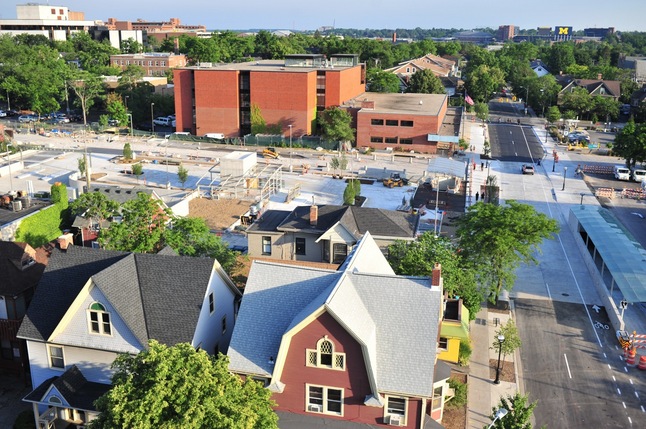
A bird's eye view of the Library Lot, where the Downtown Development Authority recently finished construction of a new underground parking garage, as the project was nearing completion back in June. What goes on top hasn't been decided, but there are talks of a public plaza and some kind of mixed-use development, possibly even a new downtown hotel.
Ryan J. Stanton | AnnArbor.com
While few doubt the properties are incredibly valuable to the future of downtown Ann Arbor, and the city is likely to get millions from selling them, the numbers in the report seemed a bit high, and two local real estate experts — Peter Allen and Ed Shaffran — agreed on that.
"I think it's a crazy number," said Allen, who argued $30 to $40 per build-able square foot would be a more realistic estimate.
The two developers said the way land is valued is a function of how much density is allowed, and each of the five sites is going to be different.
"It all depends on what's going to be developed," Shaffran said. "The value of that land as a five-story building is one thing. The value of that land as a 15-story building is another.
"At this point in time, if it were truly residential, it's probably worth $50,000 a unit," he added. "So if I can put 200 units on that particular site, the land's probably worth $10 million."
Ann Arbor developer Ed Shaffran
Ryan J. Stanton | AnnArbor.com
"I certainly believe they should be developed over time," he said. "Absolutely. Sell them and put them on the tax rolls. I think that's where the real benefit is."
At the request of the City Council, the Downtown Development Authority is studying future redevelopment opportunities for four city-owned parking lots downtown, as well as the first floor of the Fourth and William parking garage, which could be transformed into retail or office space. It's all part of what the DDA is calling the Connecting William Street planning initiative.
DDA Executive Director Susan Pollay said the land value analysis the DDA hired 4ward Planning LLC to complete probably is overly ambitious. In fairness, she said, it's a preliminary report and the consultant doesn't have all the data in yet.
"Whatever it actually ends up being, it likely won't be anywhere near that number," Pollay said. "But the part that is interesting is we're starting a process that is actually looking at this. Even this preliminary work by a land use economics consultant is more data than we've ever really done."
The initial report from 4ward Planning puts the potential land value of the old Y Lot at the corner of Fifth and William at $24 million. Meanwhile, the small Palio Lot at the corner of Main and William could go for $3.7 million, while the larger Library Lot on Fifth Avenue could go for $9.3 million and the Kline Lot at Ashley and William could go for $15.5 million, according to the report.
The consultant took into consideration different development scenarios and crunched the numbers on a per-square-foot basis like Allen suggested. Under the three scenarios, each varying in density, the overall average price per build-able square foot ranges from $135 to $270.
The consultant predicted the city could get $45 to $89 per square foot on the Kline Lot, $849 per square foot on the Palio Lot combined with the Fourth and William parking garage's first floor, $82 to $391 per square foot on the Y Lot and $107 to $262 per square foot on the Library Lot.
After going out to the community for input over the past several months, DDA officials are working toward finalizing a set of recommendations to take to the City Council as soon as November. It ultimately will be up to the City Council to decide what to do with the properties after that.
No more RFPs?
The city has tried selling its properties in the past by issuing site-specific requests for proposals (RFPs) and then letting developers propose ideas.
By most accounts, those have been largely unsuccessful endeavors.
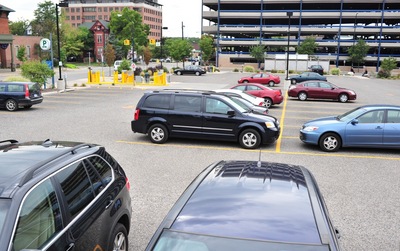
The site of the old YMCA building at Fifth and William, now called the Y Lot, is one of five city-owned sites being considered for redevelopment. A 330-room, 13-story hotel is one option DDA officials have considered for the site.
Ryan J. Stanton | AnnArbor.com
City officials zeroed in on a hotel and conference center proposal by New York-based Valiant Partners and rejected the others, but the City Council ultimately decided not to go forward with the deal, citing concerns about the project's feasibility and potential financial risks for the city.
With the DDA now taking the lead on a new process, city officials are saying RFPs might not be the way to go anymore because they haven't worked for the city in the past.
"I think the city probably needs to get out of the way in some of these instances," said Mayor John Hieftje, noting too many competing interests come into play with RFPs.
Amber Miller, the DDA's planning and research specialist, said the developer and the community weren't always finding alignment with RFPs.
Miller noted the DDA is looking at five sites at once now, so it can understand how they work together to accomplish larger goals, and those will be communicated with developers up front.
The possible scenarios the DDA has been studying for the five sites include a diverse blend of residential, retail, office and cultural uses, as well as two hotel options. That includes a 330-room, 13-story hotel on the Y Lot and a 180-room, seven-story hotel on the Library Lot.
"It's really hotel rooms that we're examining. We're not examining a conference center," Pollay said. "We were looking at residential, office, retail, hotel and open space."
Pollay said none of the DDA's scenarios actually have a conference center included. However, the 4ward Planning report notes "two of the 12 scenarios modeled involved a hotel conference center facility." Pollay said that was probably a poor choice of wording.
The hotel and conference center proposal that council considered and rejected last year proved hugely controversial and set off a grass-roots campaign complete with yard signs against it. While the DDA is distancing itself from the idea of a conference center, it's bullish on a new hotel.
"I absolutely am hearing that there's a need for another hotel in downtown," Pollay said. "I'm hearing from people who want to stay in downtown and people who are looking to book a number of rooms. The challenge is during peak periods there's only a certain number of rooms."
Chicago-based First Hospitality Group unveiled initial plans for a nine-story hotel at the southwest corner of Division and East Washington in January 2011. The developer even held a neighborhood meeting on the project, but never formally submitted a site plan.

DDA Executive Director Susan Pollay
Ryan J. Stanton | AnnArbor.com
As the city consider options for approaching developers about the five city-owned sites, DDA board member Joan Lowenstein said there are good alternatives to simply issuing RFPs. One is to first put out a request for qualifications (RFQ), where there is a pre-qualification of developers, then go with an RFP.
There also could be an RFQ without an RFP, she said, in which case a developer is selected and then a deal is negotiated; or a request for expressions of interest to elicit "out of the box" thinking.
"Some people have also suggested a design competition, since interesting architecture has already been identified as a priority in our surveys," Lowenstein said. "These are all public processes."
Hieftje said he wants the City Council to seriously consider the idea of hiring a broker and putting the Y Lot up for sale once the DDA's work is complete.
"We may want to put a caveat on it to say we're not interested in more student housing and we're leaning toward more retail/office and housing that is designed for the non-student," he said. "But don't say too much, leave it kind of open. I think it's possible we could attract corporate clients and mixed uses. That would allow us to have, I think, a better outcome than we've had with the RFPs."
Pollay agreed it might be best to avoid RFPs.
"What I've seen in the RFPs is the developers don't know what the city wants," she said. "It's to the city's interests to say 'we're not restricting it, but this is what we'd like to see built on this site' — so inform the developer what we are willing and not willing to do."
'An incredible cash register'
Allen said new development downtown not only helps drive Ann Arbor's economy, but it means more money coming into the DDA's coffers for downtown improvements.
The DDA captures a percentage of the increase in property taxes from new construction downtown, and that amounts to more than $4 million annually now.
"That's the reason the DDA is so flush with cash," Allen said. "So the DDA is a cash cow and it's just an incredible cash register, and how that unfolds over time, it's going to be interesting to see.
Peter Allen gives a report to DDA officials last year on his future vision for Ann Arbor.
Ryan J. Stanton | AnnArbor.com
Allen already is making predictions for what might happen with the Library Lot above the city's new 711-space underground parking garage, which the DDA built for $50 million. He's confident there will be a sizable park or plaza facing Fifth Avenue with potentially 15 stories of mixed-use development behind it.
"This is going to be the Downtown Diag in five to 10 years," Allen said, overlooking the site on Wednesday afternoon. "This is going to be as significant to downtown Ann Arbor as the Diag is to the University of Michigan campus."
If the Ann Arbor District Library moves forward with building a new state-of-the-art library immediately adjacent to the underground parking garage and across from the Y Lot — the two sites where the DDA is contemplating a hotel — Allen said it could become the new city center. Library officials are talking about having a 400-seat auditorium and a number of meeting spaces, and the Ann Arbor Transportation Authority is about to rebuild the Blake Transit Center across the street.
"What you have to sell is that this whole great big area is the new heart and soul of downtown, a place for downtown to come and celebrate, to grieve, to study, to have lifelong learning, to show off to their friends, just to stroll down and hear music, see art, just to be part of it," Allen said.
"It's like Bryant Park in New York. It's like a small Millennium Park in Chicago. Ann Arbor needs that kind of place, and I think this will be it and it will be a mix of office, residential and retail."
In terms of the financial markets and where investors are willing to put their money as the economy recovers, Allen said the timing is right and Ann Arbor is now perceived as a "safe haven."
"Like the $30 million condos in New York City that people are buying for art and a trophy and a safe place to park some money, Ann Arbor is now beginning to see this," he said. "This international flow of money — and looking for places to invest that are safe — is sloshing around and discovering college towns, discovering Michigan again, and really latching on to Ann Arbor."
Allen said investors are willing to get in on new development in Ann Arbor for as little as a 4.75 percent return on investment.
"People will invest in Detroit for a return of 12 to 16 percent," he said. "Ann Arbor, with 411 Lofts, it was around 6 percent. Now less than a year later, that brand-new building (Landmark on South University) has just sold at a 4.75 percent return, and I've got another client who is trying to put up a high-rise building who is happy with a 4 percent return."
While the DDA has been focused on five sites as part of Connecting William Street, Allen points out there are other sites that can be developed downtown. One of those is atop the Liberty Square parking garage, which was built years ago by the DDA with capacity to add three more stories.
"They oversized the foundations just like they did at the Library Lane site," he said. "And to put three floors of a hotel, housing, condos, flats, office — it's a huge asset of the city sitting on the books."
Ryan J. Stanton covers government and politics for AnnArbor.com. Reach him at ryanstanton@annarbor.com or 734-623-2529. You also can follow him on Twitter or subscribe to AnnArbor.com's email newsletters.
Comments
BHarding
Sun, Sep 30, 2012 : 12:54 p.m.
I wonder how we can increase hotel space without putting our established hotels out of business? If Weber's, the Sheraton, and the hotels south of it, and the Campus Inn, are hotels running at less than 65% except for big event times, is there really enough demand ? I'd love to see Dahlmann sell his parking lot for a conference center (and more parking) and get the $$$$ he needs for major upgrades for the rooms. I don't know what I'm talking about, just a thought.
Gerry
Tue, Sep 25, 2012 : 5:26 p.m.
Increasing hotel space should be the top priority.
Joe Dohm
Mon, Sep 24, 2012 : 3:34 p.m.
I think it is important to separate the discussion of whether we want skyscrapers from the discussion of whether we want a park. There are a lot of properties being discussed, and skyscraper on one doesn't preclude a park on another. It is important to understand that we can't keep Ann Arbor from changing. That said, we all have different visions for the future, with both overlap and contrast. Some of us want more things like festifools and the summer festival, and some of us feel that more economic development is important. The truth is that they support each other. No one would want to live in Ann Arbor without the cultural events and museums, the nightlife, and the good schools. But no one could afford to live in Ann Arbor without a good job. Let's find a way to make all of our goals mesh, instead of clash.
EBL
Mon, Sep 24, 2012 : 8:07 a.m.
Very good article. Sadly, it shows that for all of the talk of an open, public process, the DDA is, once again, engaged in using flawed data to rationalize a pre-determined outcome for its Connecting William Street program. Hurray to Ed and Peter for speaking the truth. The DDA did a survey for CWS which had 2000 responses. Independently analyzing the data from that survey (in particular, the open-ended questions) showed that 1) the vast majority did not want the city to put short term financial gain ahead of the long-term, highest and best use of that land and 2) A high percentage cited parks, water features, plazas , etc, when asked what they found attractive or memorable in urban areas, and, by implication, what they would like to see somewhere in our downtown. Yet the DDA has ignored this data and plunged ahead, asking if people want dense, denser, or densist scenarios, with only a postage stamp of public space on the library lot. The Parks Advisory Commission just resolved that more downtown green space be placed downtown. The Calthorpe Plan, sponsored by the DDA several years ago, after the most exhaustive public process in the city's history, identified the Library Lot, specifically, as a public gathering space/park/plaza/. Study after study shows that well-designed and properly-sited public spaces increase the value of the surrounding properties, encourages density around them, and encourages people to live and play nearby. Merely, selling off and building up every square inch of public land with no thought to public amenities would be a tragic mistake. The least the DDA could do would be to add another "scenario," asking if, and where, the public thought public open space should be placed. If the DDA continues to ignore the public outcry for a genuine public space in the center of town, they will be justly perceived as having held another sham process instead of what they claim is a truly open attempt to gain public input.
Attempted Voice of Reason
Mon, Sep 24, 2012 : 5:18 a.m.
I also would love to see a hotel downtown, near Main Street. My proposal is this: Take the Library Lot--figure out how much plaza space we want out of it. Zone it to hotel use only (except 1st floor retail/restaurant) and set a height, say 15 stories or so. Figure out a parking plan to offer, that still gives the City ownership of the land and the garage. Make a zoning specific to this property, and make it solid. Then, sell the development rights to the highest bidder, and have them otherwise go through the normal development process. Let's get the most cash from whoever wants the hotel, and then stay out of the way. No tax breaks, no city financing. Let the market decide what the development opportunity is worth, and let the City get the cash with no risk to anyone but the developer and their banks. Put all the necessary restrictions into the site specific zoning, and let the free market take it from there.
snapshot
Mon, Sep 24, 2012 : 2:25 a.m.
"DDA Executive Director Susan Pollay said the land value analysis the DDA hired 4ward Planning LLC to complete probably is overly ambitious. In fairness, she said, it's a preliminary report and the consultant doesn't have all the data in yet."Whatever it actually ends up being, it likely won't be anywhere near that number," Pollay said. "But the part that is interesting is we're starting a process that is actually looking at this. Even this preliminary work by a land use economics consultant is more data than we've ever really done." Am I to understand that Pollay is competely disregarding the hired espert's analysis in favor of her own? That the DDA is flush with cash and yet residential property owners are being killed with current property taxes and face millage after continued millage for increases in property taxes? That the mayor suggests the city "get out of the way" of development? I agree whole heartedly with him on this. In fact, I feel the DDA should get out of the way of the city. The DDA needs to go away and control of our city returned to the hands of our electorate through our "elected" officials, not unaccountable DDA appointees trying to establish a legacy at taxpayer expense.
Wolf's Bane
Mon, Sep 24, 2012 : 1:22 a.m.
Please just remember 4 things as you go on about your business: 1. Arithmetic 2. Supply 3. Demand 4. Quality of Life (Developers usually don't give @#$&* about this one)
Arboriginal
Mon, Sep 24, 2012 : 1:02 a.m.
Ann Arbor Inn.
Vivienne Armentrout
Sun, Sep 23, 2012 : 9:43 p.m.
Something I haven't seen much comment about is that for the purposes of his study, the consultant designated the entire zip code of 48104 as "downtown". I don't know what effect this would have on his calculations of value, demand, etc. and presumably it made data collection easier, but I thought it odd. As readers know, 48104 extends over a substantial number of residential neighborhoods.
Schneb
Sun, Sep 23, 2012 : 9:19 p.m.
If this was a game of euchre, selling the land--all of it--would like leading with your right bower. Once it's out of the city's hands, there's no re-do--we could end up with another Tally Hall. Slow and steady is the way smart growth happens. Build a park. If it's all that its supporters say, great! We have a nice park AND the land around it goes up in value. It will be a sparkling gem to catch the eye of the outside world as well as something for it's own citizens to enjoy. Think about it, as Peter Allen said, a park is something you show off. And people coming to Ann Arbor are not looking for mini-Chicagos, they like the look of this city because it DOESN'T consist of brick & glass canyons. A park means more of that cultural life that we KNOW works: Summer Festival, Art Fair, UMS, sports-goers and downtown theater crowds who fill restaurants and so on--jobs galore. Another high-rise residence? That's people stacked one on another, looking down at roof tops, and the rest of us walking between seeing cold bricks and glass. We'll be like bugs. How many think of the corner by U Tower/Tower Plaze and say, yes! great place! With wind whipping your hat off? No thanks. Give the park a chance. It leaves our options open. If it flops, THEN we sell the land--but we can't do it the other way around. Either way, it'll be a decision made from a market-based/what do the citizens of Ann Arbor actually want? type of approach, rather than one based on reports from consultants who 'coincidentally' give a report that suits who they see as their true customers (cough-real estate developers/business guys-cough). Build a part, lead with an off-suit ace. Smart.
Schneb
Sun, Sep 23, 2012 : 9:29 p.m.
er, make that 'Build a park, lead with an off-suit ace.
alterego
Sun, Sep 23, 2012 : 8:08 p.m.
When will there be a top-floor restaurant overlooking the town and its surroundings?
Rod Johnson
Mon, Sep 24, 2012 : 12:58 a.m.
There used to be one at what was then the Ann Arbor Inn if my memory is correct. I don't remember the view as being especially thrilling though.
Arboriginal
Sun, Sep 23, 2012 : 9:24 p.m.
Like Windows?
Tom Wieder
Sun, Sep 23, 2012 : 4:58 p.m.
The DDA is NOT a cash cow; it is a cash drain. It takes part of the city's tax revenue and spends it based on the preferences of an unelected board that thinks only about what is best for its vision of the downtown. It is time to get rid of this outdated and unnecessary mechanism for supporting our downtown. Let's forget about RFPs and RFQs. If there is an important governmental use for some of this land, then the public bodies should identify that and start building or set it aside. If not, the land should be put on the market. This doesn't take the city out of the process. We have all sorts of zoning and development codes that will help shape and control what the private buyers do with the property, and that's the proper role of the government. When the city tries to engineer what private interests do, rather than simply regulating it, we usually end up a mess - something that is neither market-efficient or maximally beneficial to the public.
Veracity
Mon, Sep 24, 2012 : 3:06 a.m.
If the DDA continues to spend more than its revenue, it will be insolvent in several years as I noted in the comment before this one. Insolvency is not allowable legally so the DDA will be disbanded. Unfortunately, the DDA's liabilities will be transferred to the city administration. The several millions of dollars of indebtedness that must be handled by the city will have a major negative impact on the city's general budget fund. Possibly a new millage or even an income tax may be necessary to supply funds to cover the accumulated DDA liabilities and ongoing obligations such as servicing the bond issues for the Municipal Building and the subterranean library parking structure.
snapshot
Mon, Sep 24, 2012 : 2:32 a.m.
Well said..I'd vote for disolving the DDA, if I could. And our city officials seem so concerned about rights and democracy. I guess its only a concern when it affects those who benefit the most from our pooled tax dollars.
PLGreen
Sun, Sep 23, 2012 : 5:18 p.m.
Exactly. How about Tom Wieder for Mayor!!
Veracity
Sun, Sep 23, 2012 : 4:39 p.m.
First, I am confused by the "Connecting William Street" designation to the development of five separated lots of varying sizes. None of the suggested property uses will link one property to another. An investor or consortium of investors will not be sought to develop all the properties with a common theme or design. The use of one property will be independent of the use of the other properties. The only commonality appears to be the DDA's urgent need to do something with the lots that will bring it money. And the DDA needs money. Peter Allen's belief that the DDA is "flush with cash" is in contrast with the DDA budgets which have for years generated less revenue than expenditures, gradually depleting its reserve fund. With the present rate of spending the DDA could exhaust the reserve fund and be insolvent in as few as two years. So the DDA is desperately searching for more revenue from its two sources. The first source of revenue is from parking fees. The recent increase in hourly parking rates downtown is an effort to increase parking revenue. The second source of revenue for the DDA is from TIF payments. Therefore, the DDA is encouraging new construction downtown and of very large dimensions since the higher post-construction property valuation the more TIF money is generated. However, in what can only be called schizophrenia, the DDA and City Council have consistently returned TIF payments to developers as remuneration for site development costs. This gifting of tax money back to developers may have been part of inducement packages intended to attract development. The end result is that the DDA and City Council will not realize a financial return from the developments for years into the future. Meanwhile, readers should remember that all five of the properties that the DDA wants to sell and have developed are presently generating revenue for the DDA (in the form of parking fees). These properties may ultimately not generate finances for the cit
ocho
Sun, Sep 23, 2012 : 4:33 p.m.
I read a lot about the 5 downtown properties but hear nothing about William St? Is it just a given that more development will spring William St to life? Second, I feel that city-owned property should benefit the people of Ann Arbor directly and that the $$$ from the sale of property or taxes should not be the only priority. I am in favor of a park/plaza. I don't see how the artist rendering of the Library Lot amount to 'Ann arbor's diag.' I'm skeptical that the DDA places much value on downtown open space. I think that the City/DDA is late to determining a vision for these 5 properties and William St. If this were taken seriously years ago then the Library, AATA, City and DDA could have included the Library and bus station in the visioning in conjunction with parking options. Finally, I previously wrote my Council members to suggest a 'trade' of Liberty Plaza for a new, better designed downtown open space (develop Division/Liberty, let's make something better for the community). The renderings I've seen of the Library Lot show an plaza entryway to whatever is build there but doesn't come close to matching what I've seen in my travels that I'd like to see in Ann Arbor.
cbs
Sun, Sep 23, 2012 : 3:26 p.m.
I don't know Peter Allen personally, but I really like the way he's thinking. His vision for the Connecting William Street project and that area of downtown is so right on. I haven't heard anyone make a better case. From Ryan Stanton's article: " He's confident there will be a sizable park or plaza facing Fifth Avenue with potentially 15 stories of mixed-use development behind it. "This is going to be the Downtown Diag in five to 10 years," Allen said, overlooking the site on Wednesday afternoon. "This is going to be as significant to downtown Ann Arbor as the Diag is to the University of Michigan campus." "What you have to sell is that this whole great big area is the new heart and soul of downtown, a place for downtown to come and celebrate, to grieve, to study, to have lifelong learning, to show off to their friends, just to stroll down and hear music, see art, just to be part of it," Allen said."
xmo
Sun, Sep 23, 2012 : 3:08 p.m.
Simple and sweet: " Sell them and put them on the tax rolls. "
snapshot
Mon, Sep 24, 2012 : 2:36 a.m.
Veracity you seem to miss zmo's point.....city sells the property, a developer buys it and decided to build something at their own expense, city increases tax base and is not responsible for profitability. You seem to be stuck in the "city property" mode.
Veracity
Sun, Sep 23, 2012 : 4:06 p.m.
XMO- You are consistent and persistent with your "Field of Dreams" view of Ann Arbor investments. Well, "build it and they will come" doesn't work for many speculative construction projects, especially hotels in downtown Ann Arbor. Valiant Partners expected a profit from their hotel/conference center but only IF hotel occupancy would exceed 75% and nightly room rates were $200. The average Ann Arbor hotel nightly room occupandy rate is 62% and the nightly room rate is presently about $84. No wonder Chuck Skelton, a hotel hospitality expert, did not consider Valiant Partners proposal as feasible and City Council ultimately rejected the proposal. If whatever is built on city property does not generate enough revenue to accommodate TIF payments then Ann Arbor would gain NOTHING financially.
utownie
Sun, Sep 23, 2012 : 2:31 p.m.
RUKiddingMe has it right. The consultants work for someone and such an unrealistic report should never have been accepted. It's a waste of money because no one believes it is even close to the truth. Ann Arbor is not good at big developments. The RFPs usually rely on funding from the city to make it all work. Next time, why not lease the land? Include a general tax payment and make the developer invest all of the funding for the construction. If there is a default, the city still owns the land. No city funds are at risk, other than land value. At least one day the land will be returned in some condition. Harder to make a mistake, but I will not hold my breath.
say it plain
Sun, Sep 23, 2012 : 9:09 p.m.
I really do think the consultant reports are just marketing materials for the DDA to use with developers... they're being rather transparent with this plan lol, by saying they don't even want to do RFPs this time, d'oh! Just get brokers selling the goods, let the city 'get out of the way', cute! Leasing the land sounds like a great idea, but given the great certainty a developer asked to fund the construction costs would need to have in a good return in such a scenario...can you imagine that happening in today's iffy economy?! Don't think so...not unless there was clear need for something, preferably not based on consumer behavior or job security or one of those tricky factors. Maybe the University could lease the land and build their own conference center?! Could run a hotel too...develop a hospitality program with it? Help the liberal arts majors by offering a certification program in say barista-ing lol?!
sellers
Sun, Sep 23, 2012 : 1:48 p.m.
wow - three stories above the Liberty Square lot - that would be a great downtown office building for someone. Wish that was around 5 years ago....
Brad
Sun, Sep 23, 2012 : 1:03 p.m.
The DDA isn't a "cash register". They aren't "creating" that $4 million per year, they're just an unelected shadow government that is allowed to skim $4 million per year from the property tax stream and use it solely for downtown purposes. The rest of the city would sure like to share that $4 mil just like we do with all the other property taxes.
DJBudSonic
Sun, Sep 23, 2012 : 12:59 p.m.
If this land was really worth $50 million, think how fast the DDA and city could spend that. $50 million barely buys a 700 car parking hole these days... It's OUR land to sell or keep, right? City owned land means owned by the people of Ann Arbor, not solely by the DDA, not solely by the City Council or Planning Comission, by EVERYONE. And it should not be disposed of without a vote of the people, or at least a true, transparent and representative process, safe from the back room deals that characterize so much of what happens in this town. If you don't think this is true, attend a few city committee meetings related to planning, it is but a handful of elected and appointed officials, real estate interests and builders who decide how to spend our money.
Vivienne Armentrout
Sun, Sep 23, 2012 : 12:50 p.m.
Thanks for this interesting overview. I'd like to know who bought the property on N. Main that was going to be the Gallery and was the old church before being demolished recently. That was an example of an over-hyped, over-leveraged development that never made it. Have the circumstances really turned around so that any development other than student housing will be successful? BTW, what is happening with Ashley Terrace these days?
say it plain
Sun, Sep 23, 2012 : 8:57 p.m.
Thanks for all that good info @Veracity! I think, though, that as Peter Allen paints the picture, it doesn't matter what the reality on the ground is...it only matters whether the 'brokers'--like the mayor wants to bring in to do the dirtywork here-- can convince developers with pools of international investors that Ann Arbor is a 'safe haven' for parking their money, low rois and all... they're just looking to put their hoarded riches in assets that aren't like equities lol...you know, that you can touch and feel and house your countrymen in if worse comes to worst. And, of course, the smartest money knows the global economy is such a treacherous house of cards that preparing for the worst is not at all a bad idea! And surely the press and the UM and the governor are doing their best to reach out internationally to...um...help sell buildings and development schemes and university degrees! Maybe that's where the consultant class has us beat in terms of analysis...then their admittedly too-high numbers become part of the marketing materials, perfect!
Veracity
Sun, Sep 23, 2012 : 3:55 p.m.
Ashley Terrace was built with $20 million loan from Bank of America and The LaSalle Group. The resulting condominiums were over priced due to the high construction costs. When Ashley Terrace entered bankruptcy, a private investor bought it for $6 million and converted the building to apartments. Because of the lower cost basis, the new investor was able to offer reasonable leases and the building is fully occupied and generating a profit. The costs of constructing big buildings in Ann Arbor remain high which will mean that resulting apartment leases will be expensive if any profit is to be realized. Thus, new high-rise student residential units lease for over $1000 a month per occupant. With 62% hotel occupancy and another 5% (230 rooms) of new hotel units soon to come on the market near Briarwood Mall, further hotel expansion faces the risks of saturation and accompanying falling rental rates. Profits will be more difficult to generate from new construction and further bankruptcies will result which is not financially favorable for Ann Arbor.
RUKiddingMe
Sun, Sep 23, 2012 : 12:30 p.m.
So the DDA uses your tax money to hire a consultant to tell them how much land is worth, and they get numbers that everyone agrees are ridiculous. So people who are paid your tax money and are supposed to be at least SOMEWHAT knowledgeable about land use and developing it use MORE of your tax money to have someone ELSE estimate what land is worth, and then get back ridiculous numbers. And now they will continue to use your tax money to sit on land and do nothing with it, using more of your money to pay interest-only payments on at least one of the parcels while it lies fallow and useless. SELL THE LAND, LET SOMEONE START PAYING TAXES ON IT, AND ABOLISH THE DDA.
snapshot
Mon, Sep 24, 2012 : 2:39 a.m.
I'm with you RU.....can we get a proposition to amend the constitution going....that seems to be the trend these days.
Chase Ingersoll
Sun, Sep 23, 2012 : 12:23 p.m.
They want to have their cake and eat it too. Ergo, they want to have all of these public plantations, where they can meet and pat themselves on the back, but at the same time they all love eating (bureaucrat salaries) of the private revenue paid by the owners of private property. Oh how hard their jobs must be facing such a horrible conundrum. Chase Ingersoll
greg, too
Mon, Sep 24, 2012 : 4:45 a.m.
What they want are tall buildings with high rental rates and occupancy surrounding pretty, underfunded (until there are more millages) parks. Hippie Ann Arbor meets urban whatever they think they are. This isn't the town that I was told I had moved into. If I knew there was this kinda mindset, I would have stayed in Chicago.
Karen
Sun, Sep 23, 2012 : 11:10 a.m.
Are the DDA elected officials? It's our money - I think we should be involved in the planning. I thought that was what the City Council was for.
HB11
Sun, Sep 23, 2012 : 1:15 p.m.
They're appointed by the mayor.
Stephen Lange Ranzini
Sun, Sep 23, 2012 : 11:03 a.m.
"We're not examining a conference center," Pollay said." "Library officials are talking about having a 400-seat auditorium and a number of meeting spaces." If the Downtown Library mileage passes, won't the $65 million building that is then built serve as the conference center our city leaders want to build downtown?
Peter Baker
Tue, Sep 25, 2012 : 4:14 a.m.
No.
Stephen Landes
Sun, Sep 23, 2012 : 9:54 p.m.
Nice thought, but it won't be big enough to really attract conference center business. We would be better off if the DDA and local developers took a long look at the entire area -- all the little parcels plus the top of the new garage and the footprint of the existing library -- and developed a comprehensive plan for the whole area. We may find that there are larger projects that could be done which could incorporate open space and a new library IF they are planned together from the beginning.