

School districts looking to cut costs face unpopular choices over bus service
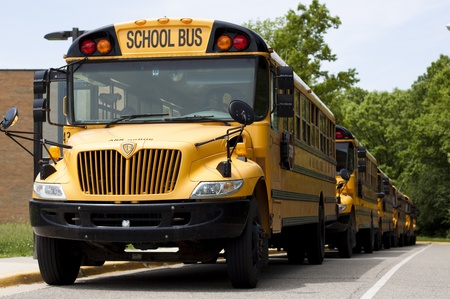
Buses wait for students outside Huron High School on Friday afternoon.
But several school districts in Washtenaw County are looking to change or reduce bus service in order to save money in the coming school year. And none more so than Ann Arbor Public Schools, which is considering eliminating bus service for high schoolers.
That possibility has not created a huge outcry in a district where about two-thirds of the high school students who are eligible to ride the bus don’t. But it has raised questions about the burden it would put on some families - and about the possibility of losing students to other districts that aren’t considering such dramatic cuts in bus service.
Martine Perreault, chairwoman of the Ann Arbor Parent Teacher Organization Council, told school board members on Friday that the district would be "cutting off our nose to spite our face" if it stopped offering bus service at the high school level.
"We are a very large geographic district and high schoolers living in the outlying areas may choose to go to other districts that are very willing to run over a bus and pick them up," she said.
Ypsilanti Public Schools and Saline Area Schools have both tossed around the idea of cutting high school transportation or cutting transportation services in certain areas of town. However, both districts ultimately decided the savings were not worth that drastic step.
Instead, both are looking at more modest changes to bus service that could save anywhere from $85,000 to $250,000.
David Arsen, professor of educational administration and policy in Michigan State University’s College of Education, said the plans for transportation reductions in Ann Arbor, Ypsilanti and Saline may save the school districts money but are ultimately pushing the costs onto parents instead of the schools.
“Basically, districts are shifting the cost of transportation services from the district budget to families who have to provide transportation themselves,” Arsen said. “It’s a pure form of privatization.”
Eliminating high school transportation and after-school shuttles is expected to save Ann Arbor schools about $1.482 million. District spokesperson Liz Margolis said she’s heard a few complaints about the proposed cut, but not nearly as many as the principal-sharing proposal that was taken off the table by the Ann Arbor school board last month.
There's a chance that the cut to high school transportation may not be included in the final budget, which the school board is expected to vote on Wednesday. At a study session last week, the board discussed a number of other measures that could be taken instead of cutting high school transportation.
Among the proposed ideas were eliminating noon-hour transportation for kindergartners by not dropping off morning kindergartners at home and not bringing afternoon kindergartners to school, enforcing walk zones to bus stops, expanding walk zones to schools and using common pick-up points for high school students, such as elementary schools.
Board members seemed interested in the idea of using common pick up points, which would save about $670,000, and enforcing the board's policy for a half-mile walk zone to bus stops, which would save about $500,000.
School officials have said over and over throughout the budget process there are no ways to make cuts to services without impacting students. Around the country, schools are transferring more and more costs for programs and services to families in order to continue to offer them.
Before the 2010-11 school year, AAPS instituted a pay-to-play system for middle school and high school sports to help cover the costs of athletic programs. Saline schools and the Chelsea School District have also instituted pay-to-play systems to save money on athletic programs.
AAPS is attempting to fill at $15.1 million budget deficit for the 2011-12 school year. Eliminating high school transportation is one of many cuts in the proposed $182.4 million budget, along with the elimination of 70 full-time teaching positions.
Interim Superintendent Robert Allen said only one-third of the 4,700 eligible high school students actually use bus services. The $1.482 million savings is the largest single cut the district is considering, other than the $7.1 million the district would save by eliminating 70 full-time teaching positions.
The district has been working with the Ann Arbor Transportation Authority to possibly adjust bus times to coincide with high school bell times for students who need to use the service to get to school.
There is the possibility that the district could end up getting enough money from the state to avoid cutting high school transportation. In the budget deal passed by the state Legislature last week, school districts will receive a new $300 per pupil cut and have a $170 per pupil cut not restored but could have up to $100 per pupil restored by meeting certain state standards for best practices. In Ann Arbor, that would mean about $1.6 million.
Major cuts to transportation are something smaller county school districts — in terms of student population — have put off because of the larger geographic areas they need to cover and the dependence of their students on school buses.
Bryan Girbach, superintendent of Milan Area Schools, said the district’s budget doesn’t currently have any drastic cuts or changes to transportation. However, district officials will be going into negotiations with their bus drivers union, as it does with all of its union groups, in the future.
Girbach said his major concern when cutting transportation is the effects it can have on student achievement.
“If students can’t get to school and absenteeism increases, that increases the concern about student achievement,” he said.
While he doesn’t know what the next few years may hold for the district’s budget, Girbach said transportation probably won’t be something district officials will be looking at in the near future.
“I don’t see that as one of the top items to look at for budgetary savings,” he said. “Maybe we’ll look at walking distances to make some minor changes and achieve some minor changes but I don’t see any full-blown cuts to transportation.”
Much of the consternation around the cut of high school busing in Ann Arbor focuses on whether or not some students would be able to get to school without district bus service.
Michele Machiele, president of the Huron Parent Teacher Support Organization, said most of the concern she’s heard about the proposed plan for high school transportation is about equity issues.
She said many parents she’s spoken to have the means to get their kids to school on their own but are worried about the families that don’t.
“We do look out for each other and yeah, it’s tough and getting tougher, but we don’t really want to make it harder for kids who are already having a hard time getting (to school),” she said. “We’ve got to make sure they don’t have hurdles to get there.”
The three comprehensive high schools in Ann Arbor already charge students who drive to school for a parking space. To park in the reserved lot at Huron High School, the cost is $60 per car and general parking is $30, with a limited number of spaces available for juniors. A parking space for the school year at Pioneer High School is $40 and the cost is $30 at Skyline High School.
The Community High School parking lot is owned by the city of Ann Arbor and is returned to public use after school lets out in the summer.
Machiele said she understood why the cuts were being considered and said parents at Huron will adjust. She said she hoped the board would look hard at other cuts to fill the budget deficit, and would get the proposed high school transportation cut off the table.
“Because the economy is the way it is, all of us are determined to live within our means and we’re all making sacrifices to keep things that are important to us,” she said. “The culture at Huron is we’ll take our medicine, we’re grown ups and we see there are cuts to be made. It’s not my favorite cut. There are some other things that could be looked at.”
Ypsilanti school officials are considering modifying bus routes and protocols, such as revamping routes and ending a tradition of transporting in-district school of choice students from their homes to school. Instead, students will be required to get to the nearest school building, where they will then be picked up and transported to their school.
Chief Financial Officer David Houle said the modifications to transportation would save the district about $250,000 if included in the final budget. He said transporting in-district school of choice students from home to schools potentially across the district was a service set up by past school boards meant to please everyone.
Ultimately, it cost the district thousands of dollars, Houle said.
“Previous boards of education wanted to provide service to answer any parent’s request,” he said. “So they ended up having the district in a situation where we’re driving from one end to the other. In this economy and funding situation, we had to look at that and see if it made any sense and there are more efficient ways to do it than that.”
Ann Arbor and Ypsilanti are both a part of the Washtenaw Intermediate School District’s busing consortium, along with Willow Run Community Schools. Ypsilanti parents had numerous complaints about the new consortium during the beginning of the school year, but the complaints have diminished in recent months, at least publicly.
The school board voted to spend up to $180,000 on bus services from Trinity Transportation Inc. in November to help ease strain on the busing system.
Houle said the district’s budget advisory task force, made up of about 20 community members, had floated the idea of cutting high school busing earlier this year. He said there hasn’t been any momentum behind the idea to this point.
“I think it’s unlikely we’re moving in that direction this fall,” he said. “But it’s something that every school district has to take into consideration.”
WISD transportation director Tom Moore said no bus drivers are expected to lose their jobs because of the busing changes. He said his department is expecting to hire new bus drivers for the fall.
In Saline, district officials listed a number of possible cuts to transportation at the district’s first budget forum in April and heard the community response loud and clear.
Superintendent Scot Graden included privatizing transportation, eliminating transportation, eliminating in-town busing or reducing the number of stops and eliminating transportation for athletics among the possible budget cuts, but all were eventually ruled out.
However, the district does have the elimination of midday busing in its proposed budget, Graden said. The district would not provide buses home for morning kindergartners or provide a ride to school for afternoon kindergartners.
Graden said the district currently requires a parent to be home when a kindergarten student is being dropped off or picked up, so the availability of those parents is already high during the day. The move is expected to save about $85,000, Graden said.
“It’s not been decided yet; there are conversations at the board level of whether it’s worth the savings,” Graden said. “That’s the only thing left on the table (as far as transportation).”
Saline schools are currently attempting to fill a budget deficit of about $6 million for the coming school year.
The feedback the district has received was overwhelmingly against cutting transportation, Graden said. He said district officials came to the conclusion that potential reductions in bus service would harm classroom learning because of the increased time it would take students to get to school.
“Getting kids to school on time would provide a significant burden from our standpoint,” he said. “We’re making sure we’re not hurting the classroom. If kids can’t get to school, they can’t learn, and we need to consider that when handling our transportation.”
Kyle Feldscher covers K-12 education for AnnArbor.com. He can be reached at kylefeldscher@annarbor.com or you can follow him on Twitter.
Comments
Townie
Tue, Jun 7, 2011 : 4:49 p.m.
Well, once again the Republicans (Slick Rick and his legislative buddies) have transferred the hit and blame to the things that really had nothing to do with the mess we're in. So how did we get ourselves into this financial mess? We voted in a group of Republicans who decided to grant $1.7 trillion in tax cuts for the wealthiest and then started two wars -- all on the same credit card. Then we (Demos and Repubs) voted to deregulate the wonderful 'financial' sector who proceeded to destroy our economy with mortgage fraud (no one went to jail...) and now we're down to this: destroying public education, public safety, etc. They (Republicans) have us scrambling for the crumbs while constantly saying 'look there' to unions, public sector folks, etc. for the 'culprits'. I guess we deserve what we get. But let's not let them get away with it and vote middle class in the next election. The future of our country is at stake.
SharonZS
Mon, Jun 6, 2011 : 8:30 p.m.
The highlighted comment above noting that parents who will be most affected having no idea that this might be happening is very likely. Strictly anecdotal--- my sister-in-law, a single mother who speaks very minimal English and works 60+ hours per week beginning at 6 am most mornings, has absolutely no clue that my nephew might not have bus transportation when he enters Skyline next fall. I suspect that many households headed by non-English speaking parents and/or low SES households hanging on by their fingertips have no idea that this is even being discussed. The District should take visible steps to constructively address potential problems (i.e. why not work with AATA so that AATA buses leave from Blake to get HS students to schools on time). How about actively soliciting and listening to the concerns of parents who will have difficulties if this is enacted? I really believe that these cuts really could work out with some proactive planning and obvious attention/problem-solving for those who will have difficulties getting their children to school.
PhillyCheeseSteak
Mon, Jun 6, 2011 : 3:37 p.m.
Eliminating high school busing would affect our family a lot. My daughter attends Skyline H.S. because of the open enrollment policy. Skyline H.S. is a long way from our home, and she takes the school bus to school (from Pioneer) and the AATA bus home. I would not be able to driver her to school: 1. because of my work schedule; 2. my unwillingness to spend 40+ minutes 5 days a week chauffering her; 3. the cost. I called the principal's office at Skyline to voice my concerns but was told they weren't taking parent feedback on this issue. I've also called the AAPS Transportation Department and they said I should wait until the end of August to learn what's been decided about this issue. (Sorry, not very helpful in making plans!) I haven't contacted Liz Margolis, but I will, as well as the school board. Interestingly, the one AATA bus route that serves Skyline H.S. (Route 18) does not even stop at Blake Transit Center until 9:33 am. (Previously, when I contacted AATA about the schedule that the #7 bus stops at Pioneer H.S., to explain that students would either be late for class or a 1/2 hour early, the response I got was that AATA creates their schedule for people who work downtown, not for students.)
Kyle Feldscher
Mon, Jun 6, 2011 : 3:04 p.m.
A name on this story has been corrected.
Len J Sunday
Mon, Jun 6, 2011 : 2:43 p.m.
I went to school in Chicago, Il. There was no free bus service. My parents gave me money for the bus to and from school. Public or private school made no difference. I took 3 buses to get to high school. I commuted to college. My parents could not afford to send me away to college. I lived in a 4 room apartment. The bedrooms were so small that my dad took the doors off. I shared a bed with my brother. Stop whining. Pay as you go.
jmac
Mon, Jun 6, 2011 : 1:45 p.m.
Not to pick on Liz Margolis but I was amazed to read that she'd only heard a few complaints about the high school bus cutting proposal, despite the (several) active threads on this topic on Ann Arbor.com! So I just emailed Ms. Margolis to make sure she's heard my concerns. You can, too, here's her email address: margolis@aaps.k12.mi.us And school busing for High School kids is no joke, the nearest AATA bus stop to my house is over 2 miles away and over an I-94 overpass; not safe and too far with heavy backpacks, etc. I can drive my kids there but can't leave work at 2 in the afternoon to pick them up at 2:30 after 6th period, so need the buses, period.
Jon Saalberg
Mon, Jun 6, 2011 : 1:06 p.m.
Why not cut all bus service? Who decides what is the "right" age for kids to need or not need bus service? I am 100% against cutting any bus services, but if it's done, it should affect all kids, not some arbitrary measure that has nothing to do with fairness - if it's about cutting enough bus service to make the budget work, the Board should say so - stop trying to rationalize a process that is clearly not objective.
mw
Mon, Jun 6, 2011 : 12:41 p.m.
High school bus service was a joke anyway. My kids could have walked three miles to school and gotten there on time as easily as riding the bus -- which came to by our street almost a full HOUR before school started even though Huron is about a mile and a half away. When they got delivered to the school 45 minutes early, they couldn't even use the school library to study. So they drove, usually carpooling with 3 or 4 other kids -- which made it both more time AND energy efficient than the bus (because the schedule was so bad, the bus was not heavily used).
Tony Livingston
Mon, Jun 6, 2011 : 12:53 p.m.
I think the school system wrecked the schedules when they started bussing everyone, everywhere. We have the same situation and the morning pickup time was move up 15 minutes when Skyline opened so kids can ride to Pioneer and then transfer to Skyline. I don't think we should provide that kind of transportation. If you choose and alternative school, then you should have to get there on your own.
RayA2
Mon, Jun 6, 2011 : 10:55 a.m.
I'd just like to say thanks to governor Slick for his part in making sure the poorest children have a more difficult time getting an education. This was long over due. Slick's friends have been wanting to make that campaign contribution to the party of the wealthy for years now and these needed school cutbacks will finally enable them to cut that check. Some of course will be upgrading the boat or summer home but that's all necessary for the trickle down economic system. Maybe if these lazy children who require such handout would just get their limo drivers up earlier in the morning, they wouldn't have any trouble getting to school.
OLDTIMER3
Mon, Jun 6, 2011 : 7:27 a.m.
@ffej440; It was 1956 Ithink when they forced all the one room schools to move into the big city schools. Sure Saline had a School earlier than that but they still had the country schools. Do the funds they get for all day kindergarten for the 1/2 day students pay enough for the 2 extra bus runs at the 1/2 day mark plus the funds you mention?
John A2
Mon, Jun 6, 2011 : 5:06 a.m.
Another thing is the high schools have way too much property too. Take pioneer for instance. The waisted land there is just a waist. Yet it makes great parking for Stadium, it is a waist of land for us. Prime business area but for some unknown reason we need to keep it and pay to keep it up and fix all the damage that the U OF M football parking caused. WHY? Lets sell it to the U and they can build a really big parking structure for the games. Lots of people like to tailgate but they can do it in the parking lot because it will be all concrete. There is just too much waisted space we are paying to keep up, I wonder how much money we can save by getting rid of our waist of space. I bet it can run into the tens of millions. It can also be used throughout the year as a park and ride, for people can park there and take the bus the rest of the way into town. There are plenty of outside of the box ideas just waiting to be explored.
Tony Livingston
Mon, Jun 6, 2011 : 12:51 p.m.
AAPS also owns the land across 7th from Pioneer.
John A2
Mon, Jun 6, 2011 : 4:50 a.m.
Lets see here, this looks like a safety issue too. We let the kids off a half of mile from there home, or not drive them at all. I don't know were these choices come from, but there are a lot of perverts out there that would love to have a chance to kidnap someone. No cops, no firefighters, no school bus, hell why don't we just give our kids to some perverts. Here is an open invitation for criminal activity. > ARE YOU PREPARED TO PAY THE ULTIMATE PRICE TO KEEP OUR PARKS AND MAKE THEM NICE FOR THE FAT POCKETS CAN HAVE A PICNIC? Sell some land, we have too many parks as it is and we have to pay to keep them up. I don't like all this ^&%$, and it's starting to look like we are being punked. Our property value already took a hit and lots of people like me lost a ton of money on real-estate. these measures are going to just keep pushing our values down. Where do we draw the line and say enough is enough. Sell some park land to some developers. bring in more tax payers. I have been in just about all the parks in A2 and they are mostly all way too big to keep up. Veterans park for instance has some 5 Baseball fields, a pool, an ice skating rink, and five or ten acres of grass. This is a waist of space. Ten acre at 1.6 million a piece, prime business lots, and we don even need to come close to recreational areas by this act. All the space there on Maple Rd, from Jackson to Dexter Roads, at least 600 feet deep except the parking lots are waisted space. It's not like there is a beautiful view there either, and this will bring in money from sale, tax, and employment. We need to loose our public safety like we need more crime and perverts from Detroit coming here for a feast.
Townie
Tue, Jun 7, 2011 : 4:42 p.m.
Waisted? You've made a great argument for better educational standards. Let's sell all the parks and build factories, right? More developers? They can't sell what they've built. 'Prime business lots..' - for what? Businesses? Plenty of empty lots.
Dog Guy
Mon, Jun 6, 2011 : 1:57 a.m.
I suspect that outsourcing to a private transportation concern would save money and that outsourcing to AATA would triple the cost.
Edward R Murrow's Ghost
Mon, Jun 6, 2011 : 2:09 a.m.
And I suspect Elvis, ET, and JFK are alive and well in Roswell. Good Night and Good Luck
kms
Mon, Jun 6, 2011 : 1:49 a.m.
Before we eliminate busing to and from school, we should eliminate bus transportation to all athletic events. Ann Arbor routinely competes with schools 50+ miles away in the Southeastern Conference...Bedford, Monroe, Adrian, Tecumseh. Why can't we compete with schools closer to home...South Lyon, Brighton, Plymouth?
HaeJee
Mon, Jun 6, 2011 : 2:33 p.m.
That is why we pay to play, to pay for busing.
stunhsif
Mon, Jun 6, 2011 : 2:32 a.m.
@kms: Mapquest all of those schools and I believe the only one over 50 miles is Monroe. You want to eliminate sports busing and you will soon see Ann Arbor athletes going to Saline and other schools.
Greg Gunner
Sun, Jun 5, 2011 : 11:37 p.m.
Although the Ann Arbor school board along with other school boards are being made out to be the villains in this story, not to mention the teachers, the real villains are Slick Rick Snyder and and the Republicans who continue to push an anti-public school agenda upon the residents of this state. How dare teachers ask for a livable wage? Who do they think they are, college graduates with 20-30 years of committed service to their school districts? And the students are way to pampered, afterall I'm sure Slick Rick and his business colleagues walked 10 miles a day through two feet of snow to get to school when they were children. Today's students don't need bus service, as their unemployed or under-employed parents can drive them to school every day. Our wealthy businessmen need the money more than the schools, and Slick Rick is doing his best to make sure they get their hands on as much of your money as they can, all without the public realizing that their pockets are being picked.
Basic Bob
Tue, Jun 7, 2011 : 2:14 a.m.
"How do you know that the schools are not managing money well?" The fact that they want to threaten us with cuts to bus service, while hiring a superintendent for roughly twice the going rate, while keeping SIX high schools open, while keeping numerous failed administrators on special assignment. IMHO, this is not what I would call effective management. Not to mention that A2 schools gets loads more money per student than other school districts to teach the exceptional children of the highly educated. Do they teach future teachers about budgets in the education program? It should be a requirement.
HaeJee
Mon, Jun 6, 2011 : 2:43 p.m.
@ basic bob, I think you missed the point. Rick Snyder has DECIDED to cut education funding. This action only means that education is lower on HIS priority list. He could have DECIDED to increase taxes for the wealthier and not cut education funding. Do you work in public eduation? Do you have a degree in education? How do you know that the schools are not managing money well?
Basic Bob
Mon, Jun 6, 2011 : 2:01 a.m.
Really, you believe that Rick Snyder caused the financial difficulties before he was even elected? This is not a new problem. Thanks to term limits, our state government is a revolving door, but the problems remain. Don't blame the politicians, blame the inability of local school districts and their employees from managing other people's money. These supposedly well-educated people are fleecing the taxpayers, while alternately whining to the left and blaming the right.
Gardener1
Sun, Jun 5, 2011 : 11:20 p.m.
For our daughter, it would be a 4 mile walk to the AATA and then at least a 45 minute commute with at least one transfer to the school. One of the reasons some high school students do not ride the school bus is the very early time they would have to get up. Last year our daughter caught the school bus at 6:00 am, rode it at least 10+ miles as it picked up other students then did a transfer at Huron at 7:15 am. In the winter, it was scary to be out on the country rode in the dark. The driver even drove past her once and a neighbor, who happened to be there, took her to the next bus stop. The return trip got her home from high school about 4:45 pm with school out at 2:45 pm. They really need to rework the school bus routes to make them humane. I was hoping to not have to buy a car, pay the extra insurance, etc. for her to get to school once she turns 16. The safety issue, especially during the winter, whether it is the school bus or teens driving is another factor. Come up with good bus times and routes, more students will ride. According to the numbers, over 1500 high school students ride the school bus. How many students live outside the AATA zone? Probably more than people realize.
WhyCan'tWeBeFriends
Mon, Jun 6, 2011 : 5:33 a.m.
I'm thinking the kids who are driving to school should pay the $20-30 per month for parking - that's a bargain for AA monthly parking. If they, or their parents, can afford a car, gas, maintenance, insurance, then surely this small sum won't be felt. Apparently 2/3 of the students fit this category. I won't try to do the math since that is a hot button issue here, but maybe charging 2/3 of the students would cover the bus costs for the other 1/3 who are not so wealthy. Wait, that sounds like redistribution of wealth - someone is bound to complain about this idea too.
treetowncartel
Mon, Jun 6, 2011 : 3:01 a.m.
Move to the city
AMOC
Mon, Jun 6, 2011 : 12:17 a.m.
I suspect at least half of the 1/3 of the eligible students AAPS claims ride the bus now are doing so because they live in areas far outside the AATA service zone. It would make a huge amount of sense to survey parents / students as to which kids will need bus service and revise the bus routes to pick them up, with no single route requiring more than a 30 minute bus ride. Then charge high schoolers $20-30 per month for the privilege of riding the bus, with the pas revoked if the student misbehaves.
Huron74
Sun, Jun 5, 2011 : 11:11 p.m.
Pushing the cost over to the parents/households that likely least able to afford the cut. In high school IIRC no wanted to to take the bus (cuz it wasn't cool, esp. at Huron where I went) and didn't unless they had to mostly for economic reasons. The families that bought their kids a car at 16 so they didn't have to drive 'em around don't care. But they make enough $$$ so they don't need to care.
a2phiggy
Sun, Jun 5, 2011 : 8:36 p.m.
I do not understand people's arguments that senior high students have AATA as an option. For us to get to our child's high school, it requires two transfers and then a 5 block walk. I don't know anyone who would want their child - at any age - to take that on - especially in the middle of winter. This is about difficult financial choices - but eliminating high school busing is the wrong choice.
masticate
Tue, Jun 7, 2011 : 9:32 p.m.
@Andrew Smith walking 5 blocks to the bus stop, then riding that bus to the downtown station, to hop on a different bus, to ride to high school could easily total over 1.5 hours of transit time. sounds like a huge timesuck to me. but of course it's easy to point the finger at other people and tell them to change their lifestyles when you're not the one that has to.
HaeJee
Mon, Jun 6, 2011 : 2:46 p.m.
My child would have to walk over 2 miles to an AATA stop. I agree with you. @Andrew Smith, does your child really walk 1.5 miles everyday to school or do you drive them?
Andrew Smith
Sun, Jun 5, 2011 : 9:45 p.m.
Is someone on this forum really complaining about her or his child having to walk five blocks? My child must walk 1.5 miles everyday - because the district says that we live "too close" to have a bus. Get real! If your child needs to walk a couple of blocks to get to an AATA stop, and then transfer, that's still better than walking 1.5 miles - even if it's below zero outside and snowing!
DonBee
Sun, Jun 5, 2011 : 7:30 p.m.
There is another alternative to cutting busing or salaries. That is cutting the 3 million dollars the district spends on Varsity sports. Moving to purely intramural sports would involve more students, reduce the clicks in the schools (and bullying) and provide the money to cover the step increase for teachers this year, as well as most of the busing. But there is no way the BOE would dare touch the sports rail given the rabid parents and fans. The sports program is not like the UofM, where it is self funding, but rather is a hugh sink for funds - $3,262,000.00 from the general fund and $600,000.00 from the sinking fund that the schools admit to in 2010/2011. Almost $4 million dollars that the school does not HAVE an obligation to spend. Like busing there is no requirement to provide any sports, only a requirement to make the number of opportunities proportional for boys and girls, so if the number is zero, Title 9 is satisfied. The board will give sports a haircut, but that will be all. Busing, teachers, HEAVE HO and OVERBOARD they go.
Edward R Murrow's Ghost
Mon, Jun 6, 2011 : 8:12 p.m.
Likely to cost almost as much money as it saves, and perhaps more. Good Night and Good Luck
Tony Livingston
Mon, Jun 6, 2011 : 12:49 p.m.
Sports are huge drain on resources. But, theater (at Pioneer anyway) brings in large sums of money. My guess is that it is very close to self supporting. Go to any sporting event and you will see a handful of parents paying $5 entry fee. Go to a theater event and you will see hundreds of people paying $9 - $12 per person. Multiply that by 5+ productions with multiple performances every year and you come up with thousands of dollars in ticket sales. I have a child in sports and a child in theater and theater is by far the better program -- more opportunities on and off stage, runs all year, much less expensive, and much more related to education. As far as music is concerned, it really is in a different categoy. It is an academic class, not extracurricular. They also raise a lot of their own money through booster club and fees to cover trips, etc.
DonBee
Mon, Jun 6, 2011 : 3:08 a.m.
Treetowncartel - Yes, I did, my spell checker missed it and so did I.
treetowncartel
Mon, Jun 6, 2011 : 2:59 a.m.
Do you mean cliques?
kms
Sun, Jun 5, 2011 : 9:16 p.m.
My kids participate in several high school sports and benefit from them greatly but I have to agree...sports, music and theater programs should be cut before axing busing to and from school.
Mikey2u
Sun, Jun 5, 2011 : 7:28 p.m.
Let's get back to one-room schoolhouses. Each schoolhouse would teach K- 12. Each schoolhouse would accommodate approximately 80 students. There would be one schoolhouse to serve the children of a half-mile radius. All children would walk to and from school. Teachers would travel from one school to another. Each school would have an administrator/maintenance person. A Principle would administer 10 to 15 schoolhouses. No need for busing children. No need for parents to drive their children.
jns131
Sun, Jun 5, 2011 : 4:43 p.m.
If you ride AATA with a student bus pass this will cost you $29 a month. This pass will get you anywhere you want to go in Ann Arbor. We do because we do not like the new drivers for the Ann Arbor district. Not nice people. What Tom Moore is saying that no drivers will loose their jobs is because if the drivers in Ann Arbor are no longer needed what they will do is send them to Ypsilanti or Willow Run to help with busing there. This is "light Bulb" idea of WISD. Why? Because you can't lay off drivers in Ann Arbor if they also work for Ypsi and WR. They just send em where ever needed. Just like Trinity. They service a huge area. Plus if you refuse to go to Ypsi or WR? They will fire you or quit. You can't get unemployment for refusal of work. What a great idea WISD had when they took over. They sent one supervisor from Ann Arbor to Willow Run because that supervisor was needed elsewhere. Massachusetts has had parents paying for bus services for years. Otherwise you drive them to school, they walk or take mass transit. The price for busing? $500 and up. Parents are not complaining because parents know they can get em a car or drop em off near a bus stop and be done with it. No brainer there. Again why parents do not know of this? Because Ann Arbor has a way of keeping things quiet. How else did the drivers get laid off on June 26? Because the board convened, voted and was done with the mess. Why? Because every one was on summer vacation. Just like our government. No one knows what the left or right is doing. People, stop and think. Busing was only created for special ed children. Not for the regulars. So busing can go bye bye any time and nothing can be done about it. So, complain all you want, this busing issue is not going away any time soon.
DonBee
Sun, Jun 5, 2011 : 7:22 p.m.
jns131 - AATA does not run within 4 miles of my house. The walk would be along roads that include a road with a 55 MPH speed limit and where traffic routinely travels at 65 or 70 MPH. There are no sidewalks for the first 3.5 miles. The children would have to cross US-23 on an overpass with no sidewalks. I am quite willing to pay a fee to the district to cover the cost of busing my children, I suspect many parents are. The other problem is that the schools do not let children in, regardless of the weather early, nor let them stay late. So someone would have to time the drop offs and pick ups correctly. Given the traffic jams reported at Huron and Pioneer already, think about another 800-1000 cars idling for 45 minutes twice a day.
AAmom
Sun, Jun 5, 2011 : 4:32 p.m.
Yes, a break is a break is a break...let's just say a solid 6-8 weeks off. However, the best teachers I know (I'm in special ed) use the summer for continuing education (which is paid for by the teacher) so that they continue their professional growth. Other teachers enjoy the break so that they may have a fruitful, energetic, healthy year to come-- as the job is relentless in its pace and workload. These is the perks of academia and we see semester breaks with Professors, too. If you envy this- then become a teacher! We could probably use you!! :) One more note, I do imagine we will see longer school years in the future- with breaks scattered throughout the year, perhaps... we'll have to see. Personally, I am in special ed and work in a year around school program...so my "summer break" is two weeks. So, I'm am jealous of those who get the summer off- but it is a deserved break for all. There's nothing more exciting than the beginning of a new school year with new faces and class configurations. Regarding the busses: I think the transportation changes should be taken with the replacement of AATA options- the lack of bus service will place already stressed working parents in a tough situation....especially the freshman who are the majority of the bus riders. I imagine there will be a lot of tardy kids that first week of school as new travel situations are worked out.
Mick52
Sun, Jun 5, 2011 : 3:20 p.m.
In 1969, about half of all children walked or biked to school. Now it is about 15% (Fed Highway Admin: <a href="http://safety.fhwa.dot.gov/mac/" rel='nofollow'>http://safety.fhwa.dot.gov/mac/</a> ). Obesity affects 17% of children, triple the rate of the last generation (CDC Childhood Overweight and Obesity ( <a href="http://www.cdc.gov/obesity/childhood/index.html" rel='nofollow'>http://www.cdc.gov/obesity/childhood/index.html</a> ). During the past 20 years there has been a dramatic increase in obesity in the United States. In 2009, only Colorado and the District of Columbia had a prevalence of obesity less than 20%. (CDC US Obesity Trends 1985 to 2009 <a href="http://www.cdc.gov/obesity/data/trends.html#State" rel='nofollow'>http://www.cdc.gov/obesity/data/trends.html#State</a> ) Health care costs are escalating and are the focus of major debate. In 1998, 5.7% of health care costs ($52 billion annually) were attributable to obesity. From a California study: "The HMA study revealed that, in year 2000 dollars, physical inactivity, obesity, and overweight cost California an estimated $21.7 billion a year in direct and indirect medical care ($10.2 billion), workers' compensation ($338 million), and lost productivity ($11.2 billion).6 The annual costs of physical inactivity were estimated at $13.3 billion, obesity at $6.4 billion, and overweight at $2.0 billion. The majority of these costs were shouldered by public and private employers in the form of health insurance and lost productivity. The study projected that these costs would rise to more than $28 billion in 2005 unless aggressive action was taken. " ( <a href="http://ajph.aphapublications.org/cgi/reprint/89/8/1194.pdf" rel='nofollow'>http://ajph.aphapublications.org/cgi/reprint/89/8/1194.pdf</a> ). The schools should get with the Safe Routes to School program and get these kids moving. It's the best place to start to get Americans healthy again. There is other research that shows air around schools is dangerous due to all the auto emissions.
Edward R Murrow's Ghost
Mon, Jun 6, 2011 : 3:30 p.m.
Three miles with crossings of several very busy thoroughfares is not too far to bike for children in K-5 elementary schools? In this, as in other things, you live in a different world than do I. Good Night and Good Luck
Mick52
Mon, Jun 6, 2011 : 2:32 p.m.
Ghost, also causing an issue is the closing of many schools. However we can overcome that. Three miles is not too far to bike. Major roads can have a crossing guard as we see now. That is the focus of the Safe Routes to School program. In England the Cycle England Bikability program has 300,000 kids enrolled. 120,000 are now biking to school. The reason is the high cost of driving, obesity and air pollution. It can be done and I predict we will have to for the same reasons, especially cost of driving. Australia has had similar results. For ten or eleven years more bikes than cars were purchased there. Both countries are also focusing on obesity in these programs. Treetown, you are correct too. Danger is one of the commonly expressed fears of parents in some areas. Another issue that has to be fixed. I think it is coming and the communities that act now will benefit the most.
treetowncartel
Mon, Jun 6, 2011 : 2:58 a.m.
The invreased fear, perhaps warranted , of someone harming your kids on the way to school is a big reason for the decline to.
Edward R Murrow's Ghost
Sun, Jun 5, 2011 : 3:42 p.m.
You are correct, Mick. I lived a little less than a mile from my elementary school in 3d, 4th, and 5th grades, and roughly a mile from my Jr. High in 6th, 7th, and 8th, and walked or rode my bike rain, snow, or shine except in the most extreme of conditions. But . . . In many cases this is no longer feasible. Whether due to the construction of strange boundaries (when one of my children attended AAPS, her elementary school was more than three miles away from our house, and several major roadways needed to be crossed, when there were two schools that were closer, one of them much more so), or due to changed housing patterns (from dense city to McMansions in vast developments in the townships), walking or riding a bike to school is no longer an option. And I think you are correct that it adds to the childhood obesity epidemic. Given housing patterns and individual school boundaries, I don't know that expecting kids to do what you and I did is a reasonable solution. Good Night and Good Luck
Edward R Murrow's Ghost
Sun, Jun 5, 2011 : 2:57 p.m.
Using DonBee's numbers above (I have no idea if they are correct, as he has not provided a web link) and <a href="http://146.142.4.24/cgi-bin/cpicalc.pl?cost1=182&year1=2009&year2=2011" rel='nofollow'>http://146.142.4.24/cgi-bin/cpicalc.pl?cost1=182&year1=2009&year2=2011</a> : $182 million in 2009 = $191 million in 2011. The current inflation rate is 3.2% Source: <a href="http://www.usinflationcalculator.com/inflation/current-inflation-rates/" rel='nofollow'>http://www.usinflationcalculator.com/inflation/current-inflation-rates/</a> Increasing $191 million by 3.2% for FY 2012 gets the us to $197 million. In other words, had AAPS revenue kept pace with inflation over the past four years, its FY 2012 revenue should be $197 million. Its expected revenue is, according to DonBee, $176 million. That looks to me like a reduction of $21 million--a cut over 4 fiscal years of more than 10%. To look at the numbers, as DonBee does, without taking into account inflation is bogus. Good Night and Good Luck
Townie
Tue, Jun 7, 2011 : 4:38 p.m.
AMCO - Yes, let's race to the bottom and make sure only the richest do well. Congrats - you've gotten your wish.
Edward R Murrow's Ghost
Tue, Jun 7, 2011 : 1:13 a.m.
Looking at the numbers in the above link: It appears that for 2008-2009, AAPS has roughly 500 fewer students than at its peak a few years earlier. 500 students / 13 grades = 38 fewer students (on average) in each grade. Then, not considering Community, the open school, etc . . . (which would only make the numbers less important than they already are): 38 students / 3 high schools = 13 fewer students per grade in the 3 high schools than would have been there at the peak enrollment for the school disrtict 38 students / 4 Jr. High Schools = 10 fewer students per grade in Jr. High. 38 students / 20 elementary schools = 2 fewer students per grade So, I'm curious. Where, exactly, can a cost savings be found that will account for the lost revenue from those lower numbers. Where does one consolidate given those very minor differences in each grade in each school? Good Night and Good Luck
Edward R Murrow's Ghost
Mon, Jun 6, 2011 : 9:55 p.m.
Hey, AMOC, Really? No one has been getting cost-of-living raises? No one? Pure hyperbole. Want student numbers? Try: <a href="http://www.a2schools.org/aaps/aaps.data0809/headcount_comparison" rel='nofollow'>http://www.a2schools.org/aaps/aaps.data0809/headcount_comparison</a> Took me about 30 seconds to find. Good Night and Good Luck
AMOC
Mon, Jun 6, 2011 : 1:24 p.m.
Hey Ghost - The only people who have been getting cost-of-living raises, or raises equal to or greater than inflation over the last 5 years are 1) government employees, 2) government retirees or 3) AAPS's new school superintendent., Almost no other groups have been getting raises lately, and many of us have taken pay cuts, lost money on the 401(k) accounts which must fund our retirement and seen the value of our homes drop by 15-25%. A cut of ONLY 10% spread across the past 4 years would be a big raise for my family. How much has the student population at AAPS dropped over the past 4 years? 2%? 3%? 10%? I've tried to find out, but the AAPS website sends me into a circular loop that display's only this years' "full time equivalents", without explanation of how the equivalence was calculated. That number is several hundred higher than the "blended fall-spring count", so who can tell.
alan
Sun, Jun 5, 2011 : 2:56 p.m.
@Art Vandelay You are making up numbers. The problem is that people read it and believe it without thinking. The average starting salary for a teacher in Michigan is $35K and the overall average is $55K. Teachers don't just work the days that kids are in school. They are there until the end of June and back by early August. They don't work 6 hour days unless you are figuring that direct contact hours are the only time they work. Most teachers are in at about seven and not gone until four. The fact that they still have some benefits that virtually every American used to have does not immediately imply to me that they shouldn't have their security. That said, the biggest issue that I see is that 80% of districts in Michigan still get their health care through MESSA at an average of 47% above private plans. Second is that teachers still have a defined benefit plan which we have found, with increased life spans, is unsustainable. Instead of bashing the teachers, most of whom do a very fine job, why not suggest a responsible fiscal alternative?
Edward R Murrow's Ghost
Tue, Jun 7, 2011 : 2:10 p.m.
Mick wrote: "Now I am seeing a MEA sponsored commercial criticizing Rep Ouimet. I find this commercial disgusting because I do not like personal attacks like this, especially when they use young children." I don't mind ads that attack our elected representatives for things they have done or not done. That's politics. But I agree with you on the issue of using children, and the ad is sadly laughable on that point. The ad also misrepresents the Snyder tax cuts by implying that Big Oil CEO's benefit from them. Nothing could be further from the truth. There is much about the Snyder tax break that ought be fodder for such an ad. That the MEA fundamentally misrepresented the tax is reprehensible. And the MEA wonders why it has such a bad rep. It's no mystery to me. One last point: the dates Alan cites are accurate. But that misses the elephant in the room: So what? The school year is what the school year is. And, as the recent efforts by the AAPS to experiment with extending the school year in one Jr. High and its feeder elementary schools prove, it is the parents who will jump up and prevent any serious effort to extend the school year. Moreover, this is the teacher's profession. If pay were to be cut (which is the implication of this criticism) because of the belief (and I emphasize BELIEF) that teachers work only 10 months a year, few would enter the profession. Look at the entry rungs of the pay scale, reduce it by 10/12ths, and then look at the definition of poverty while figuring in the cost of student loans (usually a five-year program at most ed schools). Good Night and Good Luck
Mick52
Mon, Jun 6, 2011 : 2:15 p.m.
Alan. Not sure what school your kids go to but June 14 seems late to me. Could that be related to missed days during the year adding to the school year? Or is that the regular school schedule? I was just curious, what do they do, do they work an eight hour day? Maybe it has changed, but at some schools in the past, a teacher after reaching tenure could get a MA and get a big pay boost and then a Phd and another big boost. I recall reading that some A2PS teacher made over $100k with their Phd. Now I am seeing a MEA sponsored commercial criticizing Rep Ouimet. I find this commercial disgusting because I do not like personal attacks like this, especially when they use young children. That commercial is not enhancing my opinion of the MEA.
Mick52
Mon, Jun 6, 2011 : 2:04 p.m.
Exactly what I was thinking, Ghost, 25 yrs into my public service job, "I should have gone into teaching." At the time, I saw my neighbor going out on one of his frequent summer day bike rides. You are correct I meant only nine months of work. Averages out to a decent salary if you compute it to monthly pay.
Edward R Murrow's Ghost
Sun, Jun 5, 2011 : 11:15 p.m.
Yes, and that $101K also includes payroll taxes paid by the school district--FICA, Medicare, and unemployment insurance. While UI is, admittedly rather small, the school's Medicare and FICA contribution can be $3000 - $4000, and will be more next year when the FICA tax rate goes back up. And MSPERS costs are figured into that, as well. If anyone can tell us what the per person MSPERS costs are to the AAPS, I'd like to hear it. Bottom line: It is wildly misleading to suggest that the average AAPS teacher is taking home $101,000. Good Night and Good Luck
DonBee
Sun, Jun 5, 2011 : 7:35 p.m.
Alan - AnnArbor.com posted a spreadsheet based on AAPS published number about a year ago. The total compensation (Health Care, Retirement, Salary, etc) for the average teacher was just over $101,000. Art is just doing the math based on numbers AAPS is providing. Health Care is capped at just over $12,500 per teacher this year.
alan
Sun, Jun 5, 2011 : 4:01 p.m.
I don't know about all schools Mick but my kids are released on Tuesday, June 14 this year and teachers are required to report through the 21st. They return the last week in August and the teachers report 2 weeks prior. Do they have time off? Yes. But taking it out on teachers is not productive. Exaggerating to make a point is not productive. Why not encourage the legislature to require more school days? That might help the kids as well as appease those who think teachers have some free ride.
Edward R Murrow's Ghost
Sun, Jun 5, 2011 : 3:45 p.m.
"I always thought I should have been a teacher to get nine months off and your post has me so glad I was wrong." I think you meant three months. Nevertheless, your post begs the question: why didn't you take up such a fat city career? Good Night and Good Luck
Mick52
Sun, Jun 5, 2011 : 3:34 p.m.
Is that all schools Alan? Teachers are there until the end of June and back "by early" August? What are they doing? At those times, after school is not in session, are they working 40 hrs/week? Is the shift, 7am to 4 pm the same when school is out? This is actually a fantastic idea. Since they do not have to teach, they could scrub, clean, repair, mow, trim, paint, etc. And they should actually work all summer at these tasks rather than take any time off during the summer. I ask because my father was a superintendent and thus I visited the school often during the summers and if the teachers were there, they were locked up in some hidden rooms somewhere. The place was empty. I will admit that was some time ago. I always thought I should have been a teacher to get nine months off and your post has me so glad I was wrong.
Edward R Murrow's Ghost
Sun, Jun 5, 2011 : 2:59 p.m.
@Alan Yeah, teachers are so overpaid and underworked that Mr. Vandelay went to ed school and became a teacher. Or not. Good Night and Good Luck
Tim Belcher
Sun, Jun 5, 2011 : 2:45 p.m.
There are many negative concerns associated with cutting bus service for high school students. One that I haven't heard is the potential for the quality of classroom teaching to be negatively impacted. I, IMHO assume there will be more students absent from school more often. Consequently, teachers will spend more time going over information that had been discussed in the days previous. This will reduce the amount of material that can be diseminated over the school year. I have read and heard so many people express their worry that the U.S. is ranked well below other countries in education categories but now we are going to make it more difficult for our students to learn and progress. I have met and know well quite a few teachers and while none of them are living at the poverty level or haggard with overwork, neither are they living lavishly or well-above typical middle-class Americans. I also would like to point out that more often than not, teachers do more than teach and are often contributors to community efforts at the expense of their own "free-time". If we had more "citizens" who cared as much about the youth and betterment of this nation as do teachers, then Michigan would not be able to contain all the people from other states and nations who would want to inhabit this great state. No I am not a teacher but do have the utmost respect for the profession.
ViSHa
Sun, Jun 5, 2011 : 2:16 p.m.
i know many people who drive their kids to school because the buses have become too chaotic/bullying situations (i know, anecdotal, blah blah). i think more people would use school buses if behavior problems were cracked down upon. can't behave---no bus for you. it is ridiculous how crowded the parking lots are in "neighborhood" elementary schools.
stunhsif
Sun, Jun 5, 2011 : 1:48 p.m.
Cuts to busing impact the students and parents in a big way and the savings in do so amounts to a pittance of what must be cut. The teachers unions are having the last laugh at this point.
InsideTheHall
Sun, Jun 5, 2011 : 1:22 p.m.
Hmmmm, parents driving kids to school with gas north of $4 gallon and teachers continue on with high salaries, uncompetitive benefits, and three months off in the summer. Wake up folks we have been fleeced, daylight robbery in progress!
HaeJee
Mon, Jun 6, 2011 : 2:19 p.m.
High salaries? I don't consider teachers wages a high salary.
Art Vandelay
Sun, Jun 5, 2011 : 1:22 p.m.
So let's do a little math here. 70 teacher cuts = $7.1 million in savings or just over $100,000 in total compensation per year. The teacher contract calls for them to work about 185 6 hour days or 1,110 hours per year. Total comp per hour then is over $90 per hour! And for all you folks that think all teachers really work a lot more then even with an 8 hour day it still comes to about $70 per hour. For a full time job that's equivalent to about $180,000 per year or, if you prefer, $140,000. The school board continues to cut everything but teacher compensation yet there are thousands of people that would be delighted to teach for a fraction of what the current teachers make. If we can find some good people to run for the school board that aren't beholden to the teachers and have some basic math skills the budget isn't that hard to fix. The current board and past boards, though, are all about the teachers at the expense of the kids and their parents.
chubabuba
Sun, Jun 5, 2011 : 5:09 p.m.
uh, I'm not sure how much you think the average teacher salary is...there may be a few high paid teachers in the district, but most of our teachers don't make more than $50,000/year, plus pay for classroom supplies out of pocket. I don't understand why no one wants teachers to have health benefits or a pension, I believe teaching our kids is one of the MOST important jobs and they put up with a lot of %#&* from the public. They are also REQUIRED to grade papers outside of a regular 8 hour day and plan for the week ahead outside of school hours. 6 hour days? Maybe you should teach for a week and get yourself educated about our filthy rich teachers that live in all the mansions around town.
Meg
Sun, Jun 5, 2011 : 2:08 p.m.
Compensation includes health care costs. My insurance costs my employer around $18,000 a year for my family. That would make my compensation a third higher. Payroll taxes are paid by the employer. Those costs are also reflected in the above numbers. If someone's getting rich here, it's not the teachers. Teachers work long, often uncompensated hours. An eight-hour day? Clearly, you haven't ever taught, where the expectation is that you will sponsor an activity and bring work home. I don't teach, but I sure don't begrudge any of my taxes paying those who do. We should value the teachers who educate our children at least as much as we do their physicians.
Edward R Murrow's Ghost
Sun, Jun 5, 2011 : 2:05 p.m.
Gee. I didn't know that suggesting that someone apply for a teaching job was an insult. Such an opinion tells us how failed aspiring right-wing RepubliKan politicians value teachers. Good Night and Good Luck
Chase Ingersoll
Sun, Jun 5, 2011 : 1:51 p.m.
Don't you just love being insulted by someone who is so insecure that they can't even use their real name. Your numbers are correct. And the suggestion by "Ghost" ....well I can't decide if it is just asinine or stupid, because as everyone knows 2/3 rds of the most recent teaching school college grads are still looking for employment but can't find it.
Edward R Murrow's Ghost
Sun, Jun 5, 2011 : 1:24 p.m.
I urge you to submit your application ASAP. Good Night and Good Luck
snoopdog
Sun, Jun 5, 2011 : 1:12 p.m.
You can give an elephant a "haircut" but it won't lose much weight in doing so. Busing is the haircut, salaries/healthcare and pensions are the elephant ! Good Day
zip the cat
Sun, Jun 5, 2011 : 1:08 p.m.
Who footed the bill for all the Ann Arbor school buses who hauled all the runners to dexter today. You got money for side shows but want to cut kids busing out. I counted no less than a dozen or more. WOW when will the circus end?
Townie
Tue, Jun 7, 2011 : 4:34 p.m.
The race paid for those buses and at premium rate - suspect that AAPS made a profit. Check your facts next time please.
chubabuba
Sun, Jun 5, 2011 : 4:59 p.m.
This was not paid for by the schools, they were "rented" out.
Mark Wilson
Sun, Jun 5, 2011 : 1:06 p.m.
A good compromise would be to provide shuttle service from several strategic locations around town. Do the city buses run to the high schools? If not, they should.
SMB
Sun, Jun 5, 2011 : 4:21 p.m.
They do in many areas...good idea and one that should be looked into
DonBee
Sun, Jun 5, 2011 : 12:43 p.m.
Lets see - Cut the budget? AAPS total revenue from page 3 of the Approved budget that was on the AAPS website dated November 2010. Total revenue 2009 - $182 million Total revenue 2010 - $ 181 million Total revenue 2011 - $ 183 million Total revenue 2012 (expected) - $176 million Deep cuts indeed, the total reduction in revenue is $7 million according to AAPS or roughly 4 percent. I note in each year listed above the additional costs from the step table are listed as $1.94 milion. It is not that the revenue has disappeared, but rather that the costs continue to climb. That is why we hear about the "Budget" being cut. OBTW most of the costs are personnel costs (salary, health care, retirement, training for staff, etc). OBTW(2) - the numbers above do not seem to include the sinking fund or the capital fund (at least it is not clear from the line items on page 3 and they are handled elsewhere).
Cash
Sun, Jun 5, 2011 : 12:38 p.m.
Les Gov, Pay for transportation to school......then pay for books and so on...... Yes, kind of like Mexico...free education but no one except the rich can afford the required uniforms and books. Now that is a lofty goal for our once well educated, once powerful country. How the once mighty have fallen.
John B.
Sun, Jun 5, 2011 : 7:08 p.m.
Cash: And that is precisely what the TeapubliKans want to see occur.
Sallyxyz
Sun, Jun 5, 2011 : 12:21 p.m.
There are already a large number of cars sitting and idling in front of schools at the start of the school day and at the end, at all schools in A2, dropping off and picking up students. This creates a large amount of pollution and congestion in the front of buildings, and in the case of elem schools, it jams the small schools' parking lots at the beginning and end of the school day. Even though a large number of high school students drive their own cars, many have parents who pick them up. Some high school students who take the AATA find it difficult to find buses to match their schedules, and schools run out of the free AATA passes for students. Perhaps a consolidation of bus routes would be better than cutting the service totally if there are routes that are not fully utilized, running consistently with small numbers of students. I agree with northside that school districts are being asked to severely cut their budgets while corporations are enjoying all time high profits. Eliminating buses is essentially privatizing the service and pushing costs to the families, becoming one more cost that families are expected to absorb.
Les Gov
Sun, Jun 5, 2011 : noon
The day is coming when schools simply will not be able to afford to operate a fleet of buses, or to even contract the service out. That day will be here soon. People that want their kids on the bus will need to contract with a service outside of the school. Or, at minimum, students will have to pay to ride. It isn't the school's responsibility to provide bus service.
masticate
Tue, Jun 7, 2011 : 9:27 p.m.
@ John B. LOL i love when people make up silly names to further point out their intolerance and ignorance towards disagreeing viewpoints.
John B.
Sun, Jun 5, 2011 : 7:06 p.m.
Let's just close all public schools - that would save even more money. Of course, that's what the TeapubliKans ultimately want anyways.... What a load....
Sooze
Sun, Jun 5, 2011 : 11:56 a.m.
How much money would be saved by stopping idle idling, buses sitting waiting for kids with the motors running? How much pollution is being caused by the exhaust from idling school buses? How much schoolchild asthma is being caused or exacerbated by diesel particulates from idling buses? Why should kids run a gauntlet of diesel exhaust that surrounds their school to get to the bus? And while you're at it, Ann Arbor: get bus 17 a tuneup. I've been behind it several times lately and could hardly breathe or see the road ahead due to the exhaust cloud. So: turn off the motors to save gas and reduce pollution and reduce asthma.
jns131
Sun, Jun 5, 2011 : 3:26 p.m.
OMG! That is so comical I rolled over laughing. I have heard this over and over and over so much that this has nothing to do with idling buses and children getting sick over this. What a joke. As for Bus 17? It probably passed inspection and does not need a tune up because it already is doing fine. Most newer buses do not smell because of their higher exhaust burner out take. So for now? This response really has nothing to do with what is about to happen to drivers and removal of hi school busing. So lets get to the real meat of this article.
Andrew Smith
Sun, Jun 5, 2011 : 11:55 a.m.
As it is now, students who live a mile and a half from Huron or Pioneer must walk, because the district says that they live "too close" to need a bus. For most students who now take a bus, the difference between their current school bus stop and the nearest AATA stop would be less than that - compare for yourself, the info is online. The difference between school bus stops and AATA stops seems to be mainly that the school bus stops inside a subdivision or neighborhood, while the AATA stops at the edge of it. This difference amounts, in most cases, to only a couple blocks of walking. For low-income families, AATA passes are available at reduced rates, and in some cases for free. Anyone who's seen the buses leaving our high schools at the end of the day will see that they run nearly empty: a bus constructed to hold a hundred or so students running with six (6) people inside. And that with diesel fuel nearing $6 a gallon! Students work hard to think of any possible alternative transportation and use it.
masticate
Tue, Jun 7, 2011 : 9:25 p.m.
Only two of the AATA bus routes stop at Huron HS, three at Pioneer, and one at Skyline. Taking into account probable transfers and bus delays, it is clear that riding AATA buses to and from these schools from certain areas is just absurd.
HaeJee
Mon, Jun 6, 2011 : 2:15 p.m.
You forget that the AATA stops are not located throught AAPS area. My son would have to walk over 2 miles to the nearest AATA stop next year when he starts high school.
John B.
Sun, Jun 5, 2011 : 7:03 p.m.
Diesel fuel is not anywhere near $6 per gallon, more like $4.25, but I get your point.
OLDTIMER3
Sun, Jun 5, 2011 : 11:48 a.m.
I am wondering why Salline School district doesn't have all day Kindergarten, that way the buses wouldn't be running at noon time. Not every household has a diver at home in the middle of the day,after all not every family is a single worker family. The people in the out lying areas aren't the ones who moved the schools into the big town schools they are today at their tremendous cost. Now they expect us to drive our kids to the schools or nearest bus stop. All the more autos setting their idling and polluting.
ffej440
Sun, Jun 5, 2011 : 1:34 p.m.
Schools get funded per student with half day kindergarten children getting the same as full day students. The money saved is used toward funding upper level grades that cost much more to teach. You really must be an oldtimer if you remember the rural one room schools in the area. For the fifty years I've been in Saline they have always been in town.
kms
Sun, Jun 5, 2011 : 11:31 a.m.
I'm wondering if the reason that Liz Margolis has received few complaints is because the vast majority of those affected have no idea that eliminating bus service for high schoolers is being considered. At the grad party circuit this weekend, I brought up the subject and nobody had heard previously heard of it. I'm sure the complaints will come in full force when it takes 30 minutes of waiting in a traffic snarl with hundreds of cars dropping kids off in the morning.
ViSHa
Sun, Jun 5, 2011 : 2:23 p.m.
i think the equity issue is going to really be a problem with this decision, and i agree, many who it will affect are probably not reading aa.com for the latest education stories.
northside
Sun, Jun 5, 2011 : 10:10 a.m.
Corporate profits are at an all-time high and the richest 1% has 33% of the nation's wealth. Yet school districts across the nation see their budgets cut and are forced to make choices like this.
grye
Mon, Jun 6, 2011 : 1:39 p.m.
So what? Are you thinking that the govt should step in and tell these people and corporations that we are taking your profits away from you to give to others because they need the money more than you? Kind of demeans the meaning of success. I suceed in life and the govt will take it from me because others didn't want to work as hard. Not very fair. I am not suggesting that something needs to be done but this consistent theme of screw the rich and successful people and businesses for their success is getting kind of old. How about some new ideas on how to increase businesses to create a bigger tax base.
northside
Sun, Jun 5, 2011 : 2:52 p.m.
EyeHeart I'm not sure what's more comical: * That you can't do a simple google search * That you're completely unaware of a basic aspect of the nation's economy Here's one link. Try google.com to find others: <a href="http://www.nytimes.com/2010/11/24/business/economy/24econ.html" rel='nofollow'>http://www.nytimes.com/2010/11/24/business/economy/24econ.html</a>
macjont
Sun, Jun 5, 2011 : 2:08 p.m.
Sorry EyeHeart, guess there is some date. See: <a href="http://www.bea.gov/newsreleases/national/gdp/2011/gdp1q11_2nd.htm" rel='nofollow'>http://www.bea.gov/newsreleases/national/gdp/2011/gdp1q11_2nd.htm</a> Seems that northside is closer to the truth than one might think.
macjont
Sun, Jun 5, 2011 : 2:05 p.m.
EyeHeart, I don't have the prime data, but accumulated news reports –– from nearly every source ––– support northside's claim. Are all the news reports wrong? Do you have data showing otherwise?
EyeHeartA2
Sun, Jun 5, 2011 : 1:20 p.m.
Corporate profits are at an all-time high Data please? Oh, that's right, you just made it up.