

Ann Arbor Fire Department struggles to meet response time standards as City Council considers cuts
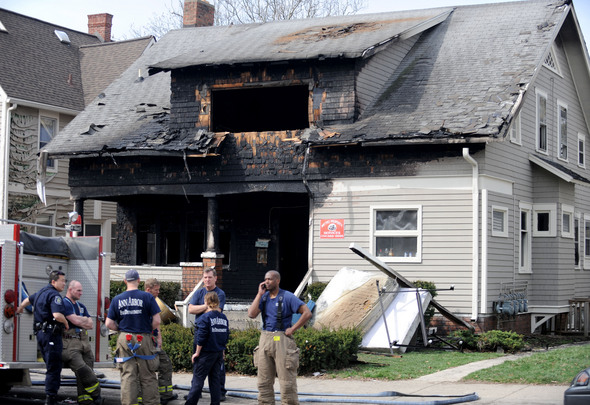
A 22-year-old Eastern Michigan University student died in April 2010 from injuries suffered in a fire that gutted this house on South State Street in Ann Arbor. The fire department has struggled to meet national standards for response times, an AnnArbor.com analysis of city records shows.
Angela J. Cesere | AnnArbor.com
The city of Ann Arbor lags far behind other communities when it comes to fire department staffing levels and continues to struggle to meet national standards for fire response times.
Those are among the findings of an AnnArbor.com analysis of more than 1,800 pages of fire department records obtained through Freedom of Information Act requests.
The reports include data on thousands of incidents handled by the Ann Arbor Fire Department over the past two years, including response times for fires and other calls.
Fires in Ann Arbor killed two citizens and caused an estimated $1.3 million in property damages last year, records show. Most of the damages — $1.24 million worth — happened to homes and apartments, while businesses and other buildings were less affected.
If Ann Arbor officials go through with a proposal to cut 12 firefighter positions from the budget, those numbers could climb, warns Matt Schroeder, firefighters union president.

Matt Schroeder
The Ann Arbor City Council meets Monday night to consider a two-year budget that includes deep cuts to public safety, including large staffing reductions in both police and fire. It's possible a decision on the budget could be pushed back to a later date.
City officials are tasked with closing a $2.4 million shortfall in a general fund of less than $80 million for the fiscal year starting July 1. The deficit is projected to grow to $4.9 million the following year if cuts aren't made, and public safety accounts for half the budget.
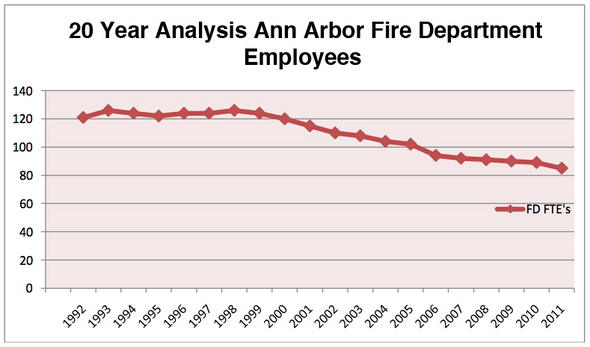
The job eliminations — which Fire Chief Dominick Lanza argued against before resigning in March and then firing off an open letter airing his frustrations — would reduce the fire department's ranks from 89 to 77. The department already lost five positions last July.
The question now is: Can Ann Arbor afford to make those cuts?
Before retiring last month, even City Administrator Roger Fraser, who recommended the reductions in fire services, acknowledged "every bit of this is an experiment."
Struggling to respond
After closing a city fire station, eliminating 37 firefighter positions and taking two fire trucks out of service over the past decade, Ann Arbor is struggling to respond to fires within time limits recommended by the National Fire Protection Association, records show.
The fire department responded to 278 fires last year, 116 of which were reported as structure fires. Of those, 101 happened inside homes or apartments.
'Major fires' reported in 2010
- April 3 — 900 block of South State Street; 5:17 a.m. Initial arrival: 6 mins 15 secs; Full alarm: 9 mins 4 secs; Damages: $140,000, one death.
- April 13 — 500 block of West Stadium Boulevard; 1:41 a.m. Initial arrival: 6 mins 31 secs; Full alarm: 7 mins 54 secs; Damages: $265,000.
- April 23 — 2500 block of Georgetown Boulevard; 1:02 a.m. Initial arrival: 2 mins 37 secs; Full alarm: 7 mins 6 secs; Damages: $310,000.
- Sept. 16 — 100 block of East Summit; 5:55 a.m. Initial arrival: 4 mins 9 secs; Full alarm: 4 mins 9 secs; Damages: $185,000.
- Nov. 7 — 1200 block of Prescott Avenue; 1:19 a.m. Initial arrival: 3 mins 5 secs; Damages: $13,000, one death; Full alarm not needed because report was of a person on fire, not structure fire.
The firefighters union is the first to admit Ann Arbor has a substandard fire department and actually has used that fact to argue against cuts.
NFPA standards state the first fire truck should arrive on the scene of a fire within four minutes, and a full alarm assignment should be in place within eight minutes. In Ann Arbor's case, a full alarm means four fire trucks and a battalion chief, according to city fire officials.
Records show it took about 4 minutes and 53 seconds on average for the first truck to arrive at each of the four major house fires last year, missing the standard by nearly a full minute. Fire professionals often stress that fires double in size every minute, so every second counts.
To a lesser degree, the department has struggled to get a full alarm on the scene within eight minutes. It missed the mark on one of the four major house fires last year.
That was the case with an April 3, 2010, fire that started on the porch of a rental house on South State Street, near the University of Michigan. The flames from a burning garbage bag ignited a porch couch and quickly spread to the home, killing 22-year-old Renden LeMasters.
According to reports, firefighters were dispatched at 5:17 a.m. It then took 6 minutes and 15 seconds for the first two trucks with eight firefighters to arrive together. A full alarm assignment wasn't in place until 9 minutes and 4 seconds after firefighters were dispatched.
In addition to LeMasters's death, two other people were injured in the fire, which caused an estimated $140,000 in property damages.
On April 13, 2010, firefighters were called to another fire on the 500 block of West Stadium Boulevard at 1:41 a.m. They could see flames and smoke coming from the home while en route and arrived to find heavy flames on the first floor, extending to the second floor.
Records show it took 6 minutes and 31 seconds for the first truck to arrive with three firefighters. A full alarm arrived just barely under eight minutes. The fire caused an estimated $265,000 in damages. The home, one unit of a duplex, was declared a total loss.
On April 23, 2010, a father and his 6-year-old daughter had to jump to safety from the roof of their burning house in the 2500 block of Georgetown Boulevard. Meanwhile, the mother and a 3-year-old boy fled through the front door as flames engulfed the two-story home.
Records show it took 2 minutes and 37 seconds for the first truck to arrive and a full alarm was in place in 7 minutes and 6 seconds, meeting both standards. Three firefighters were injured fighting the blaze, which caused an estimated $310,000 in damages.
Staffing levels lagging
According to the NFPA, the average full-time career fire department in the United States has about 1.72 firefighters per 1,000 residents.
Right now, Ann Arbor has 0.78 firefighters per 1,000 residents — a figure that drops to 0.67 with the cuts being proposed.
AnnArbor.com surveyed a random sample of Midwest college towns to find out their fire department staffing levels. The average among five communities that responded was 1.3 firefighters per 1,000 residents, nearly double the levels being considered in Ann Arbor.
The college towns surveyed were Columbus, Ohio (Ohio State), Evanston, Ill. (Northwestern), Bloomington, Ind. (Indiana), East Lansing (Michigan State) and Iowa City (Iowa).
With staffing levels dwindling, Schroeder said the Ann Arbor firefighters union proposed more than a year ago that the city apply for a federal SAFER grant.

Police Chief Barnett Jones, right, appears before the City Council with Fire Chief Dominick Lanza last year. Lanza resigned in March and Jones is now both fire chief and police chief.
Ryan J. Stanton | AnnArbor.com
Schroeder said the response the union received was lackluster at best and the city's administration refused to entertain the idea.
Dozens of communities across the country recently were awarded SAFER grants from the U.S. Department of Homeland Security, including Southfield ($2 million), Redford Township ($1.16 million), Dearborn ($940,595), Ferndale ($851,164), and Southgate ($791,680).
Counting nine fire chiefs the city has gone through in the last decade, Schroeder said he believes the Ann Arbor Fire Department has suffered from a lack of consistent leadership. The last two chiefs to resign both cited strong pressure from the city's administration to make cuts as a reason for leaving, and both left citing concerns about the staffing levels.
Police Chief Barnett Jones now doubles as Ann Arbor's fire chief since Lanza's resignation. If confronting cuts to the fire department is a reality this year, the city will come up with a plan to make sure response times are not affected, Jones said in a recent interview.
"I'm now the fire chief, I'm sitting with two assistant chiefs, and I'm talking to the union and the battalion chiefs. We'll manage it," Jones said. "There are some good people over there, and we're going to take a look at what the ICMA is going to tell us."
Ann Arbor is paying $54,000 to have the International City/County Management Association conduct a study of fire department staffing levels. A report is due mid-summer.
Until that report is issued, Ann Arbor officials acknowledge they don't really know the full impact of cutting 12 more firefighters — seven on July 1 and another five next year.
"I'm hoping that their recommendations will shed a light on how we can reorganize the fire department," Jones said. "Although I've never fought a fire, I'm learning, and the reality is there are some things we can do differently."
Schroeder argues hiring ICMA to study the fire department's staffing levels is the equivalent of the fox guarding the henhouse.
"This has always been about cutting people without any research from a neutral party or backed by any empirical evidence," he said.
'We really don't know'
The city began a new practice in mid-February of closing one of the city's five fire stations on a rotating basis to curtail overtime costs as needed. Each month a different station is assigned to be closed and property owners receive service from the nearest open fire station.
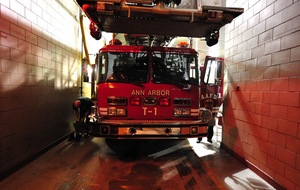
Fire professionals often stress that fires double in size every minute, so every second counts.
Ryan J. Stanton | AnnArbor.com
The union points to last month's temporary closure of Station 5, located in U-M's North Campus area. With the station closed, the next closest fire station is either in downtown Ann Arbor or on the south side of the city at Huron Parkway and Platt.
Response times in the North Campus area rose significantly, according to data provided by the union. When Station 5 was open, the fire department was able to respond to most calls within five to six minutes, but when it was closed, it took nearly 10 minutes on average.
According to the union, it now takes almost six minutes on average for one fire truck to get to the scene of an emergency.
Fires accounted for about 4.6 percent of the 6,028 total incidents handled by the Ann Arbor Fire Department last year, records show. More than 3,400 of calls dispatched were for emergency medical situations ranging from difficulty breathing to seizures to cardiac arrest.
On a normal day, Ann Arbor has six fire trucks in service plus a battalion chief who drives his own vehicle. The minimum daily staffing level has dropped from 24 to 15 firefighters.
Assistant Fire Chief Chuck Hubbard, who has been with the fire department for 25 years, said it's still hard to say how further cuts might affect response times.
"That's going to have to be looked at," he said. "Because we really don't know. I think that's what the chief is going to be looking at — is this going to create a problem or is it not?"
Ryan J. Stanton covers government and politics for AnnArbor.com. Reach him at ryanstanton@annarbor.com or 734-623-2529. You also can follow him on Twitter or subscribe to AnnArbor.com's e-mail newsletters.
Comments
Rudy Caparros
Fri, Dec 14, 2012 : 6:55 p.m.
TOXIC TRAIN SAFETY - A First Responders Petition caused The Chlorine Institute to conduct a five-month study comparing the safety of secondary containment to the chlorine "C"-Kit for chlorine tank cars. The study proved secondary containment to be, by far, the safest technology for containing and preventing releases of chlorine gas. To see secondary containment - search "CHLORTANKER."
Rudy Caparros
Mon, Dec 10, 2012 : 11:47 p.m.
HazMat Experts and Firefighters petition Dow Chemical and Union Pacific for safe rail tank cars transporting gas chlorine. Secondary containment is a necessary improvement that must be implemented. See--PETITION C KIT for First Responders Comments.
pragmatic
Mon, May 16, 2011 : 6:38 p.m.
It seems to me with only 5 major fires for an entire year that the Fire Department is overstaffed. Couldn't they cut back on going out on the medical emergencies? Towns like Columbus and Evanston should bring their number of firefighters more in line with Ann Arbor's rather than vice versa. And Ann Arbor Fire Fighters benefits are far too excessive. They can retire in their 40s and have a generous pension and health care benefits until they die, paid for by the Ann Arbor taxpayers, the majority of whom do not have these great retirement plans.
Ricebrnr
Tue, May 17, 2011 : 2:14 a.m.
"with only 5 major fires for an entire year that the Fire Department is overstaffed." Well I guess we better set our quota for only 5 major fires then and staff appropriately... Really?
your-kidding
Mon, May 16, 2011 : 3:13 p.m.
Fortunately for the AA firefighters union, they appear to have Ryan Stanton and aa.com as their own unquestioning public relations mouthpieces. Rarely have I seen such an obvious editorial purporting to be a fair, researched news article -- let alone it being above-the-fold on the front page. Earlier commenters have pointed out obvious issues with the selective use of statistics, methodology, and simply lack-of-hard questioning and thought that this article and its sidebar statistics imposes upon the reader. Of the other five cities semi-documented, how many of the fire departments also provide ambulance services? We are blessed in Ann Arbor with having nationally-recognized Huron Valley Ambulance as our primary emergency medical service. For fire departments that include paramedic and transport services , how many additional firefighters are required for staffing that specific service? What does that do to the staffing per 1,000 residents statistics? A visit to the National Fire Protection Association website makes me wonder about the objectivity of statistics they may provide. Clearly, they are the professional association for fire fighters. Might they have an agenda in their "national standards?" Ryan's fright piece does nothing to help explain whether AA needs more or can do with fewer fire fighters. As has been the case for so many years, Matt Schroeder and the union are their own worst enemies in making this case.
AA
Mon, May 16, 2011 : 12:22 a.m.
Ann Arbor is not a major metropolitan area, the current staffing levels are adequate.
Ricebrnr
Mon, May 16, 2011 : 4:19 p.m.
So how do you feel about staffing levels after the proposed cuts?
Rachel
Sun, May 15, 2011 : 10:46 p.m.
I understand there must be "shared sacrifice", but what you sacrifice makes a huge difference. There is no place for sacrificing public safety and education. Those of you who lambaste firefighters and teachers: don't complain when your house burns down and your children can't read. Firefighters and teachers preform vital services for the community, it is time we treat them with the respect they deserve.
Stephen Landes
Sun, May 15, 2011 : 9:05 p.m.
I need to see much more analysis of these four major fire incidents. Why was the response time so long? Was it due to too many things going on at the same time, so units were not available (e.g.: they were making emergency medical runs). Were the available units too far from the fire and, if yes, was that because stations were closed? What other "failure modes" can be identified that cause long response time? This is more than just a statistical association between staffing levels and response times or injuries and deaths. I am NOT arguing that staffing levels do not affect response time, just that the "analysis" provided in this article is so incomplete that it is useless. You simply cannot stop digging once you have found a couple of numbers that seem to indicate a trend. That level of analysis certainly isn't useful in identifying solutions. For example, if it can be determined that response time was slow because units close to the fire were making emergency medical runs, so responding units had to travel farther, then the new policy of having Huron Valley ambulance make those runs would alleviate some of the response time problem. This is a BIG IF and it requires a lot more digging by those with access to the data to actually make the case.
your-kidding
Mon, May 16, 2011 : 3:34 p.m.
Sorry, one more thought. Because fires can create medical emergencies for both occupants and fire fighters, HVA paramedics are also dispatched to major fires such as those mentioned in Ryan's editorial.
your-kidding
Mon, May 16, 2011 : 3:30 p.m.
Hello, Stephen. I agree with your comments but want to make one clarification. Huron Valley Ambulance is the primary emergency medical provider in Ann Arbor, and they are the medical lead in ALL emergency medical runs. Fire fighters and police can provide an important adjunct as first responders . Because of proximity, they may arrive first at a scene and can provide basic life support (airway and bleeding control) before the HVA paramedics arrive with advanced life support. This protocol is determined by Washtenaw county's medical board. In some medical emergencies, fire fighters also provide mechanical extrication of trapped individuals; for example, someone caught inside a severely damaged vehicle. We are blessed in our community to have the nationally-recognized excellence of HVA paramedics and the support of dedicated fire fighters and police during medical emergencies.
Stephen Landes
Sun, May 15, 2011 : 9:13 p.m.
Amending my own comment: Many things that can affect response time in a city change over time. In addition to actual Fire Department resources we need to look at road conditions, traffic congestion, lanes lost, changes in traffic patterns, movements in population relative to fire stations, incident time of day and competing events (e.g.: a call that requires a cross town run coinciding with the end of a football game will radically change the response time). The analysis in the article is a first level, "quick and dirty" look at the data, but it is by no means useful information as is.
Thomas Rollins
Sun, May 15, 2011 : 9:03 p.m.
The City and the Union need to get serious about the safety and security of it's residents and tax payers. The city needs to stop threatening the fire department and make deeper cuts into the police sector. The union needs to get serious about helping the city cut costs. These studies are useless and the figures point in favor of who paid for them. Why does it matter how many firefighters are on staff to get a truck to the scene for response times? You can get a truck on scene in 4 minutes but if you dont have a minimum of staff on scene your still stuck dead in the water. If the city fails there will be no fire department, and without the fire department more lives and property will be destroyed and business will suffer. Neither party seems to care about the residents who pay the bills.
David Cahill
Sun, May 15, 2011 : 8:05 p.m.
Ryan Stanton has uploaded a sample of the documents AnnArbor.com received through its FOIA request to: <a href="http://a2docs.org/doc/292/" rel='nofollow'>http://a2docs.org/doc/292/</a>
irritated
Sun, May 15, 2011 : 6:43 p.m.
Mr Stantons data about major fires that occured was from 2010, my understanding is that the station closings did not start until 2011 so what do you attribute the alleged slow response times to ? If your implying that AAFD needs to be larger then you had better have a way to pay for that size dept. In order to comply with the national standards AAFD would probably have to be twice the size, you think the city has budget issues now try negotiating that deal. I wonder how many Firefighters it takes to staff all the trucks on a daily basis and how many Firefighters there are scheduled per day ? Based on the size of the dept (89) it sounds like there are more than enough FF's to keep the trucks and the stations in service daily. Maybe the problem is an attendance issue and not staffing levels....
Ryan J. Stanton
Sun, May 15, 2011 : 6:17 p.m.
For those interested, I've posted some of the records cited in this story on A2docs. Go here to view them: <a href="http://a2docs.org/doc/292/" rel='nofollow'>http://a2docs.org/doc/292/</a>
Kai Petainen
Sun, May 15, 2011 : 10:39 p.m.
It's not a major fire, but... the Huron River Spill is not included in your list. <a href="http://a2docs.org/assets/files/2011/04/05/AAFD_incident_report_on_spill.pdf" rel='nofollow'>http://a2docs.org/assets/files/2011/04/05/AAFD_incident_report_on_spill.pdf</a> It used 8 vehicles from the AAFD (not including DPS units) 1 rescue truck, 2 trucks, 2 engines, 1 chief officer car and 2 hazmat timeline and map here: <a href="http://www.google.com/maps/ms?ie=UTF8&hl=en&msa=0&msid=214077171585683577679.0004a32a200b94a621810&ll=42.304547,-83.71891&spn=0.040182,0.104542&z=14" rel='nofollow'>http://www.google.com/maps/ms?ie=UTF8&hl=en&msa=0&msid=214077171585683577679.0004a32a200b94a621810&ll=42.304547,-83.71891&spn=0.040182,0.104542&z=14</a>
jns131
Sun, May 15, 2011 : 5:57 p.m.
The more Ann Arbor cuts? The more deaths that will occur. Keep cutting? And there will not be anything left. I guess Ann Arbor will burn to the ground before the council gets the message that we need not to be removing these vital links to our community.
Ricebrnr
Sun, May 15, 2011 : 9:59 p.m.
Your post history shows your very singular focus on this subject...
irritated
Sun, May 15, 2011 : 6:26 p.m.
Perhaps you should research why most fire deaths occur, you may be shocked to find out its not due to staffing levels
David Cahill
Sun, May 15, 2011 : 5:10 p.m.
This is an excellent research piece! It's great that AnnArbor.com is willing to provide the resources necessary to produce it. Whatis the National Fire Protection Association? How real are its standards? Is this an insurance industry group? If so, it would probably want rapid response times. Is it a government group? I expect the InternationalCity/County Management Association would naturally favor management, and want not-so-rapid response times so that local units of government would not have to pay so many firefighters.
Basic Bob
Sun, May 15, 2011 : 6:50 p.m.
NFPA is a professional association which publishes codes and standards for fire protection, including building electrical safety, smoke alarms and fire extinguishers, and many other subjects. The pertinent standard is NFPA 1710: Standard for the Organization and Deployment of Fire Suppression Operations, Emergency Medical Operations, and Special Operations to the Public by Career Fire Departments. The technical committee that maintains the standard consists of experienced safety professionals representing management, labor, research, and consumers. Their recommendations are practical and experience-based.
Tim H
Sun, May 15, 2011 : 5:10 p.m.
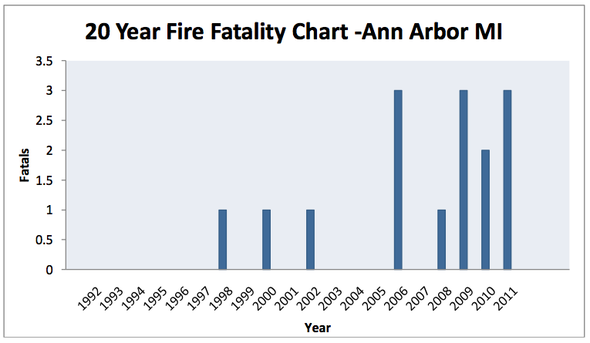
Numbers don't lie but there are way to make numbers to support whatever story one wants to tell. Using the numbers of the midwest college towns, one can derive the number of firefighter per square mile and average square miles serve by a fire station. Ann Arbor is not the worse on those counts. It is a scare tactic to have the 20 year fire fatality chart side by side with the staffing level of the fire department. I can say any fatality is not acceptable. Does that mean in spite of the high staffing level (over 120), the fire department did not do its job since there were fatality in 1998 and 2000. I would think not. In every profession, we found out we have to do more with less resources in order to survive. I don't think the fire department can exclude itself from that. Just join the rest of the world to be more efficient in doing the job. Stop spending tax money to buy a statistic study to tell a story. Be a role model for other midwest college towns that how lean and mean you can serve the tax payers.
citizenx
Sun, May 15, 2011 : 4:15 p.m.
It has been brought to my attention that when these fatal fires occurred the fire department was fully staffed and all the stations were open; therefore staffing levels obviously did not play a part in these tragic events. Its unfortunate that the AA firefighters continue using these scare tactics to justify staffing levels. I would hope that at some point the media would take the time to gather all the facts before printing their articles.
rayjay
Mon, May 16, 2011 : 2:18 p.m.
The Stadium/Packad station has been closed for a few years now, well before the fatal fires you mention.
Craig Lounsbury
Sun, May 15, 2011 : 4:28 p.m.
I would suggest your conclusion is faulty. If the fires occurred when all stations were opened and fully staffed the most logical conclusion is that fully staffed and all stations opened is not adequate.
brimble
Sun, May 15, 2011 : 4:10 p.m.
Municipal governments exist for very simple and singular purposes: 1) Provide police and fire protection, 2) Pave and maintain streets, provide water, sewer, trash, snow removal services, 3) Enhance quality of life through zoning, parks, libraries, golf courses, pools, festivals, and the like. The sets of purposes are in order of importance -- except in Ann Arbor, where the order is reversed. We have special millage money designated for the purchase of land -- no, wait, development rights to land -- located outside the city limits for the ethereal purpose of cultivating green space, but cuts to police and fire services for lack of funding. Public art and collapsing bridges. High-speed rail proposals and an aging water treatment system. The hard work of really running government isn't sexy, and in Ann Arbor, isn't important.
aes
Sun, May 15, 2011 : 7:41 p.m.
Amen!
Joslyn at the U
Sun, May 15, 2011 : 3:35 p.m.
Our city goverment at its best. How sad that we elected these people to be so irresponsible as to care more about new buildings and parks than our safety and well being as a community. SHAME on the Mayor, City Council, and The CFO (and interim city admin) Tom Crawford. SHAME SHAME SHAME
Parrhesia
Sun, May 15, 2011 : 3:19 p.m.
What does it say about Ann Arbor, one of the most educated and progressive towns in the U.S., that even our public servants have come under attack. Fire fighters and the police more than deserve decent salaries, a great health care plan (they put their lives on the line every day) and a good pension when they retire. Do we really want these essential public servant responsibilities to no longer be careers but temp jobs?
CincoDeMayo
Sun, May 15, 2011 : 5:18 p.m.
Actually, if anyone would like to outline what they consider decent in these three things (house size, age of vehicle, out of pocket medical expenses) please do. I'm interested. Feel free to add what a decent amount is to be able to save yearly for retirement, and what to have left over for food, clothing, and higher education. To me these are the essentials that a family needs to be able to cover in order to lessen burdens placed on Medicaid, subsidized housing, financial aid, social services, Social Security, etc.
CincoDeMayo
Sun, May 15, 2011 : 4:29 p.m.
snapshot What is decent for you? I really am just curious, so I hope you will answer. I am thoroughly intrigued by social economics, and would like to know what others' ideas are about what can be afforded by a decent wage and health care. Say, for a family of five. What is a good size house, age of vehicle (let's say two just because that is what most families tend to feel they need these days, although, I would like to get rid of one), and amount of out of pocket health care costs for a year. If you can just give me your idea on those three things in regards to decent.
snapshot
Sun, May 15, 2011 : 3:38 p.m.
What is decent? What is a living wage? What is good healthcare? Is being able to buy a new car every year more "decent" than being able to buy one every 4 years? Is a 2500 square foot home more "decent" than a 1500 sq foot home? Please define "decent and living" for me.
Tru2Blu76
Sun, May 15, 2011 : 3:17 p.m.
There's no doubt about the need to "fix" the shortfall in performance of AAFD. The problem boils down to determining cost-per-alarm-call and how that compares to other college towns. Is that cost greater, the same or less? The other adjustment needed is to determine what added resources would be needed to bring AAFD into compliance with the response time standard. So, we need to know clearly what the budget shortfall really means. Is it due to excess comparative cost? We also need to know what amount of revenue it would take to meet standard and still be within the comparative cost per alarm would be. Once the target figure is established, the final question is whether we face increased tax or if cutting other less vital programs would fill the gap. Personally, I think this is the problem cities everywhere are facing. I also believe that the assumptions about increasing tax revenues are bogus. Politicians have gotten themselves in this bind by continually promising "something for less" than is actually needed. The public buys into this because, naturally, we don't want to be taxed more. Rationally, I think all of the essential services (police, fire and education) should be protected so long as they are cost effective operations. That leaves citizens with the question of how to pay for such things as parks & rec. I'd like to see a study of how user fees would work in funding parks & rec and other less critical services.
John A2
Tue, May 17, 2011 : 6:05 a.m.
I believe this is putting a price on life. Can we put a price on life? Is that price fixed to serve all, or just the wealthier people. The cops will have to ignore the poorer sectors of the city because the rich are targets. This will cause an unbalanced policing. We need to get rid of the monitory system then. We can't afford to loose more cops and firemen, nor put a price on lives.
Kai Petainen
Sun, May 15, 2011 : 3:11 p.m.
This is a useful article to link to in my next blog. Excellent work Ryan.
True Facts
Sun, May 15, 2011 : 3:10 p.m.
Please can there be a week without having to hear about the cuts to the fire dept.
CincoDeMayo
Wed, May 18, 2011 : 1:54 p.m.
I sure hope so!
snoopdog
Sun, May 15, 2011 : 3:08 p.m.
Staffing levels have been cut because costs are too high, pure and simple. Right now, 96% pay higher taxes so 4% (public workers and bureaucrats) can retire at the age of 55 or even earlier. Perfect deal for them, raw deal for the taxpayers. Public employees in the rust belt states pay an average 2.5% of their own healthcare costs, most of us in the private sector pay 10 times that much for healthcare benefits that don't come close to the perks provided public employees. The blame needs to land squarely on the shoulders of the unions that will not give real and meaningful concessions. And lets not even bring up the fact that rust belt states average 60 billion in unfunded pension liability, where is that money going to come from ? Good Day
CincoDeMayo
Mon, May 16, 2011 : 2:28 a.m.
I know, I was thinking that too!
Boo Radley
Sun, May 15, 2011 : 10:42 p.m.
You speak of Taxpayers and Public Workers as if they are two different groups. Since Public Workers are also Taxpayers, shouldn't you have said that 100% pay higher taxes?
CincoDeMayo
Sun, May 15, 2011 : 4:20 p.m.
God help your relative provide for her family if she ever gets a job in safety services.
John A2
Sun, May 15, 2011 : 3:07 p.m.
I do believe that our fire department is much more important than these high waged city officials and executives. I say get rid of them first. As a city that has so, so many old houses and electrical, and irresponsible students who are in the height of partying and unawareness; we need the fire department and police just the same. This is a huge college with lots, and lots of students who are counting on our emergency services to feel safe here. If our emergency services are questionable then the parents of the students will not want their children to attend school here. That can lead to lesser students and tax revenue. That can cause a downward spiral of the collapse of U of M. I personally used to own the 2275 Westaire CT, house that burned down last winter on the new west side of Ann Arbor, and it killed two young adults. I had sold the house to the parents of the tween's who died, six months earlier. I felt real bad and morned for them, but it was irresponsible kids that caused it I do believe, (i never got the whole story) but the fire started in the kitchen. Our fire department is much more important then a bunch of Psychiatrist making 6 figures a year, and I believe I am talking for the majority of Ann Arbor citizens. I say can the doctors and let the university pay for them if they are so important, but we need our life support system intact PERIOD.
racerx
Sun, May 15, 2011 : 2:53 p.m.
Fact. The LeMasters fire was partly due to the firefighters arriving late. So what does council do? Ban couches. And this addresses the problem. Incredible. Just incredible.
Ethics Advocate
Sun, May 15, 2011 : 2:44 p.m.
Why is there no mention of the amount our firefighters earn, both salaries and benefits? The last I knew, they were the highest paid in Michigan. In today's printed paper, in a much less apparent place (pg. A7), it is stated that: "Police, firefighter and AFSCME employees pay no co-insurance costs and no monthly contribution toward their insurance preminums. The city has been trying, without success, to get them on a less costly plan that other city employeels are covered by--a move that, along with some other changes in benefits, would save an estimated $800,000, about a thrid of the entire budget deficit." Given the city financial strain that cannot readily be cured, and there is increased danger for citizens, why are the firefighters union and its members not willing to provide some assistance? Why is it more important to them to see another 12 colleagues lose their jobs than to accept a relatively small salary and/or benefits reduction that would make them like other city employees, as well as those in a number of other organizations?
CincoDeMayo
Mon, May 16, 2011 : 2:31 p.m.
Ann Arbor Firefighter - $54,000 - with a family - Subtract $8500 for federal taxes, $7,000 for out-of-pocket medical expenses, $6,000 - $7,200 for food, $16,800 for mortgage and TAXES on a $180,000 home, $3,600 on utilities; water, heat and phone, $7,200 on fuel ($300 month per vehicle :( $1500 clothing, leaves $2,200 (and that is without a car payment or cable service which obviously would add another $1,200 - $6,000 to these expenses) - $183 left over a month for a family for a family to decide how to spend on the 4-6 of them on things like savings, college tuition, sports, extra- curriculars, camps, etc. This IS a "decent" quality of life in my opinion. Nothing over the top.
Huron74
Sun, May 15, 2011 : 5:46 p.m.
@Ethics "In today's printed paper, in a much less apparent place (pg. A7),".
lynel
Sun, May 15, 2011 : 2:55 p.m.
"The last I knew, they were the highest paid in Michigan." Source of information?
greenlantern
Sun, May 15, 2011 : 2:42 p.m.
We could take the idea of cutting firefighter jobs and understand the reason for it, if the mayor and Mr. Fraser hadn't been using the cuts as a threat and a way to funnel money into other projects for the last 12 years. Look at the all the articles in the past and you'll notice it's always the same claims from the city. Fraser did the same thing at his last job and then left to come to A2. They have used the media to paint a poor picture of our fire dept. and when confronted by facts refuting their claims they simply ignore them or half heartedly "retract" them, knowing that the damage is already done. Only recently have other views been taken seriously and reported on without first making sure the city administration has the chance to have the last word in the article. The fire dept. doesn't write tickets or otherwise "make money" for the city so is an easy target for cuts,( notice they didn't cut parking enforcement when they very briefly considered it a few years back?) but is a core service and unfortunately needs manpower and well trained and experienced people to perform the job correctly. .
CincoDeMayo
Mon, May 16, 2011 : 3 a.m.
I was saying, I do have more to learn, so thank you for taking the time to give me the input.
CincoDeMayo
Mon, May 16, 2011 : 2:58 a.m.
ummm....sometimes....but that's another story.... Seriously, thanks for answering snapshot, because I really did not know what the big issue was with PA 312, or binding arbitration. To me, it makes sense to compel two sides to sit down and try to negotiate a compromise. In my experience -- and I have some in landlord / tenant mediation in the City of Detroit --- most people want to work toward an agreement. Ultimatums rarely work, and actually cause reasonable negotiations to break down, as this kind of tactic displays a lack of respect. So, basically even if compromises can not be made through negotiations (if negotiations are indeed even pursued), it sounds like you are not in favor of mediation or arbitration because you don't know who is doing the arbitrating. You say that it is "someone who doesn't answer to the taxpayers". But, I don't get that since the two parties meeting would both be those who answer to the taxpayers - the city administration and firefighters. I know I probably sound really stupid, but seriously I am just trying to understand the full extent of this outcry over PA 312. I don't know who that person (the arbitrator) is either, although, I am thinking they are somehow trained, educated and certified. But, that's a good question. Who are they? My little bit of research shows that they do not necessarily favor unions over cities, but I'll have to check into it further. I have to say that I don't know my council members well enough either. Would you believe out of all the council members I have contacted, I have only heard back from one? They are disbursing my tax dollars, and presumably should be easier to know and hold accountable... This statement "I'm wondering why you don't have a problem with "blind" compliance when it comes to disbursing taxpayer dollars" doesn't make sense since I have been fairly "vocal" about the way my tax dollars are being spent right here in Ann Arbor. But, I have more to le
snapshot
Sun, May 15, 2011 : 9:09 p.m.
Cinco, the problem is "mandatory" arbitration. I don't know who is holding out...the fire dept gets to work under it's old contract if they hold out and the city doesn't get forced into a contract they don't deem appropriate if they hold out. That mandatory issue is what I have a problem with because it "requires" a decision by someone who doesn't answer to the taxpayers. I don't even know who that person is. I'm wondering why you don't have a problem with "blind" compliance when it comes to disbursing taxpayer dollars. I see a problem with accountability but that seems to be a problem in Michigan government from the top down in my opinion. Do you send "blank" checks to pay your bills?
CincoDeMayo
Sun, May 15, 2011 : 4:11 p.m.
snapshot Thanks for bringing some of these things up. That is one thing I still don't understand. What is wrong with mediation? Why is mediation (or arbitration) a bad thing, especially if only mandated after voluntary negotiations fail? And, why is the city using that as their "party line" in messages to the public, when they have refused to meet with the fire department? When I read that PA 312 was keeping the city from negotiating with the fire department I didn't understand. But then I learned that PA 312 was just a mandatory process to go to arbitration, if negotiations failed. So thinking that negotiations must have failed I asked if arbitration had begun. What I learned was that the city is simply refusing to meet with the fire department at all after issuing an ultimatum on health care. The fire department continues to be willing to negotiate.
snapshot
Sun, May 15, 2011 : 3:22 p.m.
In fact, they will be increasing parking hours and costs to help bridge the budget deficit using the DDA, an unelected board to control and further mismanage city funds. How about fire officials coming out and advocating the disbanding of the DDA so we can keep the money under the control of ELECTED officials. Let's also have the fire dept union advocate the removal of "mandatory" mediation and open to the public contract negotiations? I think these would be a very productive step in resolving these budget issues.
Ignatz
Sun, May 15, 2011 : 2:02 p.m.
I see the term Cadillac Healthcare has risen it's ugly head. For me, the term equates to healthcare where the one who has it and needs to use it won't go bankrupt by doing so. I find it rather odd to deny such care those who are expected to put their lives on the line for the sake of the citizens.
Cash
Sun, May 15, 2011 : 1:47 p.m.
Maybe the mayor of Ann Arbor should begin thinking like the mayor of Warren..... <a href="http://www.detnews.com/article/20110515/METRO/105150313/1409/Warren-mayor-proposes-tapping-court-funds-to-balance-city-budget" rel='nofollow'>http://www.detnews.com/article/20110515/METRO/105150313/1409/Warren-mayor-proposes-tapping-court-funds-to-balance-city-budget</a>
xmo
Sun, May 15, 2011 : 1:44 p.m.
The city could save a lot of money by simply eliminating the Fire Department and paying the property owner for damages! In the article "estimated $1.3 million in property damages" This is a lot cheaper than the Fire Department budget. This way we would have more money for Art programs etc!
CincoDeMayo
Mon, May 16, 2011 : 3:05 a.m.
and humor...
CincoDeMayo
Sun, May 15, 2011 : 3:48 p.m.
I do appreciate Art....
snapshot
Sun, May 15, 2011 : 2:56 p.m.
Ask your health insurer, if you have health insurance. If you don't, your life is worth far less than someone who does. How does that make you feel? How about "public employees" lives being worth more than a McDonalds employee with "emergency health care limited to 10,000 dollars? How about a transportation worker who gets hit by a car and the driver goes to prison, but if you're a civilian, the driver gets probation? Have I answered your question?
tdw
Sun, May 15, 2011 : 1:59 p.m.
And exactly how much is a humans life worth ?
Tom Whitaker
Sun, May 15, 2011 : 1:38 p.m.
Ryan: Thanks for doing the work of collecting the hard data on this critical issue. Others in the community have been sounding this alarm for a few years now, but the facts about the impacts of cuts to response times have been buried, and now the situation is critical. Shame on the City for forcing you to file a Freedom of Information Act request to obtain information on such a basic and essential government service! No wonder the city attorney's budget is so large. Secrecy is expensive! There are so many other cuts that could be made, and funds shifted between "buckets," before resorting to putting our lives and property at risk: dismantle the DDA and LDFA and stop giving money to SPARK, dismantle Percent for Art and return the money to the respective funds it was taken from, stop any further spending on capital projects like the Fuller Road parking structure, cut the IT department, city attorney, and administrator budgets deeper. Business development and community beautification efforts are just dandy when a municipality is flush with cash, but who wants to risk opening a new business in a town with substandard police and fire protection?
Cash
Sun, May 15, 2011 : 1:49 p.m.
Good point, Tom. I posted a link to a story regarding the city of Warren where the mayor proposes just that...get rid of phony buckets that allow special interests to "hold" it from taxpayers.
snapshot
Sun, May 15, 2011 : 1:36 p.m.
Hey Ryan, I would like to see more specifics on the "other" fire departments for "comparison" like, contract terms, health care costs, salaries, working hours, overtime, pension costs, retirement age, disability claims, university contributions, nuber of fire stations, proximity, age of homes, fire codes, volunteers, on call staff, etc. etc. To just compare "manpower" provides an incomplete picture. When Schroeder says the new study is like the "fox watching the henhouse" I tend to feel the same way about "union" statements. Schroeder talks about public safety but then the union protected a firefighter who endnangered the public with reckless driving, driving without a license with several departmental violations under his belt and then caused an accident with a civilian, and he's still employed. So much for "public safety". I'd request more information and follow up on this incident but the response would be "personnel issues are confidential" except when it suits the unions needs. I also question where the "staffing statistics" come from and the methodology of how they are determined. What do the insurance companies say? They have acturaries and it's their business also to know about fires. I'm not saying there's problems in the way city government operates but I also question whether this union is working with city hall or against them in the interest of public safety. Neither entities have enough of my trust to make a decision on "what they say". I want facts, as many as I can get.
CincoDeMayo
Mon, May 16, 2011 : 2:27 a.m.
CityFF is part of the city, Snapshot, but not part of the city administration. (As far as I know, that is, from the clues that I get in these posts....)
snapshot
Sun, May 15, 2011 : 8:56 p.m.
cityFF, do you seriously expect me to believe the union wasn't involved in this individuals job retention? First off, the Chief would be responsible for the firing. Second, you and the Chief are part of the city but apparently you don't see it that way.
CityFF
Sun, May 15, 2011 : 6:15 p.m.
Snapshot - That incident you speak of was not the unions fault. That firefighter probably should have been fired but the city didn't do it. How is that the unions fault? The union can not stop the city from firing anyone. It protects its memebers from unfairness and demands everyone be treated the same. Does that sound so unreasonable?
CincoDeMayo
Sun, May 15, 2011 : 3:42 p.m.
I agree, snapshot, it would definitely be more helpful to have objective statistics to help with this decision making process. I feel like these two sides are so polarized that either one can turn the numbers to support "their side". There are just a few things that make me lean toward supporting the safety services, and have less trust in the administration. Some of it comes just from the fact that I have experience both in working in safety services, and in being part of an administrative board. I happen to know how they both work - if not these two specifically. As an Ann Arbor resident I am highly concerned about response times, not just to fires, but to emergency medicals as well. I do not feel like the city is addressing this issue competently at all. I am also concerned about the city's willingness to "negotiate in the media" but unwillingness to sit down with the fire department and work things out. The administration's carefully worded quotes would lead the public to think (among other things) that it is the fire department that is unwilling to negotiate. As a casual reader I have frequently misunderstood what is happening due to what is printed in the media. Because of my confusion, I have taken the time recently to ask more questions and research more of the issues. I am sure that there are better ways to do things and I would like to see the city work with the fire department to make it happen. Instead, all I see is the mayor and the manager protecting their position of getting rid of FTE's. And doing so frequently at the cost of distorting information to the public. That really bothers me. So does a union protecting bad employees. Please unions, if you want to keep doing the good work you do, stop protecting bad employees. There has got to be a way to protect employees without protecting the worst of the worst.
snapshot
Sun, May 15, 2011 : 3:14 p.m.
I do pay taxes and I should attend these meetings but I don't think it would be a productive use of my time. I can reach more folks here and writing to my representitives voicing my thoughts and opinions. One question that "should" be asked is "where's the money come from"? But then one could start "shoulding" all over themselves.
yourdad
Sun, May 15, 2011 : 2:53 p.m.
If you pay taxes to this reckless council, you should be there Monday to say this to both sides. If the city would have asked the insurance underwriters to do a study, they would have been happy to take the check. Unfortunately, Roger thought it would be best to hire someone who is already on the payroll to make sure his results fit his experimental agenda. I agree that both sides seem fishy at times but at least the firefighters will continue to risk their butts for ours whenever, wherever, for whoever asks.
aes
Sun, May 15, 2011 : 1:27 p.m.
Public safety should be the city government's top priority! Gambling with response time to fires is gambling with lives as well as with property.
irritated
Sun, May 15, 2011 : 6:48 p.m.
I bet AAFD response times are as good if not better than most depts around the state
Huron74
Sun, May 15, 2011 : 1:25 p.m.
Okay numbers are numbers. But if the city doesn't have the money then it doesn't have the money. Bitching and finger pointing and blaming proves or solves nothing. The real issue is: Where's the money for more FF's gonna come from?
rayjay
Mon, May 16, 2011 : 2:14 p.m.
Maybe the real issue is :Where is the money the city DOES have really going?
racerx
Sun, May 15, 2011 : 2:58 p.m.
@Huron74-this is a falsehood. The city does have the money but choose, unwisely, to spent it on other items. If the budget shortfall is $2.4M, consider that the fountain outside of Raj Malhal cost nearly $1M. This is the priority of council and mayor. Core services suffers from spending on items that should/could be re-considered.
63Townie
Sun, May 15, 2011 : 1:50 p.m.
How about applying for a federal grant, which they didn't? How about getting out of the golf course business? How about not wasting money on unnecessary studies for building projects we don't need? How about not paying city attoreys to fight FOIAs to the bitter end?
63Townie
Sun, May 15, 2011 : 1:08 p.m.
There is no "maybe" or "could" about it, response times are GOING to deteriorate further if city administrators continue with their reckless cuts to the AAFD. According to the chart, deaths this year are already at the same levels as the full calendar years of 2006 and 2009, and it's only mid May. How much worse does it have to get? Also, there is absolutely NO excuse for refusing to apply for the federal grant. It is the responsibility of our city administrators to exhaust every means necessary to keep the citizens safe. They shirked their responsibility in this instance, instead choosing to plow ahead with irresponsible cuts to public safety. As a resident, I'm outraged. Demand accountability from your city administrators. Demand to be heard.
snoopdog
Sun, May 15, 2011 : 1:02 p.m.
It is simple, there isn't the money to staff Fire and Police as there was in the past. Get the Fire and Police unions to the table, get them to agree to pay 30% of their healthcare, change the pension to 401K's and change the Cadillac Healthcare plan to a Chevy healthcare plan like the rest of us have. If they do that, they can return both departments to staffing levels similar to years ago. Good Day
Mick52
Mon, May 16, 2011 : 4:28 p.m.
YourDad is incorrect. Ann Arbor will attract good candidates and retain them. There are very few other departments that pay better than A2 or is a better place to work. As CincodeMayo points out, A2 has been attracting trained personnel because of its better pay and benefits. What A2 is attempting to do with balancing benefit packages and pay is bringing it in line with most communities.
Boo Radley
Sun, May 15, 2011 : 8:14 p.m.
Snoop, My analogy of the $50k salary was for the city administrator job, meant as a point that if a salary much less than industry standard for that position is offered, quality people will not apply. The Ann Arbor police department "used" to have a reputation of one of the best agencies to work for. Their hiring process was always very difficult and extremely competitive. Now that all of the officers there passed up other potential employment to accept what Ann Arbor promised, the game has been changed. Now that there are no other law enforcement jobs out there, the city wants to cut them loose. They came to the city to serve in good faith, and look what it is getting them.
CincoDeMayo
Sun, May 15, 2011 : 3:13 p.m.
YourDad is correct. A lot of the Ann Arbor Firefighters came highly trained and highly experienced off of other departments that did not pay well or were only paid on call. These departments funded the training and Ann Arbor got the benefit. And, Snoop, you seem to have it all worked out, but it really is not that simple. Ann Arbor Firefighters have already made concessions - and are willing to negotiate, including looking at new models and ways to get funding - but city administration is not. They would only offer an all or nothing ultimatum. I have the feeling that if your family member was willing to work for less (as most people new to their career are) that that lack of respect and willingness to negotiate from her employer would soon teach her to advocate more strongly for herself and her community.
yourdad
Sun, May 15, 2011 : 2:30 p.m.
Snoop, even if she got a job w/o a pension and good benefits, she would leave as soon as she had enough experience on the job to get one that did come with a good benefits package. Even private sector employees and the "head hunters" who search them out know this. The city should have adopted a city wide healthcare policy long ago that took it right off the negotiating table. With UMMH right downtown, it would seem that they could find someone with "real" expertise on that issue.
snoopdog
Sun, May 15, 2011 : 2:07 p.m.
@Boo, what the city admin gets is wrong. But you are wrong about not being able to keep qualified Fire and Police if cuts to healthcare and pension take place. A family member of mine has a criminal justice degree and would be very willing to go to work as a cop in Ann Arbor without having a pension, Chevy healthcare would be fine as would a salary of 45-50K. As of now after many months, she cannot find a job in this state. Good Day
Boo Radley
Sun, May 15, 2011 : 1:33 p.m.
No ... they will then have both departments staffed with substandard and poorly trained individuals. While some changes should and have been occurring in pay and benefits, there is a certain level of pay and benefit that must exist for professional career jobs. Ann Arbor will not find a qualified replacement city administrator if they decide the position will only pay $50k per year with substandard benefits. It is the same with police and fire jobs. There needs to be a change in the system that allows an administrator to be fully vested after only 5 years and draw a nice pension and benefits for life after only 9.
63Townie
Sun, May 15, 2011 : 1:11 p.m.
Yeah, there's no money because city administrators are too busy building monuments to themselves.
Carole
Sun, May 15, 2011 : 12:28 p.m.
$54K paid out to some organization to decide how our fire department should function, disgusting. I agree with Ben, Local, Crown and Cash. I was sadden to view the charts and see just how many firefighters have been relieved of duty, reading about response time which is crucial to containing fires was sad for sure, and 9 chiefs in 10 years -- doesn't this tell administrators in city hall anything. Keep our firefighters and police staffed in a safe way to protect not only the citizens of Ann Arbor, but to protect themselves as well -- where can the funds come to do this, close down DDA, have city administrators start doing the job that they were hired to do, no more contracting out, and take a real hard look around to see where cuts can be made. And definitely change some of the guidelines for retirement for administrators -- have said it before and will again, totally resent a city administrator who worked for 9 yrs, receiving $41k and health insurance for life -- something is not right here. I again commend all of the individuals who work for AAFD and AAPD -- you are great. And, I have to add in here because one person commented on it the Teachers as well. Ugly buildings, artwork vs safety of town -- know what I would vote for.
Cash
Sun, May 15, 2011 : 12:05 p.m.
Life or death? Simple as that. Are the spending priorities of city government the same as the spending priorities of city residents? People can come here and post pro-administration posts and vote all day but it doesn't change the facts. No one wants to lose their life or property to a fire. This city government infighting could end up costing lives. It's not funny anymore. It's not only embarrassing, but it could be deadly.
15crown00
Sun, May 15, 2011 : 11:52 a.m.
let the home of the mayor catch on fire and see how fast the # of fireman and the budget of the department increases.
CincoDeMayo
Sun, May 15, 2011 : 2:34 p.m.
Seriously - let's hope it does not catch on fire. It would be tragic. And, if there was any loss of property, or God forbid, life, you know it would be the fire department's fault. I've actually been praying that no homes in Ann Arbor catch on fire, including his.
local
Sun, May 15, 2011 : 11:33 a.m.
Ben, it is like that in every profession. City council cuts fire and police, yet have never lived a day in the life of a police officer or firefighter. These folks put themselves before others in many difficult and unsafe situations, yet we want to cut their numbers and expect accidents and deaths not to happen. This is the same argument being thrown around in education, cut funding, which increases class size, yet expect all kids to be taught and learn at same level. When I was growing up, I always thought it would be cool to have one of these professions because they were important and made a difference. Today, I am glad I am neither.
BenWoodruff
Sun, May 15, 2011 : 10:55 a.m.
"Although I've never fought a fire, I'm learning, and the reality is there are some things we can do differently."- Police Chief Barnett Jones I believe that says it all... Nine Fire Chiefs in 10 years, below national and college town standards in staffing? Maybe the Chief and Council need to throw on some gear and see what it's like before they make staffing decisions BEFORE a study that will surely agree with them is completed.