

Proposed cuts to nonprofit agencies draw emotional response at Washtenaw County board meeting
The emotional toll of having to trim millions of dollars from the county's budget was apparent Thursday, as Washtenaw County commissioners heard pleas to spare funding for the care of animals as well as human services programs providing food and shelter assistance.
"This is probably the worst meeting I've ever attended of my 12 years of public service," Commissioner Alicia Ping, R-Saline, remarked at one point.
"With all of the cuts and the agencies that are going to go without, and the people who are going to go without, and the animals — I just think this is horrible," she said.

Alicia Ping
But it will be up to the county board in the coming weeks to make the final decisions, and multiple commissioners shared concerns at Thursday's working session about the cuts, some indicating they plan to fight to prevent some of them.
"These aren't just numbers on a piece of paper — these are people, these are animals," said Yousef Rabhi, D-Ann Arbor and chairman of the working session. "These numbers translate to actual services that affect people, and so that's really what we're faced with here."
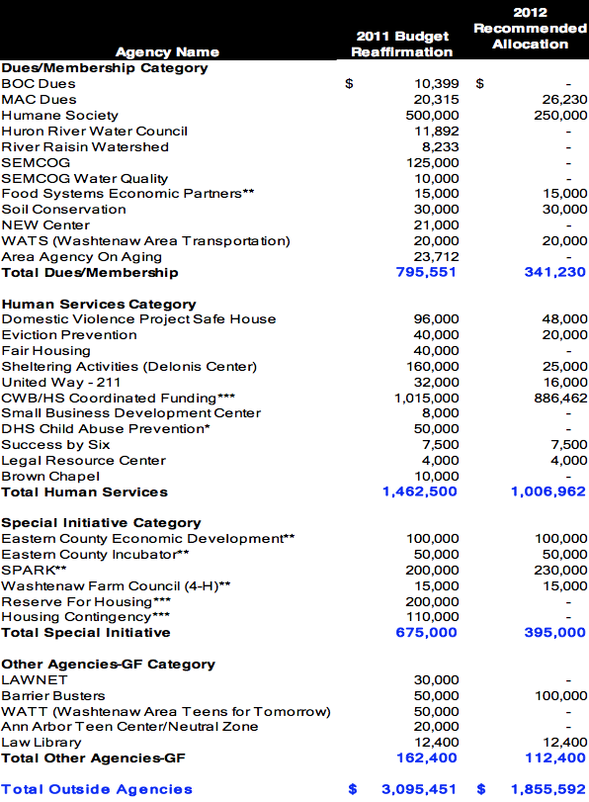
Commissioners heard an outpouring of support for continued funding for the Humane Society of Huron Valley, which faces seeing its funding reduced from $500,000 to $250,000.
Several Humane Society volunteers spoke of the agency's effectiveness in providing services, including addressing animal cruelty and ensuring proper care for animals at the shelter.
Commissioner Ronnie Peterson, D-Ypsilanti, raised a number of questions about the cuts being proposed, stressing he had no part in the recommendations.
"Somebody developed this document and I didn't participate in it," he said. "And let me say, my fingerprints ain't on it nowhere, and a whole lot of other stuff in this budget."
Still being debated is exactly what level of services the county is mandated to provide as far as animal care, and what the county's contractual obligations are to the Humane Society.
"There is state law," Rabhi said. "We must provide some services to take care of animals. My primary goal is to find out what that mandate is to identify how much that mandate costs us."
Chuck Warpehoski, director of the Ann Arbor-based Interfaith Council for Peace and Justice, showed up with a letter signed by 94 area faith and community leaders. It urges commissioners to protect the safety net that sustains the county's neediest populations.
Ronnie Peterson
"We know you've got some tough decisions in front of you," Warpehoski said. "As you make these difficult decisions, please do not balance your budget on the backs of the poor."
To get a sense of just how high the need is in Washtenaw County, commissioners heard a report from Mary Jo Callan, director of the Office of Community Development.
Callan said a new 48-month limit on state cash assistance was supposed to take effect Oct. 1, but a judge recently ordered the state didn't provide proper notice, and so families still received welfare benefits for October, but they'll be kicked off starting Nov. 1.
Callan said about 72 families in Washtenaw County will be among those losing benefits immediately, and there might be a dozen more families every month thereafter.
The state Department of Human Services office for Washtenaw County reports handling more than 50,000 cases each month, about 40,000 of which are for food stamps.
Callan noted that, as of this month, the state has implemented new eligibility requirements for food stamps. Michigan has determined food assistance eligibility based on income for roughly a decade, but the new policy now includes a review of financial assets, and families with assets of more than $5,000 in bank accounts or some types of property no longer are eligible.
Nearly 2 million Michigan residents — almost 20 percent of the state's population — are on food stamps. That statistic has increased by more than 40 percent since late 2008.
Callan told commissioners about 4,700 people in Washtenaw County experienced homelessness last year, about 55 percent of them for the first time. She said shelters across the community are reporting increased demand over last year.
The county's budget proposes reducing funding for the Shelter Association's Delonis Center, a shelter near downtown Ann Arbor, from $160,000 to $25,000. Additionally, domestic violence funding for Project Safe House is proposed to drop from $96,000 to $48,000, while the coordinated funding for other human services would drop from $1 million to $886,462.
Yousef Rabhi
"Those are two areas that are of absolute importance to the people in our community who are facing these challenges that we've been talking about," he said. "With cuts from the state, cuts everywhere else, people are coming — they need these services."
Callan said the state has made fundraising for homeless shelters more difficult by eliminating the state tax credit for charitable contributions. She said that's estimated to cost shelters and homelessness agencies across the state about $16.5 million.
"The Shelter Association has indicated it cannot afford to open its warming center, which increases the risk to those on the streets this winter," she said, noting the agency is working with the city, county and others with hopes of filling the gap.
Callan said a new Washtenaw County hotline for families facing housing instability has been heavily used since launching. Last week, she said, it received 195 calls.
Of those, 38 percent were facing eviction, 16 percent were "doubled up" and could no longer stay in their current situation, 1 percent were facing foreclosure, 11 percent were homeless and needed help finding permanent housing, and 33 percent were seeking shelter.
"About half those who called were turned away because we don't have the resources to serve them," she said, expressing regret for sharing such grim news.
Callan told commissioners food banks and pantries in Michigan also stand to lose an estimated $20.3 million due to the elimination of state tax credits for charitable contributions. She said that comes at a time when pantries are seeing increased demand and other funding cuts.
Last year, Food Gathers distributed about 5.2 million pounds of food or about 4 million meals locally, Callan said. This year, it's on track for 4.4 million meals, she said.
Callan noted the state also is cutting child care subsidies, a move that could cost working families who rely on child care to maintain employment up to $75 per month.

Barbara Levin Bergman
She said it's an even harder choice when it comes to economic development, but she'd prefer to put food on the table for families.
"We have real food scarcity in this county," she said. "My first concern is for the well-being of children and families in this county."
Ping objected to what appears in the budget to be a $30,000 increase in funding for Ann Arbor SPARK, the area's economic development group.
County Administrator Verna McDaniel explained the budget is proposing an increased contribution to SPARK from Act 88 millage proceeds to make up for other lost funding. Act 88 is a state law that allows the county to levy a millage to support economic development.
"Actually, it is really not an additional amount," McDaniel said. "It's just that one funding source dropped off by the amount of $30,000, and so we are recommending that $30,000 be plugged back in through the Act 88 funding, because this funds the transition center where employees come in and find jobs and meet and match up for jobs in our community."
Ping said she appreciated the explanation but she's still opposed to the extra $30,000 coming out of Act 88 funding — especially considering the Food Systems Economic Partnership, a program that works to implement solutions to chronic food systems issues in Southeast Michigan, is facing losing all $15,000 of its funding from the county. FSEP also facilitates the Farm to School program and other educational outreach efforts.
"This is not pretty," Commissioner Dan Smith, R-Northfield Township, said of the county's budget. "It's not something anybody likes, but it's the reality that we have to deal with."
The administration's budget proposes an increase in the dues the county pays to be a member of the Michigan Association of Counties — up from $20,315 to $26,230. Rabhi indicated he intends to lobby for cancellation of the county's membership in the association.
"I don't think that we need to be a member of the Michigan Association of Counties anymore, folks," he said. "We need to be focusing on people who are starving and people who need a roof. When it's cold outside and when it's raining outside, they need to go somewhere."
Ryan J. Stanton covers government and politics for AnnArbor.com. Reach him at ryanstanton@annarbor.com or 734-623-2529. You also can follow him on Twitter or subscribe to AnnArbor.com's e-mail newsletters.
Comments
CRAZYMAD711
Fri, Oct 14, 2011 : 6:11 p.m.
Commissioner Barbara Levin Bergman, why don't you take the proposed $15,000 for Verna and her 4 team committee, including her, which would $75,000 and give it back to the shelter? There is no union employee getting paid extra for doing extra work ever, we do it or get fired. Most union members take home a month starting 2012 is going to between $1000 for most and maybe $1500 a monthfor a few lucky souls. Stop the waste. Really take a look a each department budgets, most of them of absurd line items for MISC in the $100's, what and who is that money going to. Why are so many consultants for department when county employees can do a lot of that work and would be happy to do it for a lot less then they get. Stop wasting money on water, and color printers and other stupid things like a $1500 dishwasher for the BOC room. Tell these GREEDY higher ups to stop, and be accountable. I am sure if you to make each department give a detailed list of every item (no secret misc funds) and strange titles to all staff, we would find more money. The current budget has way too many misc. funds and other odd titles.
russellr
Fri, Oct 14, 2011 : 5:25 p.m.
Oh my goodness, some of these people that's been living on welfare and sucking the system dry might have to get a job!!! Don't tell me there isn't any, Meijer just had a job fair and very few less than 60 people showed up. They make more money sucking the system dry than working. You enable people to stay on it. They will never get out and try to find work. There are some jobs it's just that they make more money on welfare.
Justice4all
Fri, Oct 14, 2011 : 6:41 p.m.
HAHA, you're just as funny as Billy. And just where are you hiding all of these jobs you're talking about? Oh, and can I afford my mortgage with one of those plentiful jobs? What about when my kid gets sick...does it offer medical or will I have enough left over from my mortgage payment to just pay cash for that prescription. And will I still have enough for gas to make it to this job? Or what about that luxury we call eating? If you can't tell I'm not laughing any more...
HKA2
Fri, Oct 14, 2011 : 4:47 p.m.
Mike, I bet the animal control mandate would be "important to you personally" if it was your kid that got bit by a stray dog. Also, the mandate was started back in 1919, so you might have a hard time telling the people who made the law that they should now pay for animal control.
Mike
Fri, Oct 14, 2011 : 9:20 p.m.
Back in the old days the neighbors would put your dog down if it bit a kid and you'd most likely go along with it because if the dog was dangerous you'd have no choice. The other thing was that parents took responsibility for their kids being in someone elses yards, not any more; now it has to be someone elses fault
Mike
Fri, Oct 14, 2011 : 3:56 p.m.
"There is state law," Rabhi said. "We must provide some services to take care of animals. My primary goal is to find out what that mandate is to identify how much that mandate costs us." Time to put these unfunded mandates back on the people who mandated them. If you're broke, you're broke. Adopt a homeless person or and animal from the humane society if that is one of your causes. Why are you asking you neighbors to pay with their hard earned dollars in the form of taxes for something that is so important to you personally? Drive a less expensive used car, don't take a vacation, take your kids out of private schools, don't eat out or go to movies, head a fund raiser; then take that money and give it to you favorite cause. People won't do that, they just want to whine and complain and expect everyone else to pay. Put your money where your mouth is, give until it hurts if it's that important to you. I can't understand why the stae of our economy is not apparent to everyone who doesn't live under a rock; we're broke, the federal government has put us in a 14 trillion dollar hole. Do you really think this kind of fiscal irresposibility can go on without repercussions at every level of government? I know the readers of the AA news are way smarter than this but they tend to let their emotions drive their decisions and expect all of us to pay higher taxes so their sacred cows can be spared. The well has run dry folks.................
Mike
Fri, Oct 14, 2011 : 9:16 p.m.
Denile isn't going to solve the problems. They can't cut enough of their expenses to pay for all of the items everyone wants to fund. A bigger government is like an all consuming monster that devours tax payer dollars at an ever increasing rate. Shrinking the bureaucracy will reduce costs but there are always new madates and rules being made higher up that are unfunded and dumped on local government. Fix that first and the rest will follow; I think it was Nancy Pelosi who said elections have consequences.....
Monica R-W
Fri, Oct 14, 2011 : 4:28 p.m.
Nonsense....enough said.
Dog Lover
Fri, Oct 14, 2011 : 4:16 p.m.
The well has not run dry Mike. There is plenty of money in our county government, but they refuse to cut their own expenses and unnecessary staff. They tout they have made cuts, but most of those were mandated by the state. They have not taken the hit they should. Meanwhile, the non-profits who largely fund their operations to help our county citizens continue to receive cuts from the county, but are expected to keep on providing services. The people who are receiving support services now are not your usual scammers. These are people who were volunteers and donors and have now lost their house or job and need assistance while they try to get back on their feet. Our federal government woes are far different than our county woes. Our county has the money and also has the means to get more. They just choose to protect themselves and scratch the backs of organizations like SPARK instead of supporting people and animals in need.
Dog Lover
Fri, Oct 14, 2011 : 1:47 p.m.
One item that the reporter left off was the statement Commissioner Bergman made about the Humane Society contract. Blah, blah, blah....I love dogs and cats. I don't know how we will take care of the animals. When it comes down to saving animals or people, I'll save people. Maybe we'll have to put down more animals because of it. Most of the commissioners did not even have a copy of the animal control contract or letter of intent from the former County Administrator. The working session was supposed to be a public forum of sharing information, but they did a very good job of not sharing any information. The County Attorney contributed absolutely nothing, even when asked. His salary alone would feed a lot of people and save more animals. There is something not right here with the way the County Administrator presented this budget. Lack of due diligence in investing the outcome from all these cuts is apparent. There are many, many more cuts the county can do with it's own departments, but it's easier to cut someone else's budget. If we truly want smaller government, the County Administrator and Commissioners just need to look inside. The non-profits are receiving a pittance in comparison to the work they are doing for the citizens of the county, including the Humane Society. How 'bout negotiating some of the other outside contracts with the corporations who can afford to cut their prices? Very disappointing meeting last night.
Gloriagirl
Fri, Oct 14, 2011 : 1:29 p.m.
Spark needs to get their funding from the university of michigans endowment. The last category barrier busters is not explained. Unless it directly aids animals or families, that funding should be used for our children and animals, the most vulnerable in our society. Likewise with the eastern economic development, washtenaw fair grounds, and soil conservation budget items. The mission should be serving people and animals FIRST. Like Washington, the groups with the most lobbying power get the benefits while the poor and politically unconnected suffer the most. We are becomming a morally bankrupt society starting with our local government. These officials need to do their job, that's why they were elected.
David Briegel
Fri, Oct 14, 2011 : 4:29 p.m.
Mike, That is nothing more than a phony right wing talking point. And we tried it your way. Remember those wonderful Bush years with Hastert and his bagmen, Delay and Boehner? Two mismanaged wars, did you go shopping? I'm certain you're a free marketeer that just loved those no-bid Big Pharma benefits and the 2 million per year bribe to Billy Tauzin. And that bridge to nowhere? Short memory there Mike?
DonBee
Fri, Oct 14, 2011 : 4:27 p.m.
Gloriagirl - Spark is getting money because the Council used a little known law to raise taxes for them. The money cannot be spent except for areas allowed in the original law.
Mike
Fri, Oct 14, 2011 : 3:44 p.m.
The mission has to be serving people first, animals if left to their own devices can actually hunt and will do so to survive, but people have to come first. Just instituting drug testing would cause many to not ask for public help; there's an easy cut. The biggest problem we as the American people have is we don't have a lobbyist looking out for us. Our poiticians raise money and then owe huge favors to the bundlers and handlers. Obama has raised $1 billion dollars for his re-election so far. He is so bought and paid for and yet many think he is the messiah. We need to get business people running the government since they put away the emotions and make the numbers work. Kind of like people who use their credit cards to make donations to charities while they can't even affrod the monthly payments. Purely emotionally driven (nice thought, but recipe for personal financial disaster)
Mr. Ed
Fri, Oct 14, 2011 : 12:51 p.m.
If Conan Smith paid back his money then funding might not be an issue.
Dog Lover
Fri, Oct 14, 2011 : 8:10 p.m.
Conan, Bergman, Ping & Schwartz all still owe this money back to the taxpayers. Are they really trustworthy??
a2huron
Fri, Oct 14, 2011 : 12:26 p.m.
I have a a great solution to this problem: Let's give four administrators a $15,000 pay raise so they can "do more with more." Oh wait a minute. The county exec already proposed this solution. Oops.
Charlie Brown's Ghost
Fri, Oct 14, 2011 : 12:07 p.m.
I'm sure this will somehow said to be Rick Snyder's fault.
DonBee
Fri, Oct 14, 2011 : 4:25 p.m.
Actually Mike it started during Clinton and was originally the idea of Rep. Barney Frank. He was unhappy that South Boston was "Redlined" and so pushed to reduce the "proof" that people needed for loans. There are several U-Tube videos of him berating banking officials for having too high a set of standards for lending to the poor.
Mike
Fri, Oct 14, 2011 : 3:37 p.m.
Wall Street can't do this alone, Congress made the rules which allowed the housing fiasco to happen. Started with Bush and is being put into hyperdrive by our inexperienced commander in chief. Lot's more of this pain is coming our way and there isn't enough tax money to collect from every man, woman, and child in this country to pay off the national debt. Social programs are going to be hit the hardest since your taking money from folks who still have a job and gving it to those who can't find a job, don't want a job, or are too drugged out to be employable.
tom swift jr.
Fri, Oct 14, 2011 : 12:34 p.m.
Naw, I'm putting this at the feet of Wall Street and the Banking Industry, Rick Snyder isn't smart enough to destroy the economy, heck, he couldn't even run a second rate computer company.
snoper
Fri, Oct 14, 2011 : 11:55 a.m.
"With all of the cuts and the agencies that are going to go without, and the people who are going to go without, and the animals — I just think this is horrible," said Alicia Ping Don't we have enough "squeaky wheel gets the grease" mentality in our local goverment? This Board has cut jobs, cut wages, cut benefits (for everyone but themselves) They have cut services to constituents. Yet, they still feel the need to take taxpayer money and money taken directly from their employees' pockets and distribute it to their favorite charities as if it was their own money and they are making personal gifts. Grow. Up.
snapshot
Sun, Oct 16, 2011 : 3:29 a.m.
So smoper, are you implying that these programs are being funded entirely on the backs of county employees? And are you implying that any of the ruductions and budget cuts were unneccesary? I'm not seeing a reduction in the standard of living of government employees. I'm not getting what you're saying. Is there some money out there that "doesn't belong to taxpayers"that government employees have access to?
Lisa
Fri, Oct 14, 2011 : 1:36 p.m.
Not all of the cuts address charitable giving. The cuts to the Humane Society of Huron Valley are NOT affecting a donation. They are affecting a state-mandated service that the county has contracted with HSHV to provide. This cut is the equivalent of the county paying for half a road but still expecting the contractors to provide a whole road.