

Coaches have lead role in sustaining funding for high school sports programs
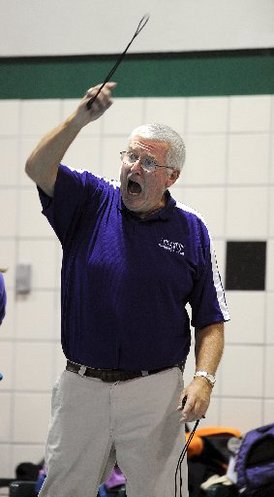
Pioneer High School swimming coach Denny Hill urges on one of his swimmers in October. Hill has seen the way high school sports are funded change quite a bit in his 41 years of coaching. (Photo: Lon Horwedel | AnnArbor.com)
His budget for boys swimming alone was more than the $51,000 he receives to run both the boys and girls programs today. Back then, Ann Arbor Public Schools district funds provided enough money to pay for everything, including swimsuits, towels, breakfast foods for early-morning training sessions and even a set of blazers the Pioneers wore to away meets.
Today, Hill, 41 years into coaching Pioneer swimmers, deals with district funding that pays only his salary, his team's transportation costs, officials and league entry fees. Funds for everything else - from stopwatches to expensive timing equipment - are raised by the coaching staff, swimmers and boosters.
So there are cookie dough sales and car washes and other fund-raising efforts. Generating money through team fees is as much of coach's duties as planning strategies.
Now, district officials are suggesting that Ann Arbor join the ranks of school districts that charge a pay-to-play fee that to cover a portion of the district's efforts to wipe out a $20 million budget shortfall. Under the plan, students will pay $150 to participate in sports in the 2010-11 school year.
The funds raised through pay to play, along with cuts to transportation and consolidating some teams among the three Ann Arbor high schools, would cover the $500,000 athletic administrators are being asked to slash from their budgets.
The pay-to-play plan has Hill and other coaches concerned.
"Right now, this year, we're going to be fine and next year we're going to be fine, but in the future, I can see athletics taking a real big hit as far as pay to play goes," Hill said. "I don't think it's the way to go. I think you put yourself in a hole that sometimes, you can't get out of and all of a sudden, that money's not going to be there. Once you've done it, you can't go back.
"I think pay to play is going to be a nuisance and kids are going to be lost, but I think it's an inevitability."
District officials say that pay-to-play fees, along with cutting transportation costs, are effective ways to trim the budget. Coaches, however, fear that asking families to pay more will put participation numbers in jeopardy.
At Pioneer, 67 percent of students participate in athletics, a figure that is comparable at the city's other two high schools. The city's two biggest schools - Pioneer and Huron - offer 35 and 31 sports programs, respectively.
Athletes find plenty of opportunities, but the number of teams leaves the district funding more sports.
Currently, the $3.6 million Ann Arbor spends on athletics is double the amount districts such as Plymouth-Canton, Farmington and Rochester spend. Those districts - which also have three comprehensive high schools - spend on average $1.7 million on athletics.
Unlike Plymouth-Canton, which designates a portion of its district funds for uniforms and other equipment, Ann Arbor pays for coach's salaries - which accounts for about 80 percent of the allotted amount - along with transportation and league entry fees.
|
Spending Reports Click the links below to
|
At times, the district's athletic directors don't feel like they are giving the coaches enough to work with.
"I think you need to provide some of the basics, and we're not providing all of the basics." Pioneer athletic director Lorin Cartwright said. "For me, part of the basics is for me to go back to Pioneer, Huron and Skyline buying helmets for football team, buying shoulder pads, buying cleats, buying starter's pistols - all those things, we're not buying those things."
Cartwright, Pioneer's athletic director since 1995, said in the 1980s, the district purchased equipment and other needs. But since 2006, when the district asked athletics to trim $245,000 from its budget, sports have had less to deal with. When those cuts were made, Cartwright trimmed each of her athletic team's budgets by 10 percent. Now facing a cut of $500,000, Cartwright isn't certain how that will get done. To most, the pay-to-play concept is inevitable.
"It's been a gradual cutback and the sacred cow is really a sacred cow," Cartwright said. "The sacred cow has been cut back year after year after year."
That leaves coaches to their own devices. At Skyline, swimming coach Maureen Isaac charges swimmers $130 in team fees to support a program that received just under $15,000 from the district last year. Pioneer football coach Jeremy Gold's team fees are closer to $200 to support a program that, four years ago, had its varsity and junior varsity teams sharing game uniforms.
In the past four years, Gold has raised his team fees by $50. Under the pay-to-play plan under consideration, players would face an additional annual fee of $150.
Gold says his program’s booster club helps an average of 30 families each year, and he worries that his roster numbers will take a hit. As it is now, his coaching duties involve visiting the community and shaking hands of local business owners to drum up financial support.
"With the way the economy is, I think you'll lose some kids and I don't know how many scholarships we can give to folks," Gold said. "So that's a concern for me."
Huron boys basketball coach Waleed Samaha does not charge a team fee and raises funds through a series of preseason activities. This year, his program raised $12,000 - mainly through working concessions at various Huron events as well as at Michigan football games. Samaha's team also works the booster club's craft show and hosts a golf outing in an effort to take care of the costs needed to team travel, equipment and summer camps.
"Fundraising is one of those parts of the job that I think any coach will tell you they want no part of," Samaha said. "But it's a necessary evil and you have to be in control of it. If you're not, you're not going to be able to accomplish the things you want to with your program."
Although fund-raising is nothing new, finding new items to sell or getting students and their parents to participate can be difficult. While some are willing to participate in fund-raising efforts, others would rather simply write a check.
Skyline athletic director John Young can relate. Young, the father of two college-aged students who participated in high school sports, never felt comfortable asking friends to support his kids' sports teams. When he runs into resistance from parents in Ann Arbor to do the same, he understands.
"People have different strengths and weaknesses," Young said. "Some people have great personalities and have the ability to go talk money out of people's wallets, and some are so embarrassed and so introverted that there is no way they're going to talk someone out of $10 let alone $1,000."
Ann Arbor's athletic directors value coaches who understand the economics. Huron athletic director Dottie Davis quickly covers the topic in coaching job interviews.
Davis said most candidates understand, realizing extra curricular activities such as high school sports must be paid for other ways. Ultimately, athletic administrators in Ann Arbor as well as in surrounding communities fear high school athletics will, in time, be completely self-funded.
For now, those, athletic administrators have learned to use what they have to spend.
"We're running on the bottom line right now and anything we'd take away right now would impact the kids," Davis said. "We're very grateful for what we have. Does everyone always want more? Sure. Can we do with less? Probably.
"But how do we make cuts without impacting kids? That's our primary concern."
Jeff Arnold covers sports for AnnArbor.com. He can be reached at jeffarnold@annarbor.com or 734-623-2554. Follow him on Twitter @jeffreyparnold.
Comments
aaconcerned
Mon, Jan 25, 2010 : 8:11 a.m.
"Currently, the $3.6 million Ann Arbor spends on athletics is double the amount districts such as Plymouth-Canton, Farmington and Rochester spend. Those districts - which also have three comprehensive high schools - spend on average $1.7 million on athletics." Is middle school athletics included in those figures as it is with AA's budget?