

Can we keep our startup companies in Ann Arbor region after rash of acquisitions?
The sale of several of the Ann Arbor region’s most promising startup technology companies to outside corporate suitors in recent months is resurrecting an uncomfortable question for the entrepreneurial community:
Will those companies stay here and grow, or will the new corporate owners extract the technology and look for the nearest exit out of Michigan?

Accuri Cytometers -- co-founded by former CEO Jen Baird, now is CEO of Accio Energy -- is being sold to Becton, Dickinson and Co.
File photo | AnnArbor.com
The uncertainty is accompanied by a deep sense of cynicism among workers who have witnessed many companies swoop in and buy local companies only to abandon the local operations as soon as possible.
That’s effectively what happened with medical device maker HandyLab, a University of Michigan spinoff company bought by New Jersey-based giant Becton, Dickinson and Co. for $275 million in late 2009.
BD initially sent indications that it would keep the company’s 22,000-square-foot Pittsfield Township operation, but ultimately announced in October 2010 that it would close HandyLab’s 50-person local office and shift manufacturing to an East Coast facility.
On Monday, Ann Arbor’s entrepreneurial community got a jolt when BD — yes, the same BD — announced an agreement to purchase Scio Township-based medical device maker Accuri Cytometers, which employs more than 60 workers here.
People with knowledge of BD’s thinking said initial indications point to the company maintaining Accuri’s Scio office.
But those promises will be viewed skeptically because of BD’s history.
"I think there's a tendency for people to be more skeptical and rightly so," said Tim Petersen, managing director for Ann Arbor-based Arboretum Ventures, an Accuri investor.
However, Petersen said Accuri has a more significant manufacturing operation than HandyLab — which might make it harder for BD to pick up and leave.
“It's my understanding that there should be more optimism,” Petersen said.
Accuri is one of several Ann Arbor tech companies sold to outside corporations in recent months. The others include:
--Adaptive Materials: The Pittsfield Township-based fuel cell maker was sold for $23 million, and an additional $5 million if the company hits certain production milestones, to United Kingdom-based Ultra Electronics Holdings in a deal revealed in January. Ultra said it plans to add to Adaptive Materials’ 55-person workforce and invest in equipment to boost production at its 47,000-square-foot manufacturing facility.
--Mobiata: The Ann Arbor-based mobile software firm was sold in November to global travel website Expedia.com. Expedia said Mobiata -- which employs nearly 20 workers, about one-third of whom work in Ann Arbor - would stay here and become its mobile development headquarters.

Arbor Networks -- co-founded by Rob Malan -- was sold in August but is maintaining its Ann Arbor-based research-and-development headquarters.
Melanie Maxwell | AnnArbor.com
--Arbor Networks: The U-M spinoff information technology security company was sold in August to Plano, Texas-based Tektronix Communications, a subsidiary of Washington, D.C.-based conglomerate Danaher Corp. Arbor plans to add 30 workers at its 90-person research-and-development office in Ann Arbor by the end of 2011, the company announced.
--Cielo MedSolutions: The Ann Arbor-based U-M spinoff health records company was sold to Washington, D.C.-based The Advisory Board Co. in a deal announced Feb. 4.
Paul Roscoe, CEO of The Advisory Board subsidiary Crimson, said he views Cielo’s Ann Arbor development office as a key part of the acquisition.
The Advisory Board plans to double Cielo’s 10-person Ann Arbor staff in 2011, he said. The new jobs will involve software development and installation.
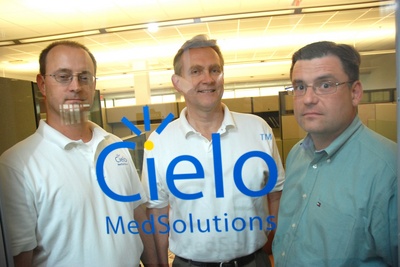
Cielo MedSolutions was sold to Washington, D.C.-based The Advisory Board. Pictured in this 2008 photo (l-r): Christopher King, senior vice president of product and operation; co-founder James Price; and CEO and co-founder David Morin.
File photo | AnnArbor.com
“We are going to invest around that office,” Roscoe said in a phone interview. “We think we’ve got a great team that already exists at Cielo. We also find that Ann Arbor provides us with what looks like a very robust pool of talent.”
Cielo’s sale is the kind of outcome the entrepreneurial community hopes for when tech companies are sold.
The Ann Arbor region’s talent pool is an asset that has convinced many corporate acquirers to stay. Johnson & Johnson, for example, decided to maintain U-M software spinoff HealthMedia’s downtown Ann Arbor headquarters after acquiring the firm in late 2008. Johnson & Johnson even formed a new wellness division around HealthMedia.
The software development talent at HealthMedia was crucial to the company’s success -- and simply exiting Ann Arbor after the acquisition would have been foolish.
On the other hand, in instances where the acquiring company is simply buying hardware, there’s a greater risk of the local office being eliminated.
That’s obviously what happened with HandyLab. BD paid $275 million for the technology and didn’t need the office.
It was a discouraging reminder of our tech companies’ susceptibility to corporate outsiders.
Nonetheless, the hard reality is that the sale of startups to outside companies adds to the Ann Arbor region’s emerging reputation as an entrepreneurial destination. As that reputation grows, more investors will migrate to Ann Arbor.
Accuri’s sale reaped returns for Arboretum Ventures and Ann Arbor-based Plymouth Venture Partners in addition to several outside investors.
Ian Bund, chairman of Plymouth Management Co., which includes Plymouth Venture Partners, said the Ann Arbor region’s entrepreneurial ecosystem grows with each additional success story like Accuri and HandyLab. Even when a company doesn’t ultimately stay here.
“It’s a shock to the system when you see a promising company like HandyLab leave,” Bund acknowledged.
Nonetheless, the talent we’ve generated while these companies are here benefits us in the long run, not to mention the positive publicity generated by the companies’ success, which contributes toward Michigan’s image recovery.
“While in an ideal world we would see these companies continue to build here, in many cases we’ve seen them as the germ for the next round of companies,” Bund said. “What happens is success can lead to other companies being born.”
Here are a few examples:
--HealthMedia’s former CEO, Ted Dacko, is now advising several tech companies, including Ann Arbor-based InfoReady Corp.
--Accuri’s co-founder and former CEO, Jen Baird, is now CEO of promising Pittsfield Township-based wind energy device firm Accio Energy.
--Dick Sarns, a luminary of Ann Arbor’s tech community, started the medical device company that was eventually sold to 3M Corp. and then to Japan-based Terumo in the 1980s. Two Terumo divisions now employ more than 400 workers in Scio Township. Sarns, for his part, went on to start Pittsfield Township-based rehab device maker NuStep, which has about 80 employees now.
The sale of tech companies is inevitable, because investors won’t invest unless a sale or initial public offering is eventually possible. And if investors don’t invest, companies have a hard time growing.
“We have to understand that some of this recycling of capital that happens when you have a great transition like this makes a big difference,” Baird said.
“This operates like a whole cycle, and it’s important to realize that if the investors don’t get a return on their investment, then they can’t turn around and invest in new companies.”
Contact AnnArbor.com's Nathan Bomey at (734) 623-2587 or nathanbomey@annarbor.com. You can also follow him on Twitter or subscribe to AnnArbor.com's newsletters.
Comments
Fred Steadman
Thu, Feb 24, 2011 : 11:12 p.m.
I had a feeling that it was more then just a coincidence that Jeff Williams was positioned at Accuri after BD purchased Handylab. I Heard rumor that the sales was "in the bag" several weeks after Jeff took the helm. As for Accuri being kept in Michigan? I hope that no one really believes that. Everyone down the street at Accuri needs to search BD's product line. When they do this they will find that BD already make Flow flow cytometers and NOT in the Good Old US. What do you think that the odds are of keeping two facilities that build the same type of instrumentation? BD's Mission Statement includes helping all people live healthy lives.... I wonder how all of the people of handylab and accuri will maintain their health while on Unemployment without insurance and fighting each other for the dwindling jobs available. You know.... A company is supposed to care about the bottom line. It has to... But there used to be a little thing called loyalty that was typically factored in to these decisions. Companies and the people that ran them had scruples and did not simply make out of hand statements like "Oh it's their company they have to do what's best for their shareholders. You CAN serve your share holders and still treat the people that built your cash cow with respect and loyalty. God knows that the employees for the most part are loyal to a fault.
glacialerratic
Sun, Feb 13, 2011 : 2:55 p.m.
Welcome to the casino. This region once was home to one of the most diverse and formidable manufacturing economies in the world. Michigan had a huge global competitive advantage in the skills and experience of its manufacturing work-force. But that's gone. We lost a bet placed by corporations and politicians that a trade-off would transform the US economy--that moving manufacturing to low-wage countries would bring down costs of consumer goods, and a post-industrial US would become the global center of R&D innovation. Surprise--the bet didn't work. Innovation can't be sustained far from the manufacturing floor and the skilled workforce and site-based engineers that make, trouble-shoot and find ways to do things better. Ann Arbor will continue to spin-off start ups to the coasts, and to feed the IP investment stream that often as not suffocates challenges by buying up and shelving ideas. This was a sucker's bet. And who's paying? Take a look at Flint, Saginaw, and dozens of other dead or dying communities to find the answer. But only part of the answer. The would-be new economy entrepreneurial class is also stifled. Unless, of course, they follow their ideas to Houston, the Bay Area, or Fairfax counties. And none of these hyper-affluent greenhouses can sustain a healthy national economy. Take a look at today's NYTimes for more evidence: <a href="http://www.nytimes.com/2011/02/13/business/13every.html" rel='nofollow'>http://www.nytimes.com/2011/02/13/business/13every.html</a>
Dcam
Sun, Feb 13, 2011 : 7:19 p.m.
Excellent comment and link, and, of course it's absolutely correct. I've preached the same thing for years, and have worked very hard to counter it in the many plants and factories I've done projects, designed, wrote and installed factory-wide, large-scale systems. Systems for actually for making parts, not busy paper, clerical work, but making production parts is something IT professionals and academics look down upon. They think the jobs are unimportant and overpaid - shopwork is for the mindless. Of course, I've got reams of data proving incompetence and ignorance is not on the shop floor always. The Ann Arbor News, about a decade ago had huge headlines proclaiming a study by University of Michigan economists that Michigan had better get rid of manufacturing jobs if it planned to keep financially viable, and the sooner the better. Send the jobs to foreign shores, at least get them out Michigan - we don't want them, nor can we afford them. Gov. Granholm and the media were all on the bandwagon - they were all wrong, and I fired off a letter stating my opinion. Among my projects: MSU/NSF's K800 superconducting cyclotron, Sarns Corp NC lathe programming system, elevator mechanisms for the USS Abraham Lincoln, factory-wide data collection, real-time, quality analyses systems for Dana Corp, CMI, Hy-Lift. I think my credentials are as good as any academic pontificator who cares to challenge me. I've taken on some of the most respected over the years, and won.
Dug Song
Sun, Feb 13, 2011 : 4:27 a.m.
@bugjuice: I agree that most of us building non-automotive tech companies in Michigan look toward opportunities outside the state, sometimes to the detriment of our local integration in the community. Not to ascribe blame, but there's a discernable Michigan inferiority complex - where you'd expect some level of pride in dealing with local companies, you often find exactly the opposite. A few years ago, after a decade of being a good corporate citizen but a bad townie (didn't really know anybody here!), with hard decisions to make about staying (no family left in the state, a child about to enter school, and another in the works), my wife and I decided to double-down on the community we wanted to raise our children in. <a href="http://a2skatepark.org" rel='nofollow'>http://a2skatepark.org</a> <a href="http://a2geeks.org" rel='nofollow'>http://a2geeks.org</a> <a href="http://a2newtech.org" rel='nofollow'>http://a2newtech.org</a> and so forth. But the real project I'd hoped to accomplish (with Martha Bloom and Bhushan Kulkarni at <a href="http://aaacf.org" rel='nofollow'>http://aaacf.org</a> ) was the Entrepreneurs Foundation of Ann Arbor (e.g. Bay Area <a href="http://efbayarea.org" rel='nofollow'>http://efbayarea.org</a> Austin <a href="http://givetoaustin.org" rel='nofollow'>http://givetoaustin.org</a> Boulder <a href="http://efcolorado.org" rel='nofollow'>http://efcolorado.org</a> etc.). We didn't get very far before baby #2 (and company #4) intervened. The idea is simple - marry local philanthropy & business in a way that sets a model for new entrepreneurs, companies, employees, and investors to participate in their local communities. New startups set aside some ownership to the fund as a commitment to the community ("If we do well, our city does well"); past entrepreneurs and investors join as charter members to lead the way (and find new startups to work with or invest in); and the corporate service programs get everyone involved in the broader community. It has done wonders for cities such as Austin & Boulder, where local investors actually require new companies to participate as a matter of course, founders aspire to leave their mark, and everyone aligns to benefit their community. I'm ashamed this still hasn't happened. @Hot Sam: That's Arbor's testbed. Robra's clearly on the wrong side of
Stephen Landes
Fri, Feb 11, 2011 : 8:11 p.m.
@bugjuice What make of vehicle do you drive?
bugjuice
Fri, Feb 11, 2011 : 11:29 p.m.
I've never owned a new car and bought used ones, mostly Japanese and less than $10k. So I assume that makes me disloyal? Poppycock! Now tell everyone who makes your underwear and where it was made.
Dcam
Fri, Feb 11, 2011 : 9:19 p.m.
Aesop's fable about an injured lion being nursed back to health by small forest creatures proves the fallacy of expecting loyalty to be a two-way street. Loyalty is never(very rarely, anyway) downward - especially when corporate money's in play.
Stephen Landes
Fri, Feb 11, 2011 : 9:08 p.m.
You want corporations to have some sort of loyalty to you, so do you view it as a two way street?
bugjuice
Fri, Feb 11, 2011 : 8:49 p.m.
Where was your underwear made?
bugjuice
Fri, Feb 11, 2011 : 8:48 p.m.
What does that have to to with the price of rice in Viet Nam?
Stephen Landes
Fri, Feb 11, 2011 : 8:08 p.m.
Being an entrepreneur is not a one shot deal -- if a company is sold and moved what we have left is the money and talent. The challenge is to do it all over again. What our city, county, and state need to do is understand the root causes for the relocation of some of these enterprises and then design policies, procedures, and structures that answer the relocation drivers. What we cannot do is have the DDA and city council work against entrepreneurs and the business community with their out of control spending, threats to increases or add taxes, and inability to get basic services and infrastructure right. Whatever projects their fertile little minds gin up need to be evaluated against the criteria that make Ann Arbor the right place for business start ups to begin, thrive, and stay here. How does the new city hall and accompanying fountain address the concerns of people who can choose to move a business elsewhere? Does a new parking structure on Fifth really answer a business need? Does it help or hurt our case to have developers jumping through hoops for months to years before getting approval to build? The more attractive we make Ann Arbor as a place to do business, to build connections, to interact with a critical mass of talented, enthusiastic, and energized individuals, the less desirable it is to move a business out of town. We will never succeed by trying to make investors feel guilty for "abandoning Ann Arbor". We can succeed by making Ann Arbor the place they always want to come back to.
Dave Miller
Fri, Feb 11, 2011 : 5:58 p.m.
We must begin by asking the right question. Why can't companies reach scale and stay profitable in the State of Michigan? If we can determine an answer to that question, then we should be able to understand why acquiring companies move their newly acquired assets out of Michigan. How about State unfunded or underfunded obligations to public sector Unions - Do you think a State's fiscal condition comes into play when a Company determines where to locate? Let's consider the political environment which Michiganders have allowed to evolve over the decades. When both sides of the political aisle are beholden to the same Union influences, then the legislation that is introduced and supported, generally is pro-Labor, often times finding the Employer disadvantaged. Those would be the same employers that create jobs. I know, this may come as shock to many in Michigan, but Unions don't create jobs nor do Governments create jobs in the private sector. Governor Snyder and the Michigan state legislators must undertake the mission of creating a business friendly environment through restructuring the business tax codes, through the elimination of onerous regulations, and by allowing Michigan to become a Right to Work State. And Michigan must get its fiscal house in order. Continuing to do what we've done in the past and expecting a different outcome is a description of insanity - and for too long, Michigan has resisted all attempts to make this State business friendly and to operate in a fiscally responsible manner. In addition, Michigan must make an investment in its critical infrastructure that will encourage the use of the natural geography that found Detroit to be a large trade center from the founding of this Country. We can achieve that status again with the right investments, and that too would aid in attracting and retaining business, and job creation.
bugjuice
Fri, Feb 11, 2011 : 6:22 p.m.
Union membership has decreased since Reagan was president, some 30 years ago and is at it's lowest point since unions came into being in the USA. Working people's real wages, benefits, both public and private, have gone down while corporate profits and CEO salaries have never been higher. The gap between rich and poor has never been wider. Tax breaks to corporations and the wealthiest in our country increased as jobs have left. Blaming unions for the economic mess is a tired Republican talking point. But the more you continue to repeat it, the more that the gullible among us will continue to believe it.
jhammer
Fri, Feb 11, 2011 : 4:56 p.m.
I don't understand. We bash the companies because they accomplished what they set out to do? Are you suggesting that start ups have no exit strategy other than to provide a social service for the community? I say congratulations to these start ups. Better to have started up, grown, and successfully sold than to have never existed at all. Get over it people. If you've got a problem with it, start your own.
bugjuice
Fri, Feb 11, 2011 : 8:20 p.m.
Does anyone really believe it's a good thing for a nation to grant the same human and constitutional rights to it's citizen's that it does for private business interests, many operated by well hidden individuals and nebulous institutions whose officers who cannot be held legally liable? Because this has been trend of the SCOTUS legal decisions for the last 20 years. In fact, in many cases business gets more opportunity and a better chance at success than any individual. When corporations fail, shareholders get hurt, CEO's walk away often in better shape than the institution they led. When individuals fail, it's over with little recourse. Add to these trends the fact that corporations get better financial perks than individuals. They pay far less income tax (lawyers and accountants) than regular working people do because the legal deck is stacked in their favor. In 2008, General Electric's effective tax rate was 5.3%; in 2007 it was 15%. The marginal U.S. corporate rate is 35%. Wouldn't we all like to pay 15%, much less 5.3%? With rights come responsibility. Since corporations have "rights" similar to mine they should have the same responsibility!
jhammer
Fri, Feb 11, 2011 : 6:11 p.m.
Try building a business from scratch, mortgaging your house, begging investors, working 100+ hours a week, dealing with ups and downs, dealing with growth and problems, etc. And then you are presented a check and a chance for an easier, saner life where you might see your kids play soccer for once. Let's see if you turn it down. They owe nothing to us as a city. They already gave at the office.
Townie
Fri, Feb 11, 2011 : 5:53 p.m.
Unbridled greed - is that the goal? I didn't suggest that start ups had to provide a 'social service'; just that society isn't totally abandoned in the rush to get rich fast. By your logic, if start ups are successful and our communities destroyed in the process then that's OK for our country? I'm saying that we nudge (by peer pressure and perhaps financial incentives) the dial back to some societal balance. Right now it's strictly 'get your money and fast'. I assume shipping jobs to China for a faster, better profit is desirable?
bugjuice
Fri, Feb 11, 2011 : 5:42 p.m.
It's one thing when business entities make a profit and prosper, but when they make a profit, send that profit somewhere else without reinvesting in the community that helped them make that profit (thru workers efforts, education and loyalty), then walk away from that place... it may not be illegal, but it is immoral. And I am saying that it IS the intent of some start ups is to make a quick profit, sell out and move on all without having a stake in the place they reside or the people they employ. If business want loyal, hard working employees they need to show them some respect and loyalty as well.
Dcam
Fri, Feb 11, 2011 : 4:29 p.m.
The only way a start up will grow into a stable, Michigan business is when those starting companies have their own money, ideas, and desires tied up in the businesses they start. What we have today, especially among UM generated businesses, are university projects by people who have no intention of building a business beyond getting funding and then selling it. And it's not their own money involved - it's university money, taxpayer money, or venture capitalist (which in large part is still taxpayer money) money. Individuals who take risks personally are shunted aside as being irrelevant and taxed out of business, in spite of the fact that those are the people who are the true innovators and company creators. One can easily follow the same group of people flitting from project to project, start up to start up - never once investing their own money, only their connections to ensure a profit from selling the efforts and talents of others. Like locusts, they feast while the state withers. I had a high-tech business in the '80s, and the Ann Arbor News -'92, in spite of validation by Fortune 500 companies and the Michigan Technology Transfer director's praises, called me a curmudgeon because I was too tuned into product, therefore unsuccessful as a business. My business was a success, and I accomplished what I set out to do - prove that one doesn't need 100s millions of dollars and the University of Michigan to do what a billion dollars of taxpayer money and 20 years couldn't be done by ITI(MMTC) and all their academic expertise - and still can't be done. The start up environment is a joke today. It's not about building stable, growing businesses - it's about transferring money to a very few people and limiting non-allied individuals from competing. MEDC, SPARC and every other program is aimed at that purpose.
Townie
Fri, Feb 11, 2011 : 4:48 p.m.
Dcam - thanks for a realistic assessment of our present business environment. I've seen exactly the same thing repeated over and over: start ups created just to sell and make a few top folks very wealthy while the people lower down worked hard thinking they would be part of the success but got sacrificed before seeing anything. We really live in a 'the rich get richer' country now and where individual success and wealth are the goals, not raising all boats in the community (which eventually makes for a society that benefits everyone). More and more the Republican Party (and slowly but sure the Demos as well) is focussed solely on this approach and our democracy erodes as 'business' takes control of our media, our legislators and country. The goal isn't our community or our country but profit and the enrichment of the few. One only needs to look at the present gap between the wealthiest and poorest in our society to see that (just check the gini scores between the US and Egypt if you want a surprise).
bugjuice
Fri, Feb 11, 2011 : 3:02 p.m.
These ARE OUR companies. They ARE part of the social fabric. They do HAVE a responsibility to do no harm to the community in which they locate. Without basic rules of equality for all, including business entities, corporations can do whatever they like regardless of the consequences. Indeed this is what we have witnessed for several generations now and are reaping the devastation of unfettered so called "free market" capitalism. We have culture that puts business and corporations on a pedestal, placed them above the laws that govern the rest of us. Business interests have rigged the rules in ways that favor corporations more than people. Now we have a society that places the interest of business and their profits above the people. Who among us has condemned business and corporations for outsourcing jobs overseas or massive layoffs of our friends and neighbors? Yet, in the same breath, those who condemn these community and people destroying actions want to give corporations more power to do what they want, all in the name of "growth and success? For whom? Certainly not for workers left behind in the quest for ever increasing profits.
braggslaw
Sat, Feb 12, 2011 : 2:15 a.m.
Laws regulate businesses The koombaya garbage you are talking about equals entitlement If you do not like the laws you are free to vote and introduce your proposals into the arena of ideas Most likely people will recognize that those proposals already lie in the graveyard of ideas ...Cuba, user, north Korea
Stephen Landes
Fri, Feb 11, 2011 : 9:06 p.m.
I'm just wondering if loyalty is a two way street with you?
bugjuice
Fri, Feb 11, 2011 : 8:46 p.m.
What brand of tv or phone do you have? Where was your underwear made?
Stephen Landes
Fri, Feb 11, 2011 : 8:13 p.m.
What make of vehicle do you drive?
bugjuice
Fri, Feb 11, 2011 : 5:28 p.m.
So it's ok for corporations to do as they wish as long as it's not illegal. It may be wrong, but hey, it's legal, so it's ok. Where have we heard that before? Corporations may now contribute unlimited amounts of money to political campaigns, secretly and without any oversight. They buy the politicians who write the laws that govern them. Do you really think they have our nation's best interest at heart? If you do, then you are living in capitalist heaven.
JSA
Fri, Feb 11, 2011 : 5:11 p.m.
There is no basis in law to support your position. You just don't like today's reality but expecting any change in the direction you prefer is not going to happen. We have a constitution that guarantees our right to try to succeed but it does not guarantee whether or not will succeed. Communism and Socialism are, for the most part, dead. Move on.
bugjuice
Fri, Feb 11, 2011 : 4:08 p.m.
What you're saying is that we should essentially be slaves to corporations and their profits regardless of how hard we work, our skills and education or ambition. You are blaming people who in this day and age have little or no control over their own destiny. If a worker is unhappy, they can just leave go on their own and if they have a great idea and work hard they can succeed. That's a myth. Unfortunately the rules and laws are stacked in favor of big business and everyone knows it. It's a myth, long lost but still perpetuated by some, that the average jane or joe can succeed on their ambition and skills alone. This whole philosophy that unfettered free market capitalism will solve all problems and you can be a success (whatever that means) by your own hard work and grit is reminiscent of the old Protestant work ethic that told poor people they were poor because they weren't as pious as the wealthy who got that way because that had a deeper belief in God. Indeed, the wealthy got that way because they controlled the legislative processes that wrote the laws and rules of economic engagement to favor their selfish interests over and above the interests of workers or the social structure of the community in which their business resides. It's relatively easy for a corporation to move according to the whims of the global "marketplace". It's not so easy for people who are the fabric of a community.
bugjuice
Fri, Feb 11, 2011 : 3:47 p.m.
Stating that business interest are not charities is a straw man argument that misdirects the debate and doesn't answer the question of whether corporations should include some morality other than greed and profit in making bushiness decisions that affect the communities where the are located. The same goes for the simplistic statement about a corporations "duty" to provide jobs for the "lazy". Many people with good educations, skills and desire to work have lost jobs to corporations who made decisions based only on profit (or simple greed as is excessive profit like oil companies, or multi million $ CEO salaries should be called) There are plenty of hungry, well educated, hard working and ambitious people who have been left behind due to corporate greed. Like your other arguments, this is a straw man diversion from the real and serious economic problems we all face and the responsibilities we all share, business and individuals alike. Essentially, you're giving corporations a free ride. Free to profit without any other social or moral responsibility that we as people, part of the social fabric of a community, have to make every day.
braggslaw
Fri, Feb 11, 2011 : 3:27 p.m.
business employe people, provide jobs and pay taxes and are regulated by state and federal laws. They are not charities and should not be operated by charities. If you do not get a return on investment everything falls apart. There is no "social" money tree to shake. Is it a corporation's duty to provide jobs for the unskilled or lazy? Or is it an individual's job to attain skills that ae valued in the market place. I of course support the latter, become good at something people need and you will never go hungry. That is within the power and choices of every individual.
xmo
Fri, Feb 11, 2011 : 2:31 p.m.
I guess we elected Gov. Rick and the Republicans to make Michigan attractive to businesses. Lets they do this or businesses will not be the only things leaving this state!
bugjuice
Fri, Feb 11, 2011 : 3:19 p.m.
As some might say, don't let the door hit you on the way out.
JSA
Fri, Feb 11, 2011 : 2:17 p.m.
There is a major error in this article. These are not "our companies". They are the property of the individuals who have invested their money in hopes of making a profit on their investment. Making statements about "social conscience" is absurd. Yes, it would be nice if these companies stayed in Michigan but they are under no legal or moral obligation to do so. Why would anyone want to keep a business here when the business climate is so uncompetitive?
Dcam
Fri, Feb 11, 2011 : 9:27 p.m.
Of the major UM spun-off start ups, whose money funded them? Who paid for the infrastructure? Who paid the salaries? Who paid for the patents, if any were involved? Who guaranteed private investors returns on investment by their association with UM and Granholms promise to cover losses if at least a 7% return wasn't realized? Mostly the taxpayers. Therefore, by rights, they are publicly owned companies. When a group of investors use their own money to create an enterprise, then it is wholly their company to do with what they choose. But, when taxpayers fund the bulk of it - they owe the public some return for its risk.
bugjuice
Fri, Feb 11, 2011 : 3:21 p.m.
They DO have a moral obligation (and should have a legal one as well) unless you believe that corporations are allowed to be completely devoid of morality in their business decisions.
bugjuice
Fri, Feb 11, 2011 : 2:45 p.m.
At one time in our history, not too many generations ago, corporations were an integral part to the communities where they located. Corporations were tied to a community by more than just the jobs and wages. Now corporations are given free rein to suck the life out a community then leave it behind with no consequences to the corporation.
rusty shackelford
Fri, Feb 11, 2011 : 2:03 p.m.
Short answer: no. Long answer: probably not.
bugjuice
Fri, Feb 11, 2011 : 1:33 p.m.
The problem is that corporations have no social conscience or desire to be sincere contributing members of our society. Corporations have structured the legal, political and social rules to serve the CEO's and administrators first, shareholders second and the rest of society a distant third. The rules have been so written and structured to have limited their role in society to that of a profit making machine at any cost. We have allowed and encouraged corporations to separate and be separate from the social structure of the community in which they reside. This gives them free rein to do whatever they want with little regard for their employees and the community.
Dcam
Fri, Feb 11, 2011 : 10:02 p.m.
According to Milton Friedman, a corporation has no conscience, it has no morals and it has no social obligations because it has no brain, and therefore cannot be held responsible for what it does. And he's right, it has no brain. Friedman then goes on to say that people make decisions for the corporation, and they should be held responsible for the corporation's actions. That sounds nice, but corporate law has insulated officers from liability for corporate activities (based on 14th Amendment rulings in corporate favor as citizens) - except when it comes to compensation. Adam Smith says bluntly there is no legitimate reason for corporations to exist, and they are merely enlarged monopolies which constrain labor, markets and capital for their own benefit. And, they effectively raise prices far above those which competitive markets would bring. Most people should be reading 'Inquiry into the Nature and Causes of the Wealth of Nations' by Adam Smith, they refer to it enough when defending capitalism. It would do them good to see what capitalism really is - rather then wrongly saying the main purpose of a business is to enrich the owners and shareholders. Wealth to the owners and shareholders is a by-product of a well-run business that benefits all, not just the principals.
Hot Sam
Fri, Feb 11, 2011 : 1:18 p.m.
Perhaps someone could start a business teaching how to wire racks. The Arbor Network picture looks more like Arbor Spaghetti. I would be very reluctant to do business with such a mess!
Rich
Fri, Feb 11, 2011 : 4:45 p.m.
That's their test lab.
braggslaw
Fri, Feb 11, 2011 : 12:17 p.m.
The best solution is to make Michigan a business friendly state with talented workers. I don't want the governor (like the previous governor) to pick winners and losers. Make the state attractive and businesses will stay and possibly decide to come to Michigan. Lower taxes, reduce the costs (and numbers) of public workers and allow people and companies to keep more of the money they earn. That is the recipe for growth and success.
bugjuice
Fri, Feb 11, 2011 : 2 p.m.
Maybe if you keep repeating the false claim/myth that public employees were the cause of global economic meltdown it's possible that the more gullible among us will believe it.
bugjuice
Fri, Feb 11, 2011 : 1:55 p.m.
As if growth and success (whatever that means) are the only solutions. Recent history shows us that growth at any cost (our of control markets) and the lust for success (greed) got us into this mess, not the number of public employees or how much they're paid. So the road to "success" is more greed and more growth at any cost to society as a whole?
Soothslayer
Fri, Feb 11, 2011 : 12:35 p.m.
And they should make it warmer and sunnier too.